Sanrex PK160F-80: A Technical Review for Robust AC Power Control
PK160F-80 Thyristor/Diode Module: 800V 160A AC Control
Introduction to the Sanrex PK160F-80 for High-Power AC Switching
The Sanrex PK160F-80 is an isolated Thyristor/Diode module engineered for robust control of AC power circuits. It integrates a thyristor and a diode in an anti-parallel configuration, providing a workhorse solution for AC switching with exceptional surge current immunity. This design delivers reliable performance in demanding industrial environments.
- Core Specifications: 800V VRRM | 160A IT(AV) | 6000A ITSM
- Key Advantages: High surge current survivability, simplified thermal management due to an isolated base.
The module’s architecture is particularly suited for applications subject to high inrush currents, offering a dependable safeguard against electrical stress. For complete specifications, you can Download the Official PK160F-80 Datasheet (PDF).
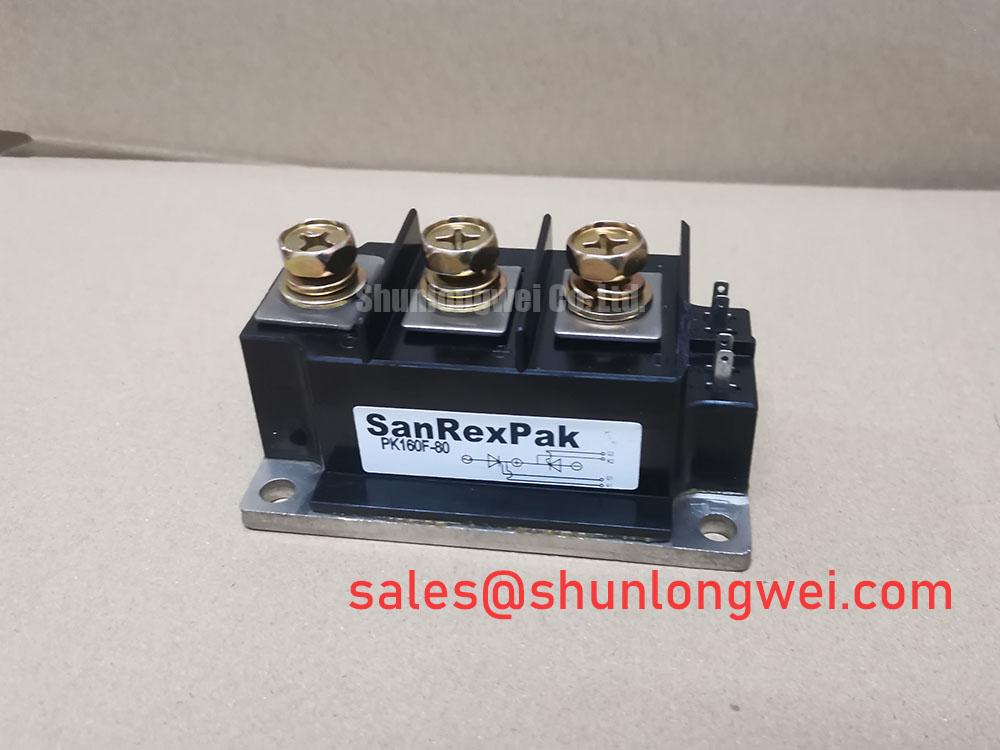
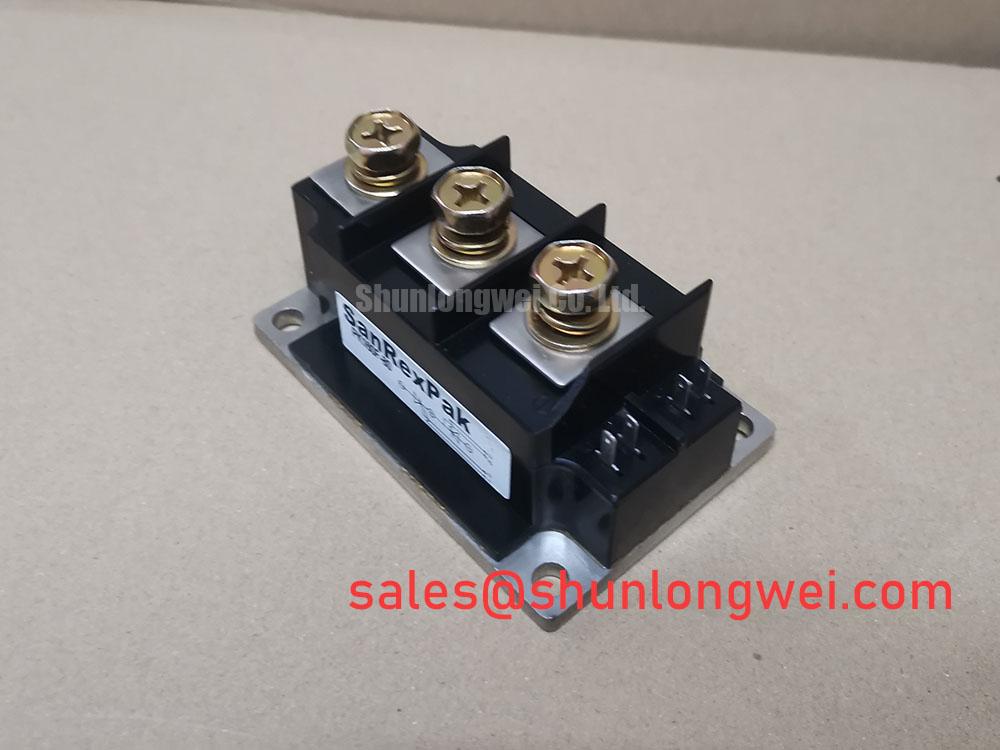
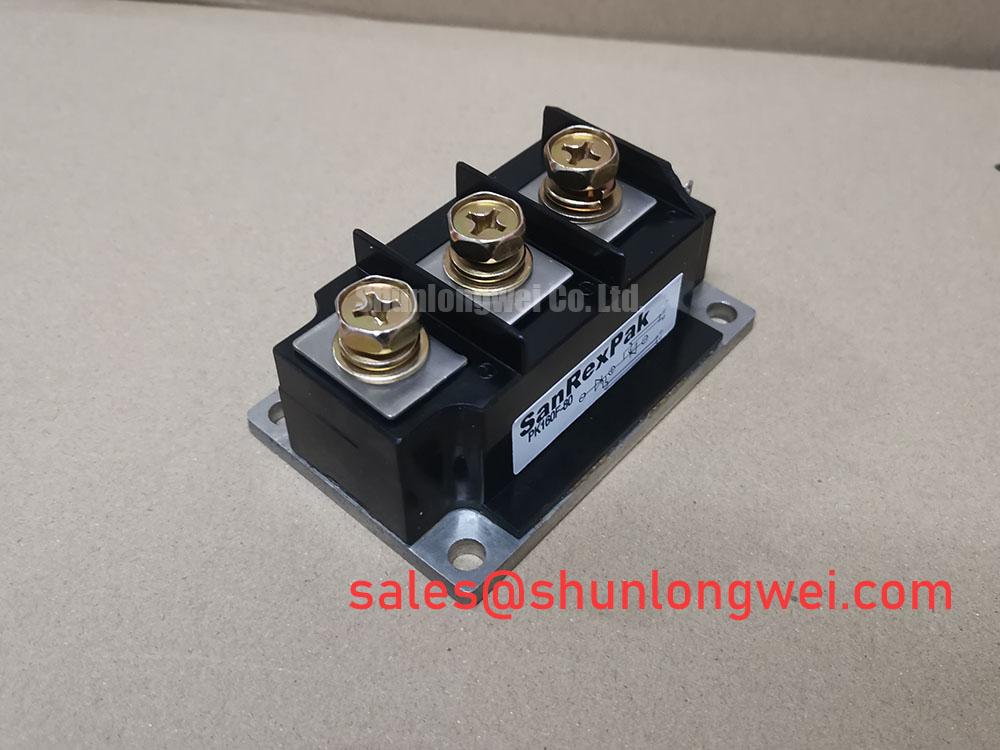
Technical Analysis: Engineering for Reliability
Two key parameters from the datasheet underscore the PK160F-80’s value in industrial systems: its surge current rating and thermal impedance. The non-repetitive surge on-state current (ITSM) is specified at a massive 6000A for a 60Hz half-cycle. This rating acts as a critical safety margin. You can think of it as a circuit’s safety net, capable of handling a sudden, massive electrical load—like a motor startup or a fault condition—without failing. This high surge tolerance is fundamental to building resilient systems that can withstand unpredictable operational stresses, a topic further explored in discussions on analyzing component failures.
Furthermore, the module’s design directly addresses thermal performance. The datasheet specifies a thermal resistance from junction to case (Rth(j-c)) of 0.14°C/W for the thyristor. This value can be imagined as the width of a pipe for heat; a lower number signifies a wider pipe, allowing thermal energy to escape the semiconductor die more efficiently. This is complemented by the module’s 2500V isolation voltage (VISO), which allows it to be mounted on a common heatsink without requiring additional, thermally-resistive insulation pads. This simplifies assembly and enhances overall thermal management, a core principle in reliable power system design.
Optimized Application Scenarios
The specific characteristics of the PK160F-80 make it a strong candidate for several high-power AC control applications:
- AC Motor Soft Starters: The high ITSM of 6000A effectively manages the large inrush currents typical of inductive motor loads during startup.
- Industrial Heater and Furnace Control: Its 160A average on-state current rating provides ample capacity for regulating power to resistive heating elements in industrial processes.
- High-Power Light Dimmers: Well-suited for controlling large-scale lighting systems in theaters or architectural installations, where it can handle the current demands of numerous lamps.
- Static Switches: The robust AC control capability is ideal for building solid-state switches used in power transfer and load management systems.
This module excels in AC power control roles where high inrush currents and efficient thermal dissipation are key design priorities.
Key Specifications of the PK160F-80
| Absolute Maximum Ratings | |
|---|---|
| Repetitive Peak Reverse Voltage (VRRM) | 800 V |
| Average On-State Current (IT(AV)) | 160 A |
| Surge On-State Current (ITSM) @ 60Hz | 6000 A |
| Operating Junction Temperature (Tj) | -40 to +125 °C |
| Electrical & Thermal Characteristics | |
| Peak On-State Voltage (VTM) @ 500A | 1.60 V (Max) |
| Gate Trigger Current (IGT) | 150 mA (Max) |
| Critical Rate of Rise of Off-State Voltage (dv/dt) | 500 V/µs (Min) |
| Thermal Resistance, Junction to Case (Rth(j-c)), Thyristor | 0.14 °C/W (Max) |
| Isolation Breakdown Voltage (VISO) | 2500 V (RMS) |
| Mounting Torque (M6) | 4.7 N·m (Recommended 2.5-3.9) |
Engineer’s FAQ for the PK160F-80
What is the recommended mounting torque for the PK160F-80?
The datasheet specifies a maximum mounting torque of 4.7 N·m, with a recommended range of 2.5 to 3.9 N·m for the M6 mounting screws. Proper torque is critical for ensuring low thermal resistance between the module’s baseplate and the heatsink. Insufficient torque leads to poor thermal contact, while excessive torque can cause mechanical stress and damage the isolated substrate.
What does the anti-parallel thyristor/diode configuration achieve?
This configuration creates a single-quadrant AC switch. The thyristor controls power flow in the positive half-cycle of the AC waveform (when triggered by the gate), and the anti-parallel diode automatically conducts during the negative half-cycle. This is a common and cost-effective topology for applications like AC phase-angle control and soft starters. For more complex control, such as four-quadrant operation, different power semiconductor topologies would be necessary.
How does the dv/dt rating of 500 V/µs impact my design?
The dv/dt rating indicates the module’s immunity to false turn-on caused by rapid voltage spikes across the thyristor when it is in the off-state. A high rating of 500 V/µs, as specified in the datasheet, signifies high noise immunity. This makes the PK160F-80 suitable for electrically noisy industrial environments where line voltage fluctuations are common, reducing the need for extensive snubber circuit designs to prevent unintended activation.
What is the primary benefit of the 2500V isolation voltage?
The 2500V RMS isolation voltage allows the module’s electrically conductive baseplate to be mounted directly onto a grounded chassis or heatsink without an external insulating layer. This simplifies the mechanical design, reduces assembly complexity, and improves heat transfer by eliminating the thermal resistance of an additional insulation pad, contributing to a more reliable thermal solution.
Enabling Robust Industrial Power Control
The Sanrex PK160F-80 provides engineers with a dependable and high-performance component for AC power regulation. Its combination of high surge survivability and an electrically isolated package enables the design of resilient and thermally efficient control systems for a wide array of industrial loads.