Cosel CBS1002415-F4 100W Isolated DC-DC Converter: Technical Overview and Application Guide
Cosel CBS1002415-F4 100W Isolated DC-DC Converter Description
Introduction to High-Reliability Power Conversion
The Cosel CBS1002415-F4 is a professional-grade, isolated DC-DC converter tailored for high-density power architectures requiring 100W of regulated output. This half-brick module converts a wide 24V nominal input into a stable 15V DC rail, delivering up to 6.7A of current. By utilizing conduction-cooled technology via an integrated baseplate, it addresses the challenges of heat dissipation in enclosed environments. The -F4 option specifically features M3 tapped mounting holes, facilitating secure attachment to heat sinks or chassis in high-vibration settings.
- Core Specifications: 18-36V DC Input | 15V DC Output | 100.5 Watts.
- Key Advantages: Enhanced thermal conductivity via an aluminum baseplate and reduced EMI footprint through high-frequency switching optimization.
Download Official Datasheet (PDF)


M3: Technical Analysis and Thermal Engineering
The engineering logic behind the CBS1002415-F4 centers on its high power density and isolation capabilities. With a 1.5kV DC isolation rating, it provides a robust barrier between the source and sensitive logic circuits. This is particularly relevant when navigating coordinated input protection strategies, where under-voltage lockout and over-voltage protection ensure module longevity during transient fluctuations in industrial batteries or bus bars.
Thermal performance is arguably the most critical parameter for this half-brick module. You can think of the aluminum baseplate as a thermal highway; its purpose is to provide a low-resistance path for heat to escape the internal switching components. In high-wattage designs, minimizing the junction-to-case temperature differential is vital. Proper integration with an external radiator prevents the converter from hitting its thermal shutdown threshold, which is essential for maintaining system uptime in stagnant air environments.

Electrical efficiency is rated between 87% and 89%, depending on the load conditions. This high efficiency reduces the “waste energy” that must be managed as heat. When engineers evaluate thermal management for reliability, the CBS1002415-F4 stands out due to its predictable derating curves provided in the datasheet, allowing for precise life-cycle modeling in various ambient temperatures.
M4: Optimized Application Scenarios
This converter is specifically suited for infrastructure where 24V battery systems are standard but 15V precision rails are required for peripheral control. Its footprint makes it a candidate for distributed power architectures in the following fields:
- Telecommunications: Providing regulated power to signal processing units where space is at a premium and reliability is non-negotiable.
- Industrial Automation: Driving sensors and actuators that require a stabilized 15V rail resistant to the electrical noise of factory floors.
- Railway Systems: The M3 mounting holes (-F4 option) ensure mechanical stability against the constant mechanical stress of rolling stock.
- Test & Measurement: Serving as a primary isolated source for data acquisition systems where isolation prevents ground loops.
Best Match: The CBS1002415-F4 is the ideal selection for 24V nominal systems requiring 100W output with conduction cooling and mechanical vibration resilience.
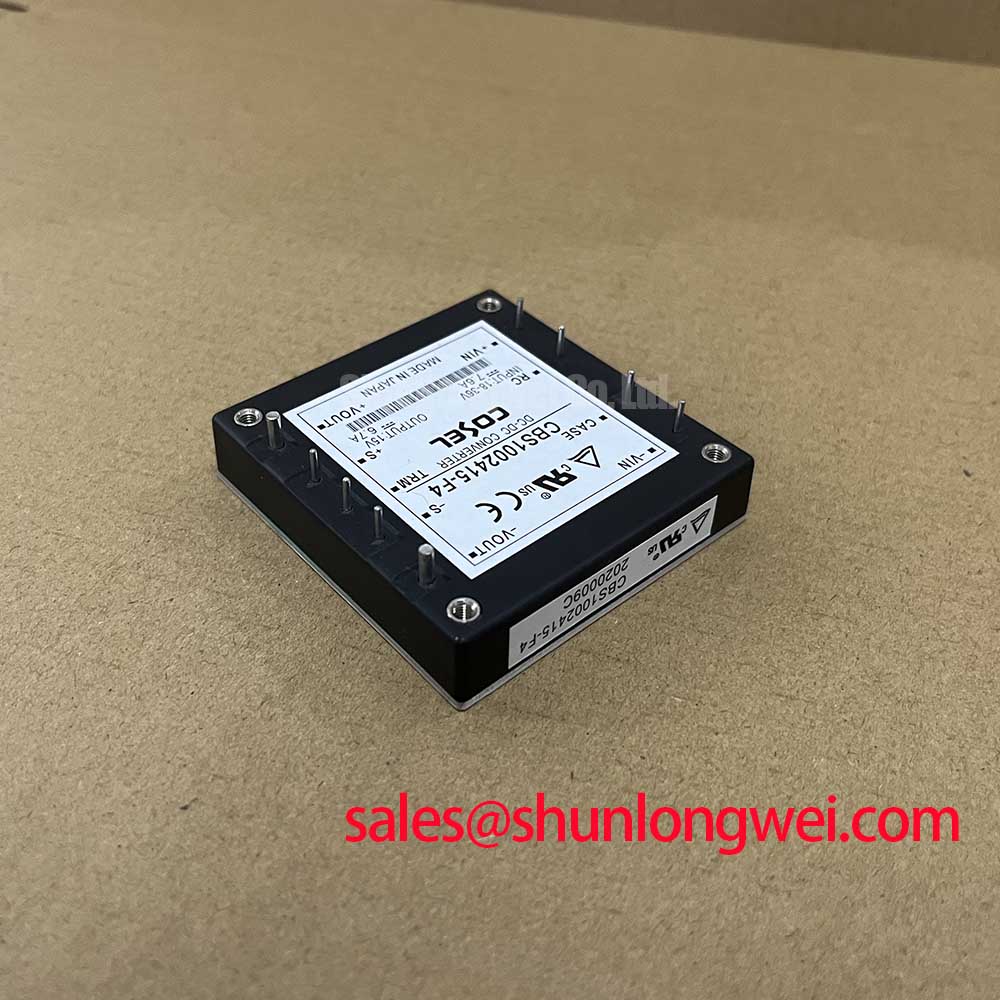

M5: Key Technical Specifications
| Parameter Group | Specification | Value |
|---|---|---|
| Input Characteristics | Voltage Range | 18 – 36V DC |
| Efficiency (Typical) | 88% | |
| Output Characteristics | Rated Voltage | 15V DC |
| Rated Current | 6.7A | |
| Ripple Noise (Max) | 150mVp-p | |
| Isolation & Protection | Input-Output Isolation | 1,500V DC (1 minute) |
| Overcurrent Protection | Works over 105% of rated current | |
| Mechanical | Form Factor | Half-Brick (57.9 x 12.7 x 61.0 mm) |
M6: Engineer FAQ
Q: How do I calculate the cooling requirements for the CBS1002415-F4?
A: Engineers should refer to the “Derating Curve” in the datasheet. Since it is a baseplate-cooled module, you must ensure the baseplate temperature does not exceed 100°C. Total power dissipation can be estimated by (Output Power / Efficiency) – Output Power. Thermal grease and a properly sized heat sink are recommended to maintain operation under maximum load.
Q: What is the significance of the -F4 suffix for this Cosel model?
A: The -F4 option indicates that the module is manufactured with M3 tapped mounting holes on the baseplate. Standard versions may use non-threaded holes. This is essential for applications utilizing predictive maintenance strategies, as it ensures consistent contact pressure for optimal thermal transfer over the device’s lifespan.
Q: Can this module be operated in parallel for higher current?
A: Standard CBS series modules do not support direct paralleling for current sharing without external circuitry. It is generally advised to use a single higher-wattage module or implement an OR-ing diode/MOSFET configuration if redundancy is the goal.
Closing Statement
The Cosel CBS1002415-F4 represents a disciplined approach to power conversion, balancing a rigid mechanical build with high-efficiency electrical design. By offering a stable 15V output from standard 24V inputs, it provides engineers with a reliable building block for complex industrial and communication systems. Its isolation characteristics and thermal baseplate design ensure that performance remains consistent even when the operating environment is demanding.