Mitsubishi TM25T3A-H: A Technical Guide to the 800V 25A 3-Phase Thyristor Module
Mitsubishi TM25T3A-H | 800V 25A 3-Phase Thyristor Module
Introduction to Industrial AC Control with the TM25T3A-H
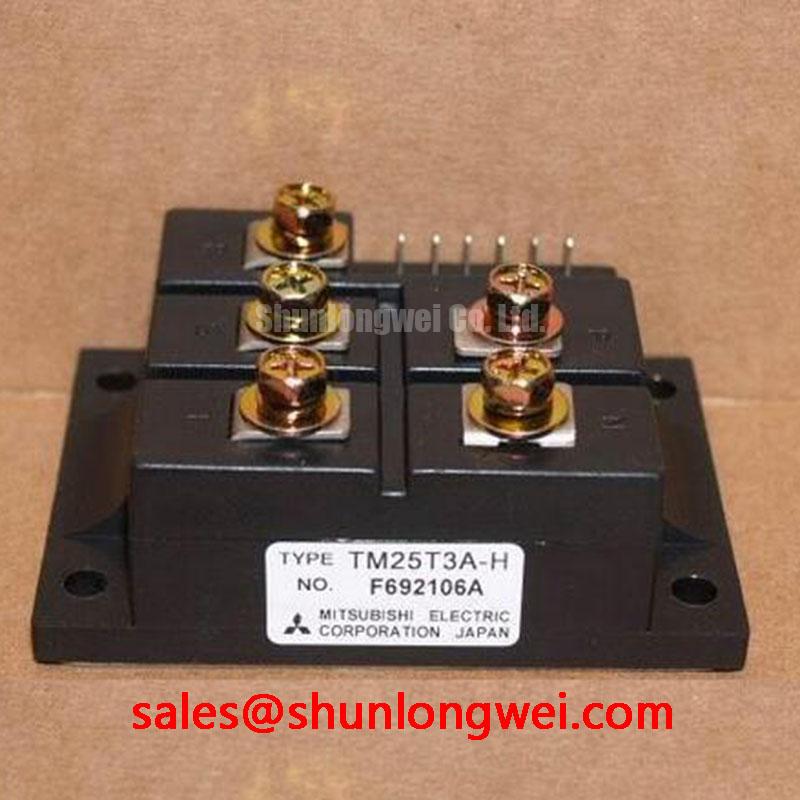
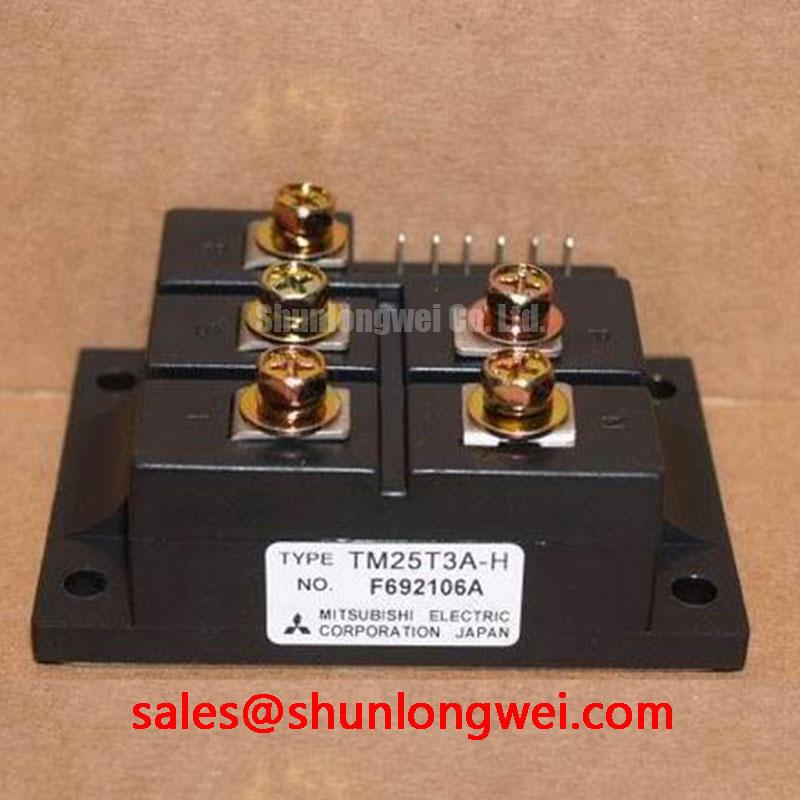
The Mitsubishi TM25T3A-H is a robust 3-phase thyristor (SCR) module engineered for high-reliability AC power switching and rectification. By integrating three sets of thyristors into a single insulated package, this module provides a streamlined solution for phase control and power modulation. It features a repetitive peak reverse voltage of 800V and an average on-state current of 25A per phase. This configuration is essential for engineers managing industrial loads where space efficiency and thermal integrity are primary design constraints.
- Core Specifications: 800V Peak Voltage | 25A Average Current | 2000V Isolation Voltage.
- Key Advantages: Enhanced thermal stability via isolated baseplate and simplified 3-phase busbar connectivity.
One common engineering inquiry involves determining how the TM25T3A-H handles transient voltage spikes. With an 800V rating, it provides a significant safety margin for 200V to 440V AC lines, effectively mitigating the risks of semiconductor puncture during line-side noise events. To better understand protection strategies, you may explore our guide on thyristor suppression circuit design.
Download Official Datasheet (PDF)
Technical Analysis of Thermal and Electrical Integrity
The TM25T3A-H excels due to its sophisticated thermal management architecture. The internal thyristor chips are mounted onto an electrically isolated copper baseplate. This allows multiple modules to be mounted on a single common heatsink without the need for additional insulating washers. The thermal resistance from junction to case ($R_{th(j-c)}$) is meticulously controlled to ensure that heat generated during the conduction phase is efficiently transferred to the cooling system.
To visualize this, imagine thermal resistance as a bottleneck in a water pipe. A lower $R_{th}$ value represents a wider pipe, allowing heat to flow more freely away from the sensitive silicon junction. This physical property is critical for maintaining long-term reliability in high-duty cycle applications. Effective isolated baseplate technology is the foundation of preventing premature failure in industrial power semiconductors.
Furthermore, the repetitive peak off-state voltage ($V_{DRM}$) of 800V ensures that the device remains non-conductive even in the presence of significant harmonic distortion. In systems utilizing phase-angle firing, the ability to withstand high $dv/dt$ (rate of rise of off-state voltage) is paramount. The TM25T3A-H is designed to resist parasitic turn-on, which can be a common failure mode in less robust SCR designs. This makes it an ideal candidate for precision thyristor control in electric furnaces.
Optimized Application Scenarios
The TM25T3A-H is versatile across several industrial domains where AC-to-DC conversion or AC power regulation is required:
- AC Motor Soft Starters: The high surge current rating ($I_{TSM}$) allows it to handle the initial inrush currents typical of inductive motor starts.
- Industrial Heater Controllers: Its linear phase-control compatibility permits precise temperature regulation in ovens and kilns.
- Battery Charging Rectifiers: The 3-phase bridge configuration provides a smooth DC output with lower ripple compared to single-phase alternatives.
- Welding Power Supplies: Robustness against repetitive thermal cycling ensures longevity in high-frequency welding environments.
Best Match: The TM25T3A-H is best suited for 3-phase AC power regulation systems requiring high isolation safety and low-profile mounting footprint.
Key Specifications Table
| Parameter Group | Specification Detail | Value (Typical/Max) |
|---|---|---|
| Absolute Maximum Ratings | Repetitive Peak Reverse Voltage ($V_{RRM}$) | 800 V |
| Average On-State Current ($I_{T(AV)}$) | 25 A | |
| Electrical Characteristics | Surge On-State Current ($I_{TSM}$) | 500 A (60Hz) |
| Critical Rate of Rise of Off-State Voltage | 500 V/µs | |
| Thermal & Mechanical | Isolation Voltage ($V_{iso}$) | 2000 V (AC 1 min) |
| Thermal Resistance ($R_{th(j-c)}$) | 0.45 °C/W (per phase) |
Engineer FAQ
Q1: How do I calculate the required heatsink size for the TM25T3A-H?
A: Start by calculating total power dissipation ($P_d$) using the forward voltage drop and duty cycle from the datasheet. Use the formula $T_j = T_a + P_d times (R_{th(j-c)} + R_{th(c-s)} + R_{th(s-a)})$, where $T_j$ must remain below 125°C.
Q2: What is the significance of the 2000V isolation rating?
A: This rating ensures that the internal high-voltage circuits are safely separated from the mounting baseplate. It allows engineers to mount the module directly to a grounded chassis or heatsink without risking electrical leakage or operator injury.
Q3: Can this module be used in a highly inductive load environment?
A: Yes, but it requires a properly sized snubber circuit (RC network) and a varistor to protect against $dv/dt$ induced turn-on and overvoltage transients during switching operations.
The Mitsubishi TM25T3A-H provides a high-reliability bridge between low-level control signals and high-power AC loads. Its combination of integrated 3-phase topology and superior isolation performance enables engineers to design compact, efficient power conversion systems that stand up to the rigors of industrial environments. By prioritizing thermal conductivity and surge resilience, this module ensures consistent operation across its entire service life.