MCC26-16IO1B IXYS Thyristor Module: 1600V 27A Phase Leg for Industrial Power Control
MCC26-16IO1B IXYS Thyristor Module | 1600V 27A Phase Leg
High-Voltage Reliability through Advanced Planar Passivation
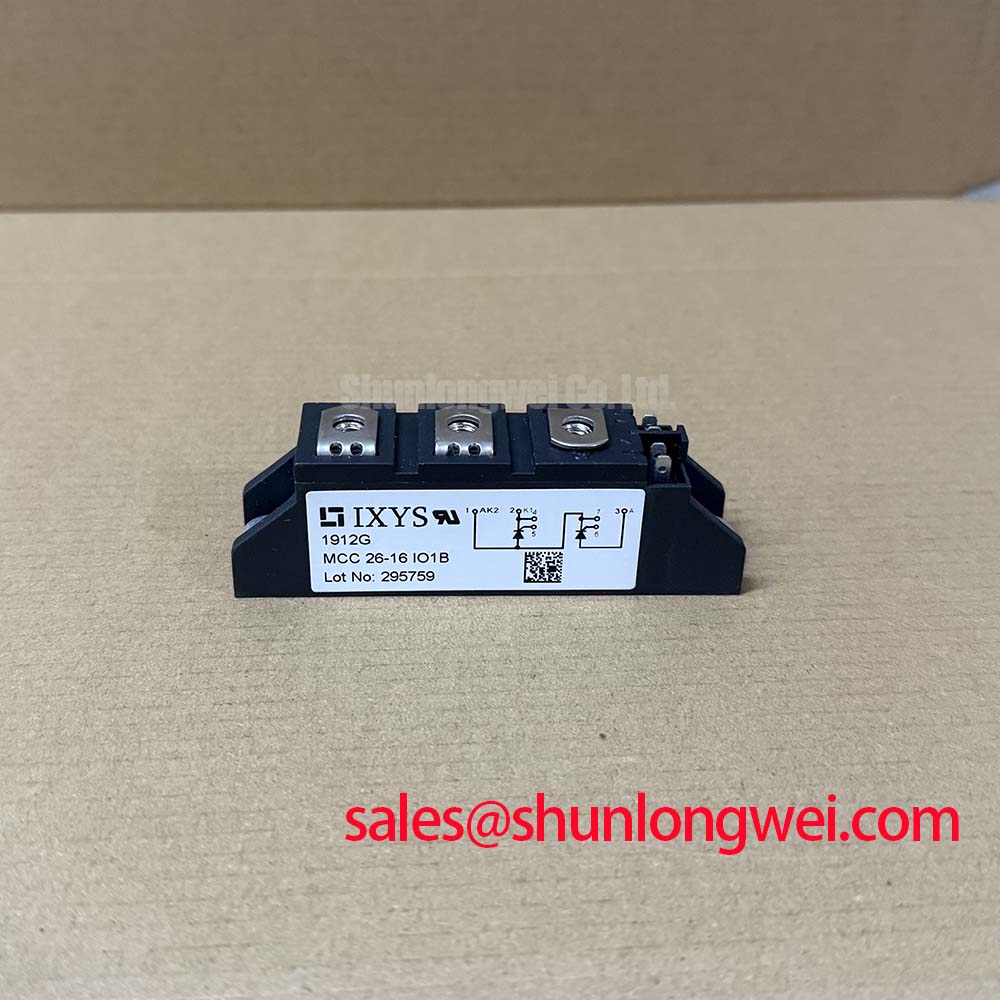
The MCC26-16IO1B is a high-performance Thyristor/Thyristor (SCR) module designed for robust AC power control in industrial environments. Utilizing planar passivated chips, this module ensures exceptional long-term voltage stability and leakage current control, even under high thermal stress. Its dual thyristor phase-leg configuration provides a compact footprint for complex rectification and switching topologies.
- Core Specifications: 1600V VDRM/VRRM | 27A ITAV (at TC=85°C) | 3600V~ Isolation.
- Key Advantage 1: High surge current capability (ITSM up to 520A) simplifies fuse selection and protection coordination.
- Key Advantage 2: Excellent thermal behavior via direct copper bonded (DCB) ceramic substrates, reducing the complexity of power semiconductor cooling systems.
Engineers often ask, “Can the MCC26-16IO1B handle direct 480V three-phase rectification?” With a 1600V repetitive peak reverse voltage rating, this module provides a generous safety margin against line transients in standard industrial mains applications.
Download Official Datasheet (PDF)
Technical Analysis: Ruggedness by Design
The engineering value of the MCC26-16IO1B lies in its combination of high blocking voltage and thermal efficiency. The 1600V rating is critical for industrial sectors where line voltage fluctuations and inductive kickbacks are common. Unlike lower-rated devices that require bulky snubber circuits, the MCC26-16IO1B utilizes planar passivation to maintain dielectric integrity over thousands of operating hours. This technology is a cornerstone of fortifying semiconductor reliability against surface contaminants and moisture.
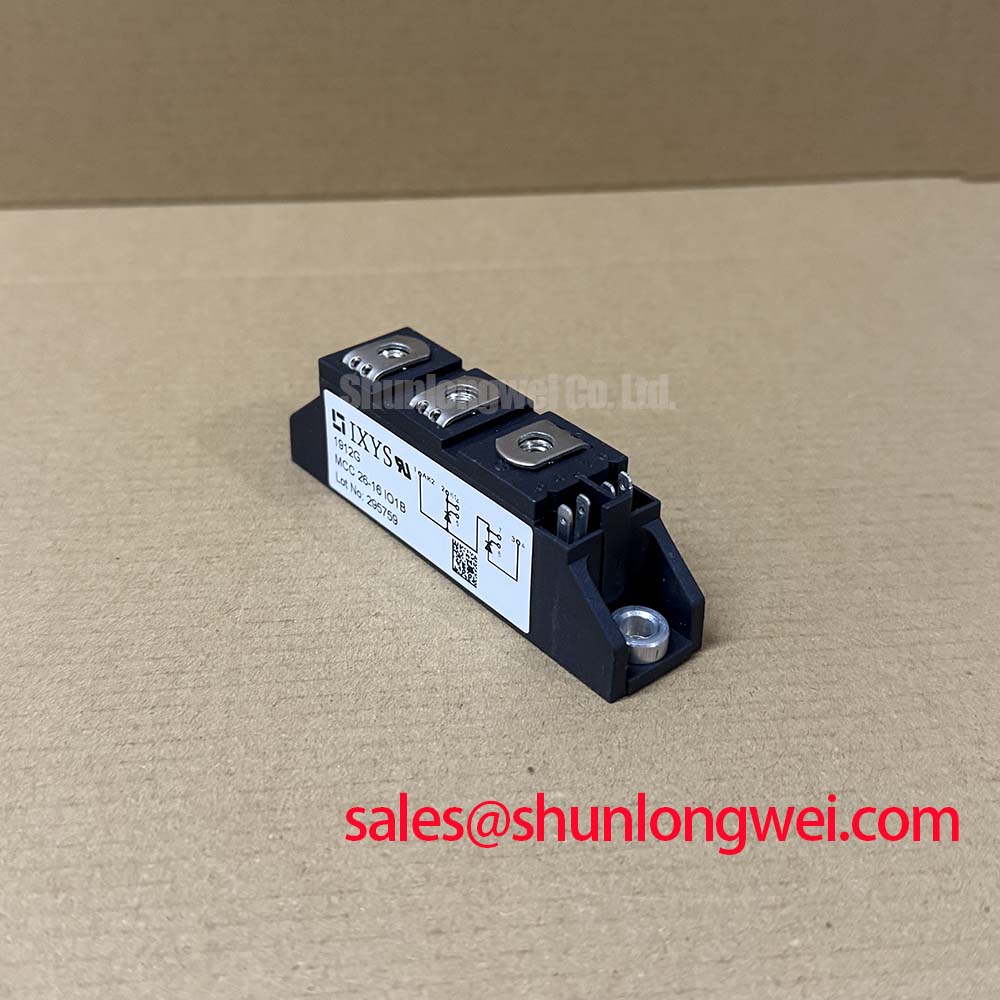
Thermal management is another standout feature. The module achieves a junction-to-case thermal resistance (RthJC) of 1.06 K/W per thyristor. To understand this value, one can use a simple analogy: think of thermal resistance as the narrowness of a heat escape tunnel. A lower value means the “tunnel” is wider, allowing heat generated at the silicon junction to flow more freely to the heatsink. This prevents the “bottleneck” effect that leads to thermal runaway and device failure.
Optimized Industrial Application Scenarios
- Motor Control (Soft Starters): The high dV/dt ruggedness (1000V/µs) allows for smooth starting of asynchronous motors without unintended triggering from electrical noise.
- Line Rectifiers for 3-Phase Supplies: Its phase-leg configuration is ideal for building controlled bridge rectifiers in high-power DC supplies.
- Lighting and Temperature Control: Precise phase-angle control enables efficient dimming and heating element regulation in large-scale building automation.
- UPS and Static Switches: The 3600V~ isolation ensures operator safety and galvanic separation between control circuits and the power grid.
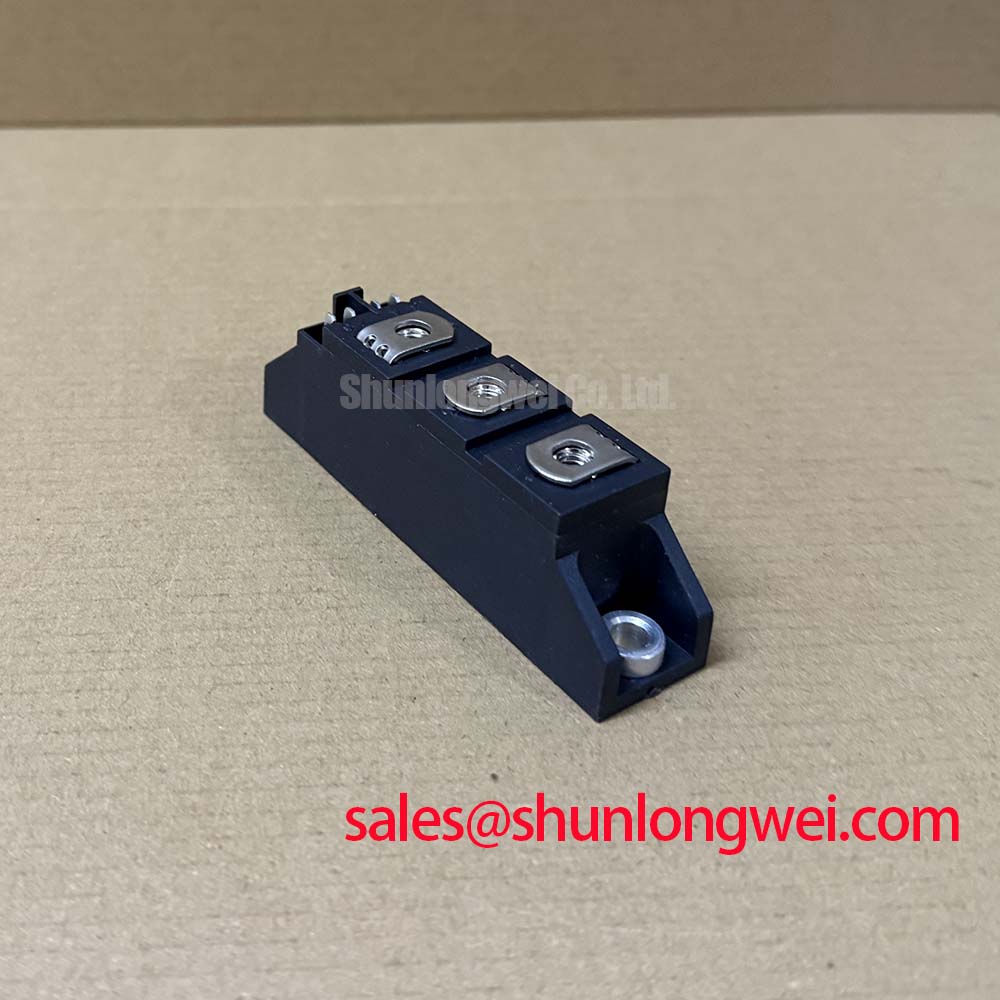
Best-Match Conclusion: The MCC26-16IO1B is best suited for 400-500V AC grid applications requiring a compact, isolated phase-leg solution with 1600V transient overhead protection.
Key Technical Specifications
| Parameter Group | Specification Name | Value |
|---|---|---|
| Absolute Maximum Ratings | Peak Repetitive Voltage (VRRM/VDRM) | 1600 V |
| Average On-state Current (ITAV) | 27 A (TC = 85°C) | |
| Surge On-state Current (ITSM) | 520 A (10ms, 50Hz) | |
| Electrical Characteristics | Gate Trigger Voltage (VGT) | 1.5 V |
| Critical Rate of Rise (dV/dt) | 1000 V/µs | |
| Thermal & Isolation | Thermal Resistance (RthJC) | 1.06 K/W (per Thyristor) |
| Isolation Voltage (VISOL) | 3600 V~ |
Engineer’s Frequently Asked Questions
Q1: What is the benefit of the isolated baseplate in this module?
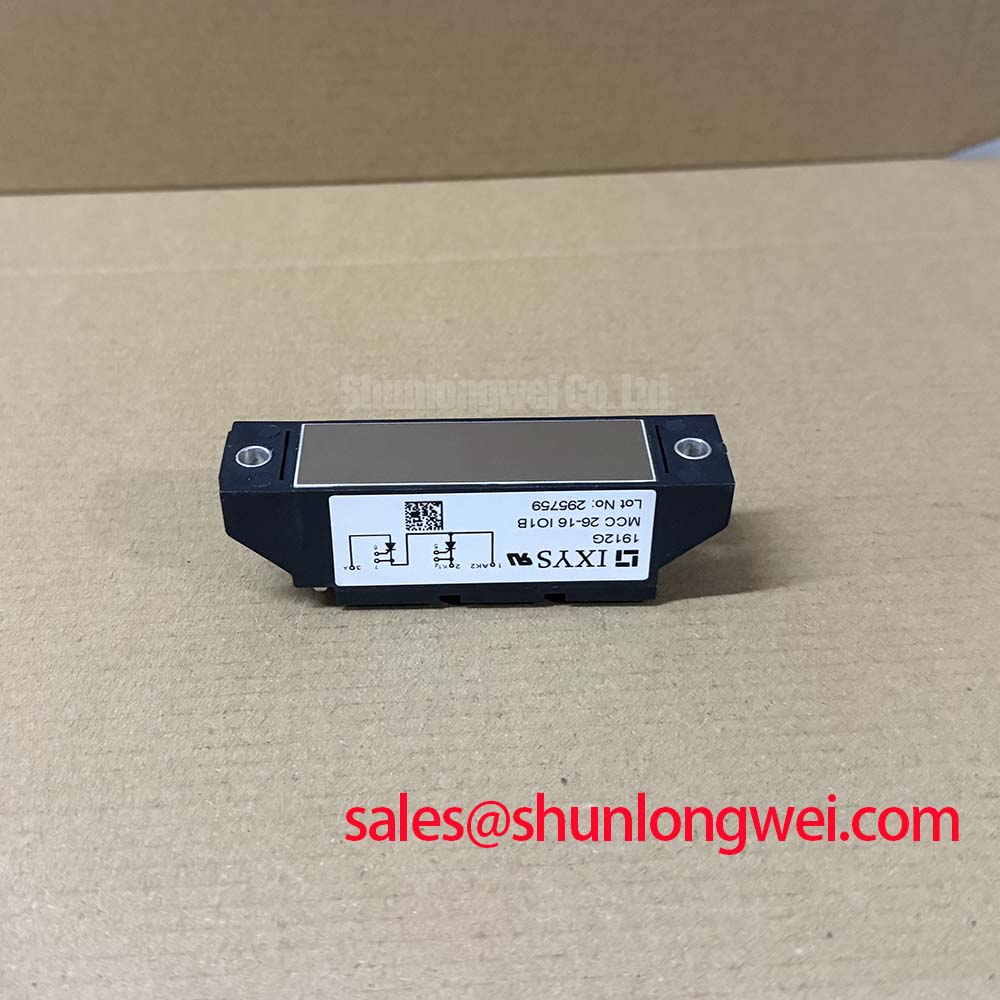
The isolated baseplate allows multiple MCC26-16IO1B modules to be mounted on a single common heatsink without additional electrical insulation pads. This significantly reduces thermal resistance between the module and the ambient air, improving system power density.
Q2: How should I calculate the maximum power dissipation for the heatsink?
Based on the datasheet, the total power loss can be estimated using the forward voltage drop (VT max 1.27V at 80A) and the average current. Engineers should use the provided Ptot vs. ITAV curves to ensure the junction temperature never exceeds 125°C under worst-case load conditions.
Q3: Is the MCC26-16IO1B compliant with international safety standards?
The module features UL-recognized components and is designed to meet standard creepage and clearance distances for industrial power electronics. It is housed in the industry-standard TO-240AA package, ensuring compatibility with common mechanical mounting hardware.
The MCC26-16IO1B provides engineers with a reliable, high-voltage switching component that balances thermal efficiency with electrical ruggedness. By leveraging advanced planar passivation and a high-integrity isolated package, this module serves as a dependable building block for next-generation power conversion systems, empowering robust industrial performance in demanding electrical environments.