High-Performance Power Conversion: A Deep Dive into the Vicor V300B28H150BL 150W DC-DC Converter
Vicor V300B28H150BL 300V Input 28V 150W DC-DC Converter
Industrial-Grade Power Conversion with Vicor V300B28H150BL
The V300B28H150BL is a high-density DC-DC converter module belonging to the Vicor Mini family. This H-grade component is specifically engineered for high-reliability environments where efficient power transformation from a nominal 300V DC source to a regulated 28V output is required. By utilizing proprietary Zero Current Switching (ZCS) and Zero Voltage Switching (ZVS) topologies, the module significantly reduces switching losses and conducted EMI, making it an ideal choice for sensitive instrumentation and high-performance industrial buses.
- Core Specifications: 300V Nominal Input (180–375V range) | 28V Output | 150W Maximum Output Power.
- Key Advantages: Minimized thermal stress through soft-switching and high power density in a compact “Mini” footprint.
- Engineering Intent: This module addresses the common challenge of “How can system designers maintain high efficiency across a wide 300V input range without massive heat sinking?” by maintaining peak efficiency of approximately 88.5% at full load.
Download Official V300B28H150BL Datasheet (PDF)


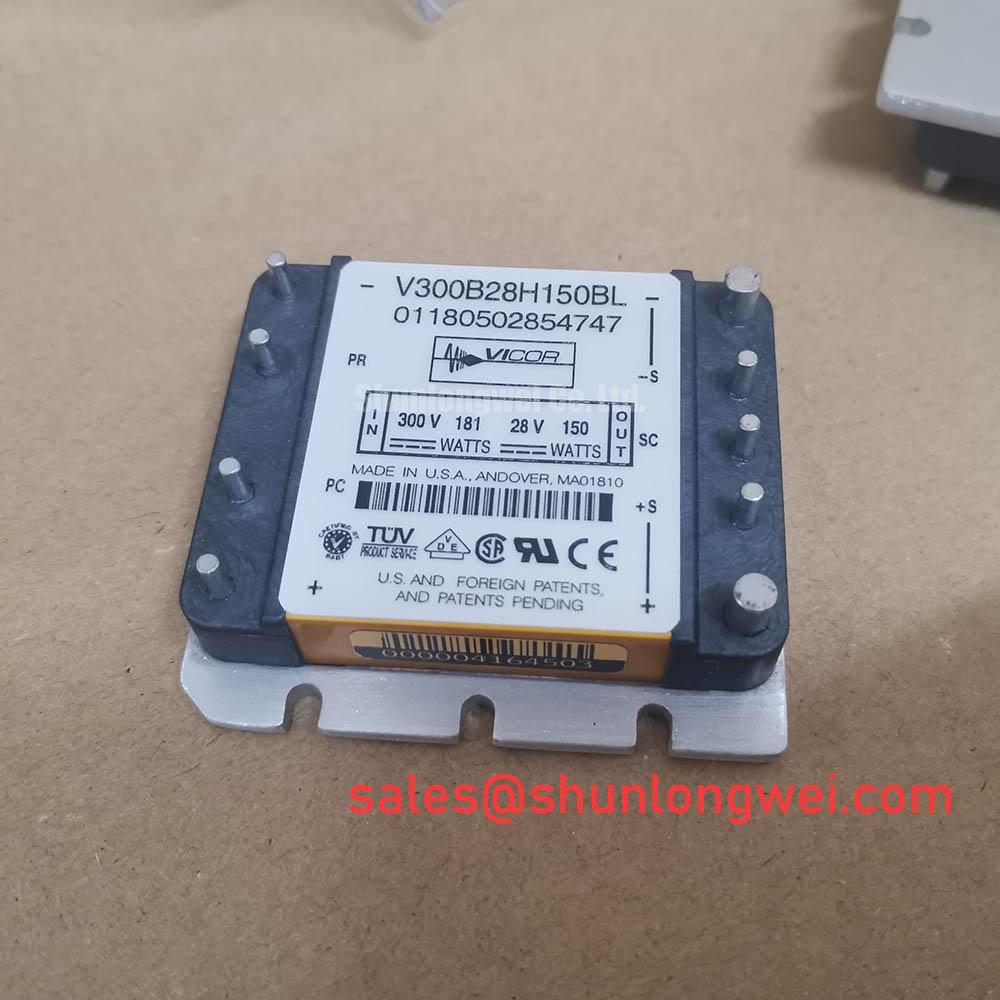


Technical Analysis of ZCS/ZVS Architecture
The engineering foundation of the V300B28H150BL lies in its high-frequency switching capability. Unlike traditional pulse-width modulation (PWM) converters that force the power switch to turn on and off while current is flowing—leading to massive energy spikes—the Vicor ZCS/ZVS topology ensures that switching transitions occur at moments of zero current or zero voltage. Analogy: Think of ZCS/ZVS as a master clock-maker timing his movements to avoid friction; by switching at the exact moment voltage or current is zero, the module reduces internal “friction” or switching losses, keeping the system cooler and significantly more reliable over its operational lifespan.
The H-grade designation indicates a robust operating temperature range of -40°C to +100°C baseplate temperature. This resilience is critical for power semiconductors and modules used in outdoor environments or unconditioned industrial enclosures. Furthermore, the module incorporates an isolated baseplate, providing 3000Vrms isolation between the input and the baseplate, which is a fundamental requirement for high-voltage reliability.
One of the primary benefits for system engineers is the reduction of parasitic inductance impacts. Because the switching is “soft,” the high-frequency harmonic content that typically plagues high-voltage power lines is suppressed. This simplified EMI filtering requirements, allowing for more compact system designs and reducing the overall Bill of Materials (BOM) for noise suppression components.
Optimized Application Scenarios
The V300B28H150BL is exceptionally well-suited for applications where input stability and thermal overhead are primary constraints:
- Industrial Automation Control: Delivers a clean 28V rail for PLC and sensor networks from a high-voltage DC bus, ensuring stable logic levels.
- Distributed Power Architectures: Its ability to be paralleled with N+1 redundancy makes it ideal for modular power systems requiring high uptime.
- Railway Traction Secondary Power: Specifically rated to handle the fluctuations of a nominal 300V bus while maintaining isolation and efficiency.
- Defense and Aerospace Systems: The H-grade temperature range ensures performance in high-altitude or extreme climatic conditions.
Best match: High-efficiency 150W regulated 28V supply for wide-input 300V industrial networks requiring minimal EMI and robust thermal resilience.
Key Specifications and Electrical Parameters
| Category | Parameter | Rating/Value |
|---|---|---|
| Input Specifications | Nominal Voltage | 300 Vdc |
| Voltage Range | 180 – 375 Vdc | |
| Inrush Current | < 500 mA | |
| Output Specifications | Set Voltage | 28 Vdc |
| Power Rating | 150 Watts | |
| Output Current | 5.36 Amps | |
| Environmental | Operating Temperature (H-Grade) | -40°C to +100°C |
| Storage Temperature | -55°C to +125°C | |
| Physical | Dimensions | 2.28 x 2.2 x 0.5 in (57,9 x 55,9 x 12,7 mm) |
Engineer FAQ: Implementing the V300B28H150BL
Q1: How should I manage the cooling requirements for a 150W load in high-temp environments?
A: Effective thermal management is essential. The V300B28H150BL (B-style) features a slotted baseplate. For maximum power at high ambient temperatures, we recommend a forced-air heat sink or mounting the baseplate to a liquid-cooled chassis to ensure the temperature never exceeds 100°C.
Q2: Can I parallel multiple V300B28H150BL modules for higher power output?
A: Yes. This module supports parallel operation for power augmentation or redundancy. Use the PR (Parallel) pin to ensure synchronized switching and balanced current sharing between modules. Refer to the datasheet’s application section for optimal component placement on the PR bus.
Q3: What is the benefit of the ‘H-Grade’ designation for industrial systems?
A: H-Grade ensures the module is 100% tested and verified for operation down to -40°C. This eliminates the risk of “cold-start” failures common in standard-grade converters used in telecommunications or outdoor control boxes.
Empowering Modern Power Systems
The Vicor V300B28H150BL stands as a testament to efficient power density. By integrating ZCS/ZVS switching with a rugged H-grade thermal profile, this 28V converter enables engineers to build smaller, more reliable systems without compromising on electrical performance or isolation safety. Its slotted baseplate architecture and high power density make it a cornerstone component for modern 300V bus architectures.