Semikron SKM100GB128DN 1200V 100A IGBT Module: Technical Guide and Applications
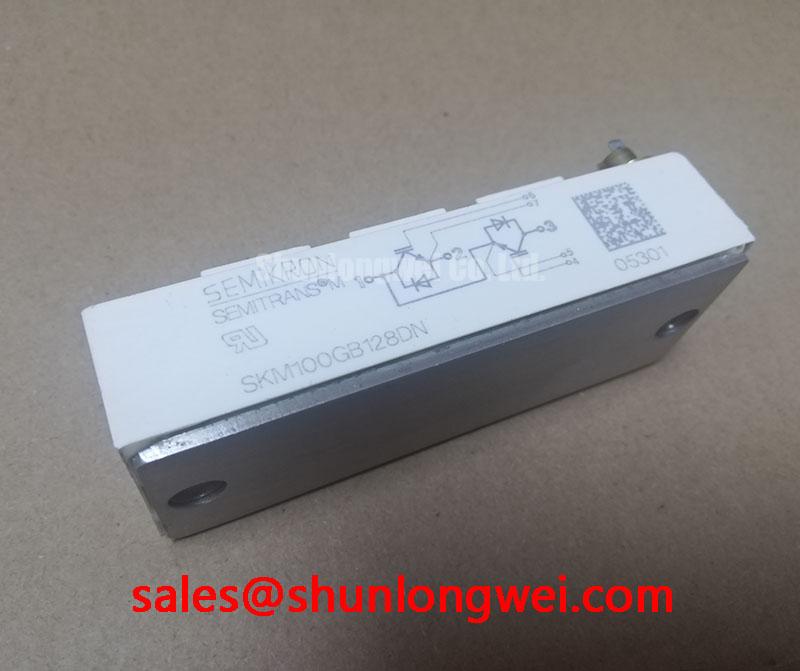
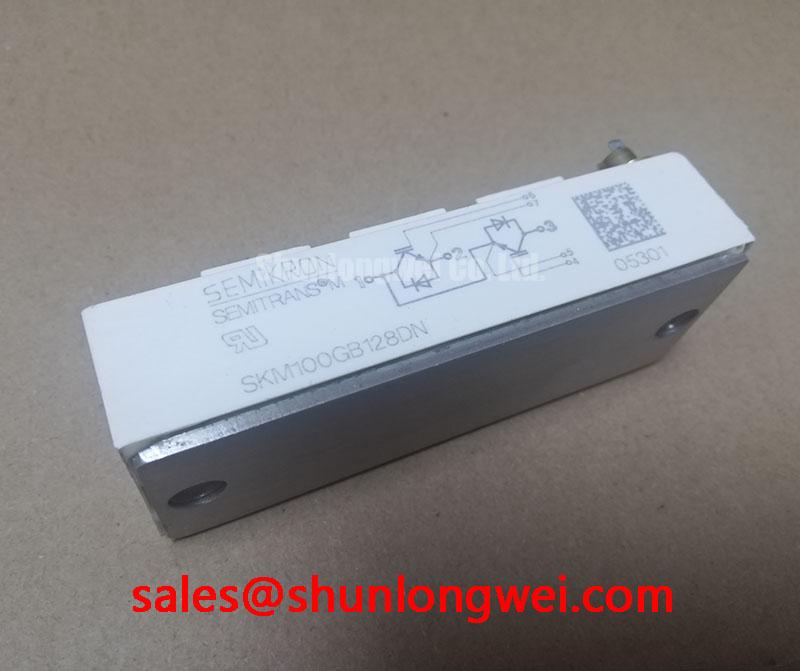
SKM100GB128DN Semikron 1200V 100A IGBT Module
Introduction and Core Product Highlights
The Semikron SKM100GB128DN is an industry-standard dual/half-bridge IGBT module integrating Trench IGBT3 and Controlled Axial Lifetime (CAL) diode technologies within a SEMITRANS 2 footprint. Offering a robust balance between conduction efficiency and switching speed, this 1200V, 100A nominal module is engineered for demanding industrial power conversion systems.
- Core Ratings: 1200V collector-emitter voltage, 100A continuous collector current at 80°C case temperature, and a typical collector-emitter saturation voltage of 1.70V.
- Engineering Value: Low thermal resistance minimizes thermal management constraints, while the soft-recovery CAL freewheeling diode optimizes electromagnetic compatibility (EMC).
- Design Intended Use: This module provides a reliable dropping replacement for standard half-bridge power systems operating at switching frequencies up to 20 kHz.
Download Official Datasheet (PDF)

Technical Analysis and Engineering Significance
At the core of the SKM100GB128DN is Trench IGBT3 technology, which reduces the collector-emitter saturation voltage (VCE(sat)) to a typical value of 1.70V at 25°C. This low saturation limit significantly reduces static conduction losses when the device is fully turned on. For a detailed breakdown of how trench structures lower on-state resistance, see our guide on trench gate evolution and VCE(sat) optimization. The gate-emitter threshold voltage (VGE(th)) typically falls between 5.0V and 6.5V, offering standard noise immunity against spurious switching transients.
The companion CAL diode behaves as a soft-recovery freewheeling component. By controlling the axial carrier lifetime during recovery, the CAL diode limits reverse recovery current spikes and minimizes switching EMI. This helps stabilize high-frequency switching circuits. Learn more about how the freewheeling diode behaves as a critical system reliability partner in our analysis of freewheeling diode system dynamics.
Heat dissipation is controlled by an isolated copper baseplate. This baseplate yields a low junction-to-case thermal resistance (Rth(j-c)) of 0.25 K/W per IGBT. Thermal resistance acts like a highway lane limit: a lower resistance value operates like a wider, multi-lane highway, allowing heat to move away from the silicon junction to the heatsink quickly to prevent thermal runaway.
Optimized Application Scenarios
- AC Inverter Motor Drives: Low conduction losses optimize thermal performance under continuous operating loads.
- Uninterruptible Power Supplies (UPS): Excellent switching behavior under inductive loads allows for highly reliable power backup paths.
- Solar Inverters: High efficiency up to 20 kHz switching frequencies matches standard grid-tied solar conversion designs.
- Electronic Welding Equipment: Standard SEMITRANS 2 footprint packaging ensures mechanical compatibility and high thermal cycling resilience.
Optimized for power systems demanding high-frequency efficiency and standard SEMITRANS footprint reliability up to 100A.
Key Technical Parameters Table
| Category | Symbol | Test Conditions / Details | Value (Typ / Max) |
|---|---|---|---|
| Maximum Ratings | VCES | Collector-Emitter Voltage (Tj = 25°C) | 1200 V |
| IC | Continuous Collector Current (Tcase = 80°C) | 100 A | |
| ICRM | Repetitive Peak Collector Current (tp = 1 ms) | 200 A | |
| Electrical Properties | VCE(sat) | Collector-Emitter Saturation Voltage (IC = 100A, VGE = 15V, Tj = 25°C) | 1.70 V (Typ) |
| VGE(th) | Gate-Emitter Threshold Voltage (VGE = VCE, IC = 3 mA) | 5.8 V (Typ) | |
| VF | Diode Forward Voltage (IF = 100A, VGE = 0V, Tj = 25°C) | 1.80 V (Typ) | |
| Thermal Properties | Rth(j-c) | Thermal Resistance, Junction-to-Case (per IGBT) | 0.25 K/W (Max) |
| Tvj | Virtual Junction Operating Temperature | -40 to +150 °C |
Engineer FAQ
Q1: What gate voltages are recommended to switch the SKM100GB128DN reliably?
A1: A turn-on gate voltage of +15V is recommended to achieve the lowest collector-emitter saturation voltage losses. For turn-off, a negative gate voltage of -7V to -15V should be applied to prevent parasitic turn-on. You can review our technical guide on mastering the Miller plateau for driver configuration strategies.
Q2: How does the CAL diode in this module improve circuit reliability?
A2: The CAL diode utilizes an optimized axial carrier lifetime profile that ensures soft recovery. This soft-recovery feature limits the rate of reverse current change (di/dt), lowering electromagnetic interference (EMI) and reducing turn-on power losses in the complementary IGBT.
Q3: How do I calculate the heatsink thermal requirement for this module?
A3: The heatsink thermal resistance requirement is determined by multiplying the total module power dissipation by the sum of junction-to-case thermal resistance (0.25 K/W) and case-to-heatsink contact resistance (typically 0.05 K/W). Ensure the junction temperature never exceeds 150°C under full load.
The Semikron SKM100GB128DN provides a highly effective switching platform for power electronics engineers. Utilizing high-efficiency Trench gate semiconductors and soft-recovery diodes, it allows designers to maintain structural reliability and low thermal footprints in standard SEMITRANS packages.