SKD115/16 Semikron Three-Phase Bridge Rectifier Module: Technical Review and Applications
SKD115/16 Semikron Three-Phase Bridge Rectifier Module
Introduction and Core Technical Advantages
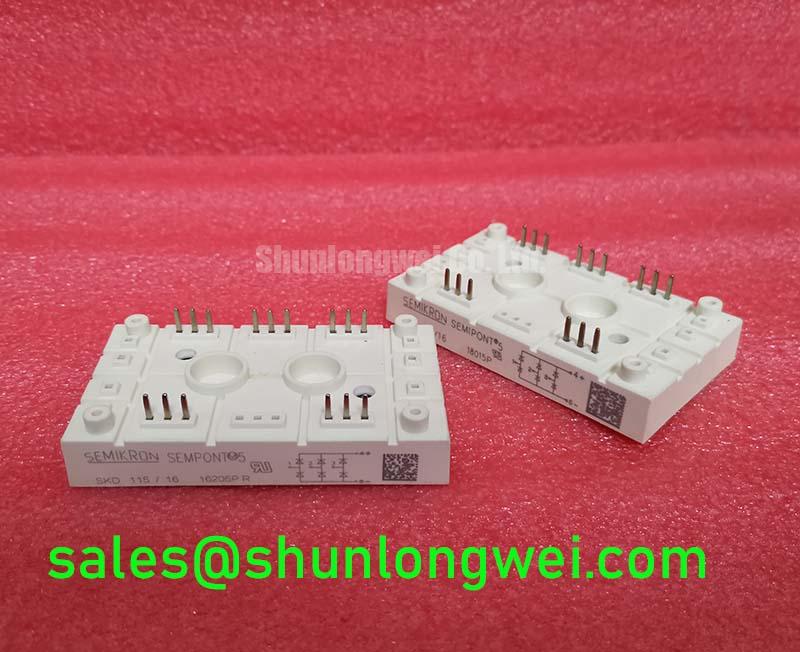
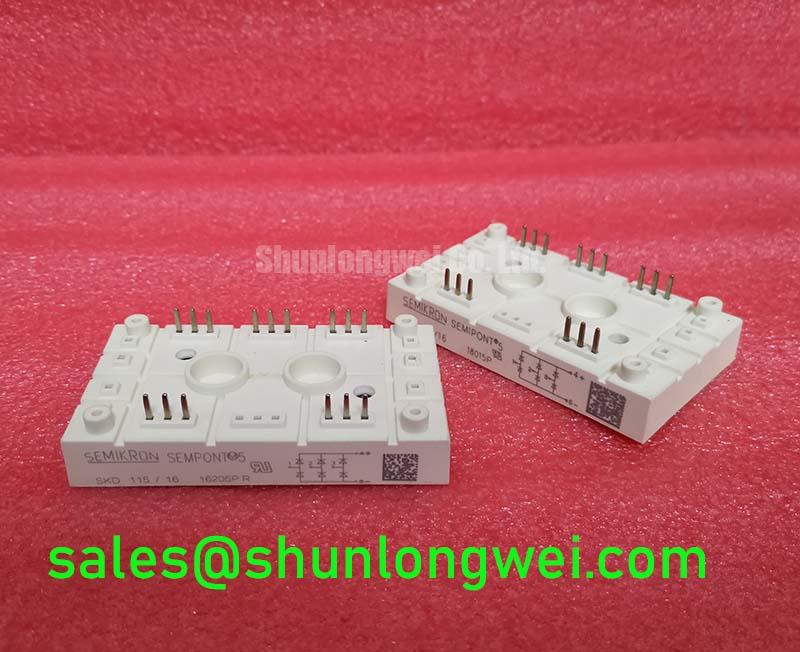
The Semikron SKD115/16 is a heavy-duty three-phase bridge rectifier module engineered for high-power industrial applications. It is housed in the robust SEMIPONT® 3 package. This module delivers exceptional thermal efficiency and robust electrical performance across demanding utility environments.
- Core Ratings: 1600V Peak Reverse Voltage | 115A Nominal Output Current | 1150A Surge Current Capability
- Key Benefits: Reduced heatsink footprints due to optimized thermal transfer, and enhanced reliability under grid instability.
- Design Intent: Resolves the critical question of how to manage high inrush currents during the startup phase of variable frequency drives.
Download Official SKD115/16 Datasheet (PDF)
Under-the-Hood: Technical Analysis and Thermal Physics
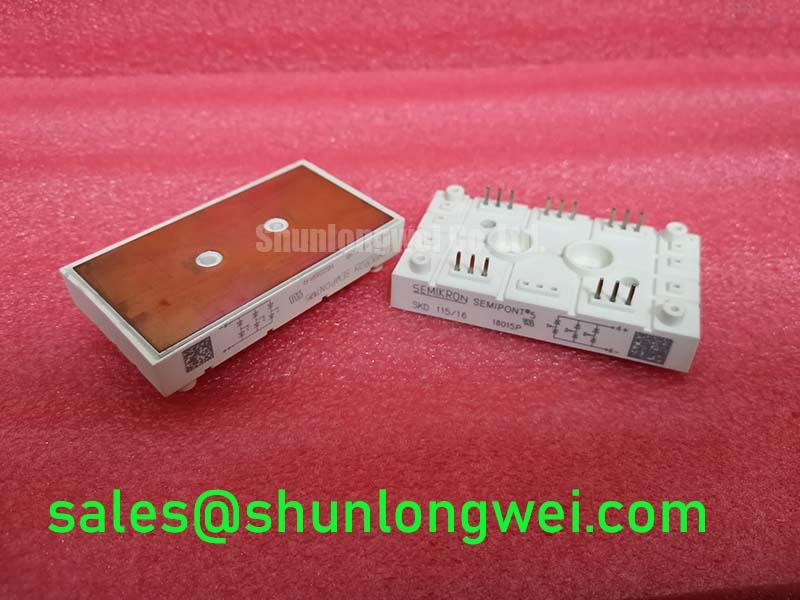
The SKD115/16 is built on an isolated metal baseplate utilizing alumina ceramic substrate technology. This construction offers up to 3000V AC isolation voltage. It completely eliminates the need for external isolating barriers when mounting to a common industrial heatsink. The 1600V rating ($V_{RRM}$) provides a safe voltage margin when operating on standard 400V or 480V AC utility lines.
In power systems, transient overvoltages are a common threat. The SKD115/16 counters this with a massive surge forward current rating ($I_{FSM}$) of 1150A at a 10ms half-sine pulse. You can think of this surge capability as a robust concrete retaining wall. Just as a strong wall absorbs the impact of a sudden flash flood without cracking, this silicon structure safely absorbs extreme grid transients without degradation.
Thermal management is another core strength of this design. The module is engineered with direct copper bonding. It optimizes the heat path from the silicon junctions to the sink. This design reduces thermal fatigue during continuous load changes. It makes the module highly reliable in power semiconductors applications.
Optimized Industrial Applications
The SKD115/16 is designed for seamless integration into several high-power configurations:
- Input Rectifiers for Variable Frequency Drives (VFDs): Safely handles the high inrush charging current of the DC-link capacitors.
- Industrial Power Supplies: Provides stable, low-ripple unregulated DC power for large control cabinets.
- Battery Chargers: Withstands continuous high-current operation under demanding thermal conditions.
- DC Motor Field Controllers: Offers precise control and resilience against inductive voltage spikes.
Conclusion: The SKD115/16 is the ideal three-phase rectification module for grid-connected industrial electronics requiring maximum thermal cycling durability and transient surge protection.
Key Specifications Table
| Symbol | Parameter Description | Conditions | Value |
|---|---|---|---|
| $V_{RRM}$ | Repetitive Peak Reverse Voltage | $T_j = 25^circtext{C}$ | 1600 V |
| $I_D$ | Maximum DC Output Current | Three-phase bridge, $T_s = 85^circtext{C}$ | 115 A |
| $I_{FSM}$ | Peak Surge Forward Current | $10text{ ms}$, $sin 180^circ$, $T_j = 25^circtext{C}$ | 1150 A |
| $V_F$ | Maximum Forward Voltage Drop | $I_F = 150text{ A}$, $T_j = 25^circtext{C}$ | 1.6 V |
| $R_{th(j-c)}$ | Thermal Resistance (Junction-to-Case) | Per diode / total module | 0.90 / 0.15 K/W |
| $V_{isol}$ | Isolation Voltage | AC, 1 minute, 50 Hz | 3000 V |
Engineer FAQ
What makes the SKD115/16 more durable than discrete diode packages?
The integrated isolated baseplate design of the SKD115/16 ensures highly uniform thermal expansion across all internal diode chips. This minimizes mechanical stress under cyclic loads, preventing premature joint degradation.
How do I calculate the thermal requirements for the SKD115/16 heatsink?
To design an efficient cooling system, multiply the total power dissipation ($P_{tot}$) by the heatsink-to-ambient thermal resistance. Ensure the junction temperature never exceeds the absolute limit of $150^circtext{C}$ during maximum output.
Does the SKD115/16 require snubber circuits?
In standard configurations with short low-inductance busbars, no external snubbers are required. However, for highly inductive lines, placing a simple RC snubber across the DC terminals is a recommended safeguard against high $dv/dt$ transients.
For more design alternatives in this current range, engineers can also evaluate the SKD 60/16 three-phase rectifier to compare thermal performance and package dimension trade-offs.