Crydom D53TP50D 3-Phase Solid State Relay: Technical Guide and Application Insights
D53TP50D Crydom 3-Phase Solid State Relay Technical Guide
Introduction and Core Specifications
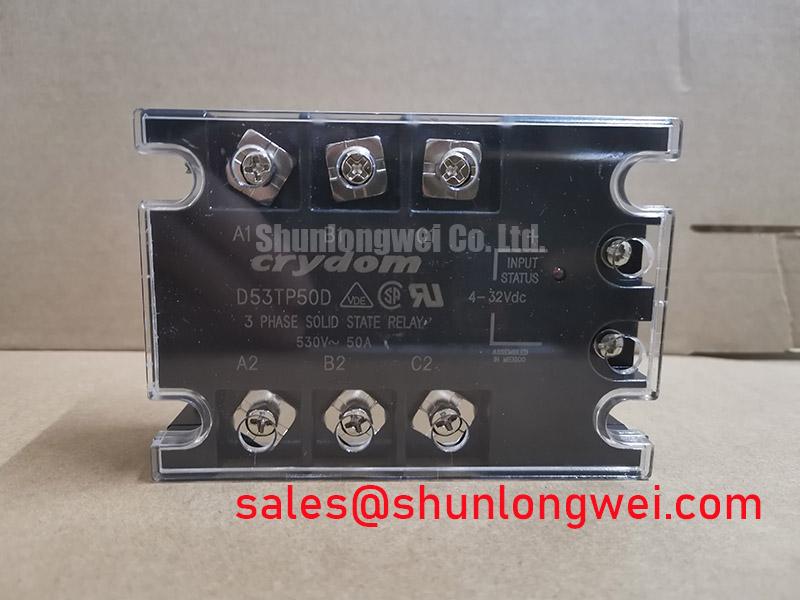
The D53TP50D is a panel-mounted, 3-phase Solid State Relay (SSR) manufactured by Crydom (Sensata Technologies). This component is designed for switching medium to high AC power loads in industrial settings. As a professional electronic components trader, we provide verified facts from the official manufacturer datasheet to assist design engineers. The module features zero-voltage turn-on to reduce electrical noise during operation.
- Operating Voltage Range: 48–530 VAC
- Maximum Load Current: 50 A RMS per phase (with appropriate thermal management)
- Control Input Voltage: 4–32 VDC
A key engineering advantage is its high transient overvoltage rating of 1200 Vpk, which guards the internal circuitry against line voltage spikes. The integrated IP20 touch-safe cover improves physical protection for maintenance personnel.
Download Crydom D53TP50D Official Datasheet (PDF)


Technical Analysis of Thermal and Switching Behavior
The D53TP50D operates using zero-crossing switching. This technique permits the relay to turn on only when the AC line voltage reaches the zero-point of the sine wave. This minimizes the initial surge current and reduces electromagnetic interference (EMI) in nearby control systems. It is particularly useful for protecting sensitive logic controllers on the same power line.


Thermal design is critical to avoid premature module degradation. The junction-to-case thermal resistance (Rjc) of the D53TP50D is 0.25 °C/W. You can think of thermal resistance like a physical bottleneck in a water pipe. A lower resistance value means thermal energy flows more quickly out of the silicon to the heatsink. This prevents localized heat buildup from exceeding the maximum junction limit of 125 °C.
When selecting fuses for short-circuit protection, look at the I²t rating. The D53TP50D has a maximum I²t rating of 2520 A²s (over a half-cycle of 8.3 milliseconds). High-speed semiconductor fuses must be sized below this value to prevent internal damage during fault conditions. For details on protecting thyristor-based switches, see our guide on inrush current suppression.


Target Application Scenarios
- Industrial Heating Systems: Ideal for resistive heaters where zero-crossing switching limits voltage drops and extends heating element life.
- Electric Motors: Suitable for fractional horsepower three-phase motors with moderate starting currents.
- Industrial Lighting: Controls large banks of discharge lamps without creating line voltage variations.
Best Match: Best suited for multi-phase resistive industrial heating control applications operating under 530 VAC with stable, continuous currents.
Key Specifications Parameter Table
| Absolute Maximum Ratings & Electrical Characteristics | |
|---|---|
| Operating Voltage Range (47-63Hz) | 48 – 530 VAC |
| Transient Overvoltage (Vpk) | 1200 V |
| Maximum Load Current (per phase, with heatsink) | 50 A RMS |
| Minimum Load Current | 100 mA RMS |
| Control Voltage Range | 4 – 32 VDC |
| Maximum Turn-On Time | 1/2 Cycle (Zero-Voltage Turn-On) |
| Minimum Input Current (for turn-on) | 10 mA @ 5 VDC |
| Isolation Voltage (Input to Output, 50/60Hz) | 4000 Vrms |
| Junction-to-Case Thermal Resistance (Rjc) | 0.25 °C/W |
| Ambient Temperature Range (Operating) | -40 °C to 80 °C |
Engineers FAQ
How do you calculate the correct thermal interface for the D53TP50D?
Use the total power dissipation value from the datasheet curves at your operating current. Ensure a thermal pad or silicone grease is applied between the baseplate and heatsink. For calculations, consult the SSR thermal management guide.
Can this relay be used with highly inductive motor loads?
Yes, but ensure the motor startup current does not exceed the relay surge rating. Back-to-back thyristors in the D53TP50D handle inductive loads, but RC snubber networks may be required if dV/dt limits are exceeded.
What is the difference between zero-crossing and random turn-on for the D53TP50D?
The standard D53TP50D uses zero-crossing switching for resistive loads to minimize noise. A random turn-on model (typically denoted by a suffix like -10) turns on instantly, making it suitable for phase control applications.
Concluding Statement
The Crydom D53TP50D offers reliable 3-phase switching for industrial processes. Its 1200 Vpk transient resistance and 4000 Vrms isolation provide strong protection against line voltage anomalies. Engineers can apply this module to optimize efficiency and safety in heavy-duty heating and motor systems.