PVI PD050VL1 5.0-Inch VGA Industrial TFT-LCD Display Module: Technical Overview and Integration Guide
PVI PD050VL1 5.0-Inch VGA Industrial TFT-LCD Display Module
Introduction and Core Highlights
The Prime View International (PVI) PD050VL1 is an active-matrix a-Si TFT (Amorphous Silicon) industrial display module engineered for compact instrumentation requiring true VGA resolution in a space-constrained form factor. It delivers crisp graphics via a 640×480 pixel grid on a 5.0-inch diagonal screen, addressing engineering requirements for high pixel density without transition overhead.
- Core Specifications: 5.0-inch Diagonal | 640×480 VGA Resolution (160 PPI) | 250 cd/m² Typ. Brightness
- Key Benefits: High visual sharpness in sub-6-inch chassis; simplified parallel RGB interface integration
- Design Objective Answered: Solves the challenge of maintaining legacy digital video timings while fitting graphical diagnostics into compact enclosures.
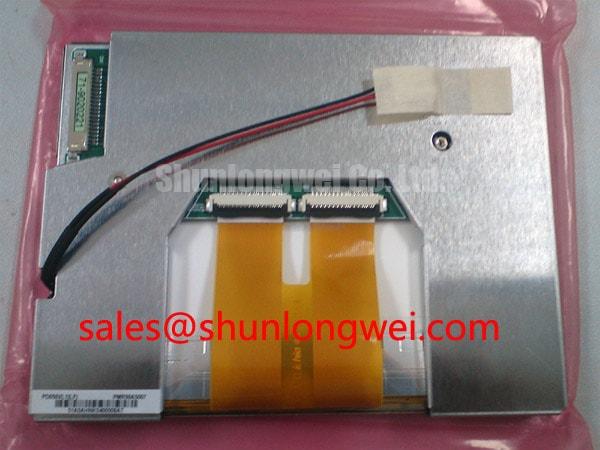


Technical Analysis: Optical Density and Driving Architecture
The primary unique value proposition (UVP) of the PD050VL1 lies in packing a 640×480 VGA raster into an active area of 101.76 × 76.32 mm. At roughly 160 pixels per inch, it avoids the blocky visual artifacts standard QVGA panels experience when rendering complex waveforms or dense numeric menus. System architects can consult foundational display physics under our LCD core technology resources.
To understand the engineering advantage of this pixel pitch, consider a printed blueprint. Shrinking line art to fit a smaller canvas requires finer pen strokes; likewise, the tight aperture ratio and subpixel alignment of this panel retain legible text and sharp graticules without requiring firmware anti-aliasing filters that place extra processing load on the host microchip.
Driving this TFT-LCD requires a standard 18-bit parallel digital RGB input operating at typical pixel clocks around 25.175 MHz. This native parallel bus allows direct attachment to baseband microcontrollers and FPGA controllers without specialized serializer bridge chips. For proper synchronization and to prevent latching issues, review our technical guide on TTL LCD interface timing. System designers migrating from larger modules like the PVI PD064VL1 can preserve baseline firmware display pipelines while drastically reducing housing volume.
Optimized Application Scenarios
- Portable Oscilloscopes and Spectral Analyzers: 160 PPI resolution provides crisp waveform rendering and graticule visibility in handheld form factors.
- Industrial Process Controllers: Fits standard DIN enclosures while presenting full parameter maps without multi-level scrolling.
- Medical Patient Monitors: Compact profile and 400:1 Contrast Ratio ensure distinct differentiation between physiological trend plots and numerical vitals.
- Avionics and Marine Sub-Panels: Reliable operation across -20°C to +70°C and solid chassis construction withstand vibration-prone operating profiles.
Delivers dense VGA visualization in a 5-inch footprint, ensuring seamless mechanical retrofits for high-precision diagnostic and instrumentation platforms.
Key Technical Specifications
| Parameter Category | Specification Characteristic | Value / Rating |
|---|---|---|
| Optical Performance | Luminance (Typ.) | 250 cd/m² |
| Contrast Ratio (Typ.) | 400:1 | |
| Viewing Angle (CR ≥ 10) | Horizontal: 100° (50°/50°), Vertical: 50° (15°/35°) | |
| Electrical Characteristics | Logic Supply Voltage (VCC) | 3.3V Typ. (3.0V to 3.6V) |
| Signal Interface | 18-bit Parallel RGB (6-bit / color) | |
| Typical Pixel Clock (DCLK) | 25.175 MHz | |
| Backlight Unit | Lamp Source | Single Cold Cathode Fluorescent Lamp (CCFL) |
| Lamp Voltage / Current | 490 Vrms / 5.0 mArms | |
| Environmental Ratings | Operating Temperature | -20°C to +70°C |
| Storage Temperature | -30°C to +80°C |
Engineer FAQ
Q: What timing constraints govern the pixel clock on the PD050VL1?
A: The panel targets a typical dot clock frequency of 25.175 MHz with a 60 Hz vertical refresh rate. Data setup and hold times relative to DCLK require adherence to strict nanosecond margins to prevent sampling errors across the parallel RGB lanes.
Q: How does the CCFL backlight integrate into modern DC-powered embedded boards?
A: The CCFL lamp requires an external high-voltage inverter providing 490 Vrms operating voltage with a starting voltage rating exceeding 750 Vrms. Inverter selection must ensure proper current regulation at 5.0 mArms to avoid premature tube degradation.
Q: What mechanical precautions are recommended when designing chassis mounts?
A: The display frame uses perimeter mounting flanges. Avoid non-uniform torque on mounting screws to prevent mechanical bending forces from propagating to the glass substrate, which can cause optical mura defects.
Q: Does the PD050VL1 support 24-bit color data?
A: No, the driver architecture is wired for 18-bit RGB (6 bits per subpixel), yielding 262,144 displayable colors. When connecting to 24-bit host processors, the 6 most significant bits of each channel should map to the panel inputs, tying unused LSB lines according to system noise design guidelines.
Engineering Sourcing Summary
The PD050VL1 maintains relevance in specialized automation and test environments where compact form factor, native VGA sharpness, and direct parallel bus communication are decisive system criteria. Engineers seeking verified factory documentation or integration data can obtain resources through verified distributor networks.