Mitsubishi RM50TC-2H: A Robust 1000V 50A Three-Phase Diode Bridge Module for Industrial Applications
Mitsubishi RM50TC-2H 1000V 50A Diode Bridge Module
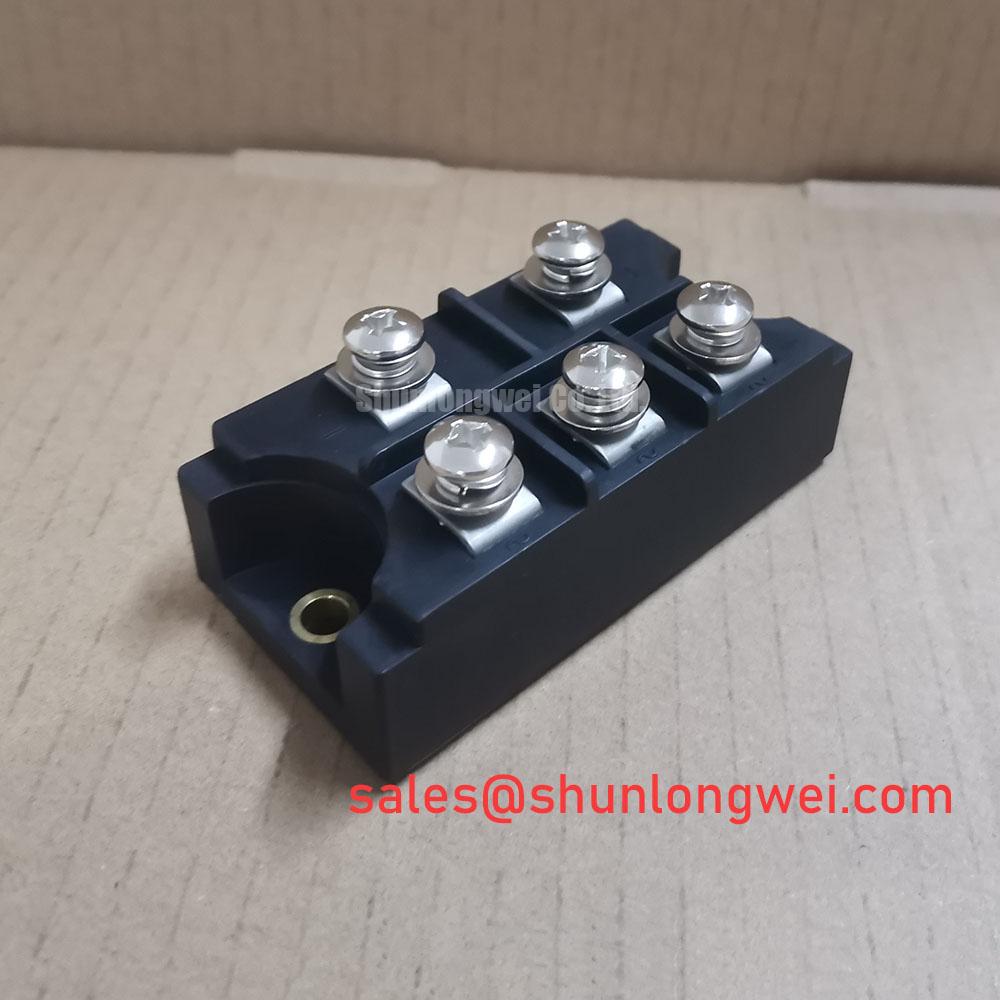
The RM50TC-2H is a three-phase diode bridge module engineered by Mitsubishi for AC-to-DC rectification in industrial power conversion systems. Designed with an electrically isolated baseplate, this device delivers reliable thermal conduction and high surge suppression across industrial mains supplies.

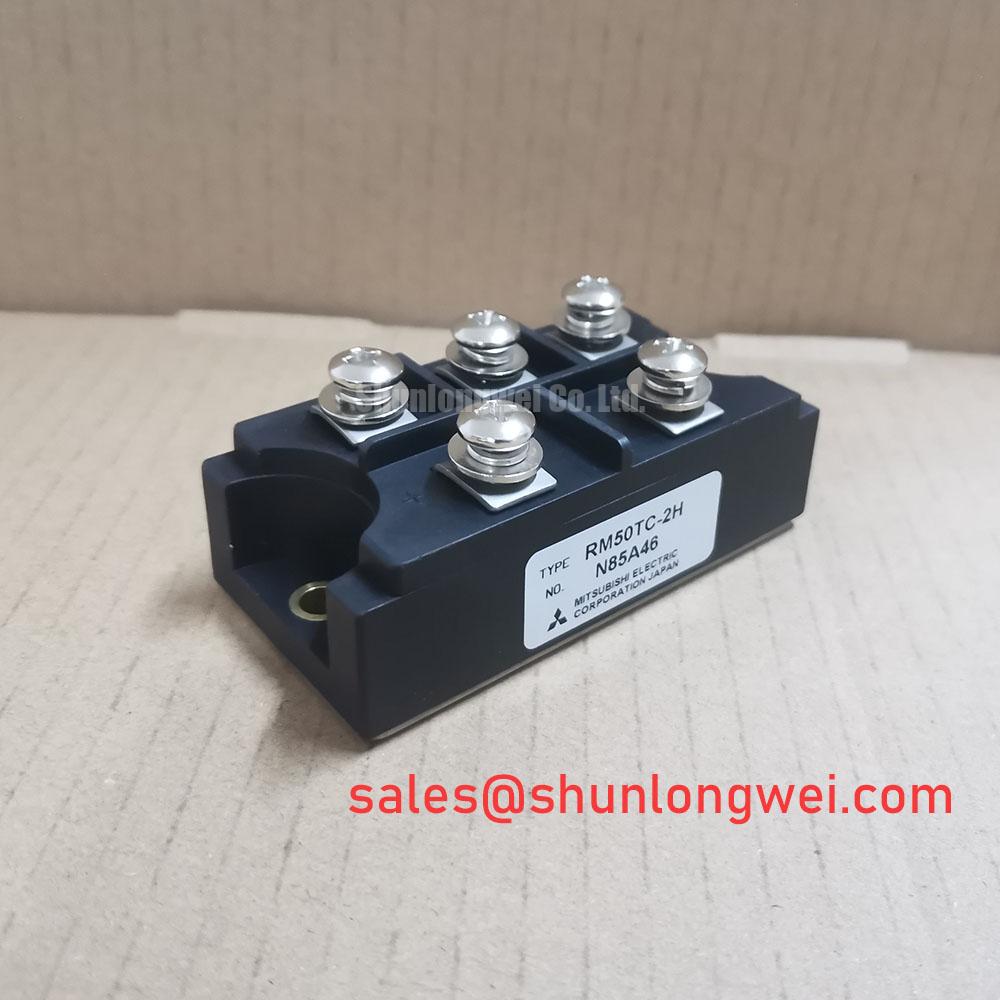
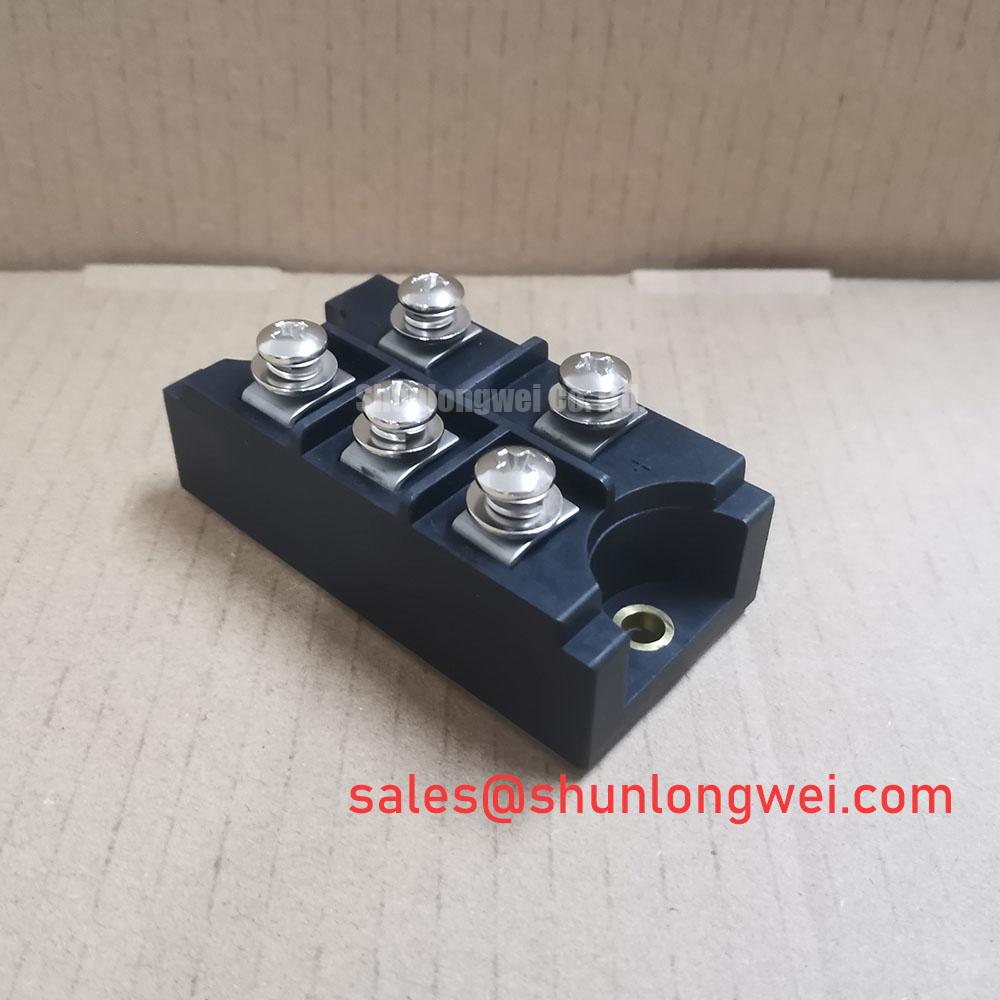
- Core Ratings: $V_{text{RRM}} = 1000text{ V}$ | $I_{text{O}} = 50text{ A}$ ($T_{text{C}} = 98^circtext{C}$) | $I_{text{FSM}} = 500text{ A}$
- Engineering Advantages: Direct mounting to common heatsinks without external insulation barriers; balanced three-phase forward voltage drop for uniform thermal distribution.
- Design Inquiry Solved: Eliminates phase-to-phase current imbalances and simplifies DC busbar design in standard 380V/440V AC line front-ends.
Download Official RM50TC-2H Datasheet (PDF)

Technical Analysis and Engineering Value
The RM50TC-2H incorporates six silicon rectifier diodes arranged in a three-phase bridge configuration within a single compact module. With a repetitive peak reverse voltage ($V_{text{RRM}}$) rating of 1000V, it provides substantial voltage headroom against line transients when connected to standard 380V to 480V AC distribution grids. Its peak non-repetitive forward surge rating ($I_{text{FSM}}$) of 500A ($60text{ Hz}$, half-cycle) ensures robust survival during capacitive inrush events upon system power-up.
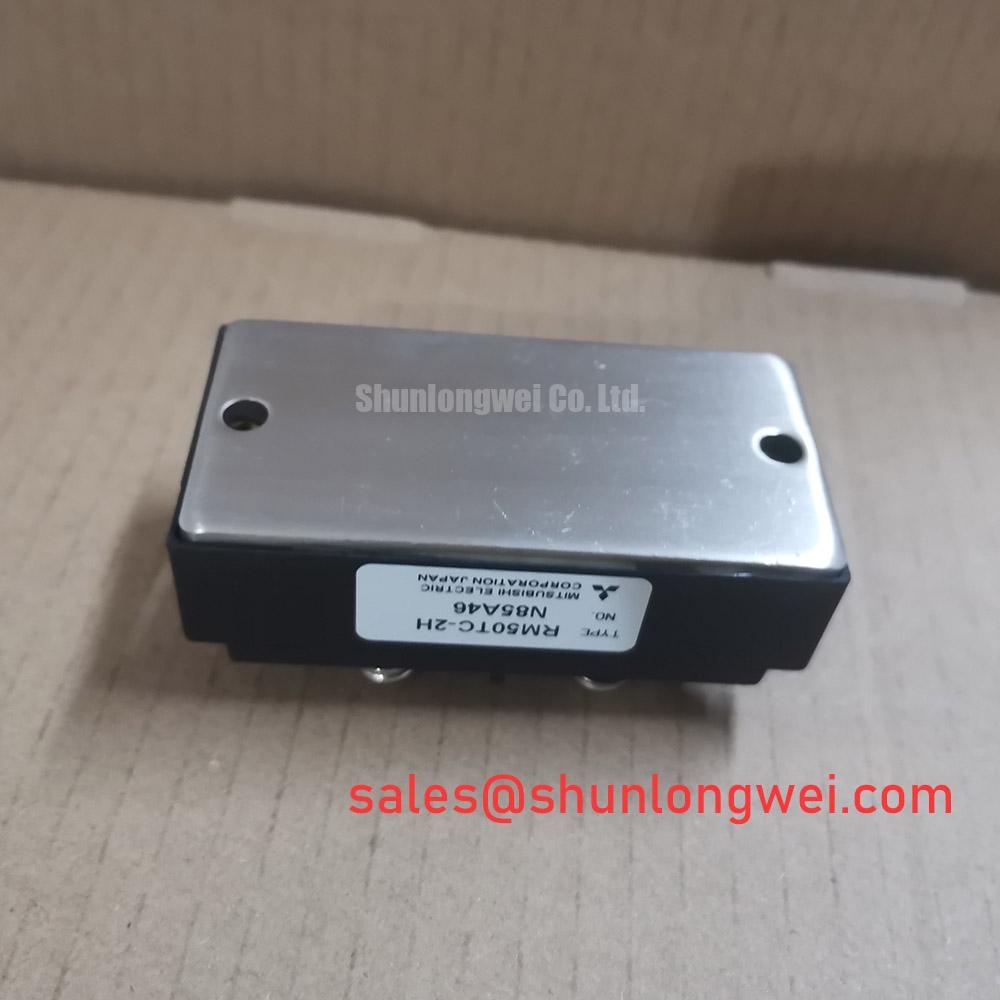
Thermal management is streamlined via an electrically isolated copper baseplate providing an insulation voltage rating of $2500text{ V}_{text{RMS}}$. One can think of junction-to-case thermal resistance as the resistance to fluid flow through a pipe: the lower the thermal resistance ($R_{text{th(j-c)}} le 0.35^circtext{C/W}$ per module), the faster conduction heat transfers away from internal junctions, preventing localized hot spots under continuous 50A DC output loading.
Optimized Application Scenarios
- Variable Frequency Drive (VFD) Input Rectification: Serves as the primary line-frequency input converter stage for motor drives requiring stable DC bus supply.
- DC Power Supply Units & Battery Chargers: Delivers high rectification efficiency and ripple reduction from standard industrial 3-phase lines.
- Uninterruptible Power Supplies (UPS): Handles input utility conversion with high surge tolerance against line perturbations.
- DC Motor Field Exciters: Provides rugged, isolated three-phase rectification for medium-power DC motor field control circuits.
Delivers optimal electrical isolation and robust surge withstand capability for standard industrial 400V-class three-phase front-end rectifiers.
Key Specifications and Maximum Ratings
| Parameter / Absolute Maximum Ratings | Symbol | Rating Value | Unit |
|---|---|---|---|
| Repetitive Peak Reverse Voltage | $V_{text{RRM}}$ | 1000 | V |
| Non-Repetitive Peak Reverse Voltage | $V_{text{RSM}}$ | 1100 | V |
| Average Output Rectified Current (Three-Phase Full Wave, $T_{text{C}} = 98^circtext{C}$) | $I_{text{O}}$ | 50 | A |
| Peak One-Cycle Surge Forward Current (Non-Repetitive, $60text{ Hz}$) | $I_{text{FSM}}$ | 500 | A |
| Current Squared Time ($t = 8.3text{ ms}$) | $I^2t$ | $1.0 times 10^3$ | $text{A}^2text{s}$ |
| Operating Junction Temperature Range | $T_{text{j}}$ | -40 to +150 | $^circtext{C}$ |
| Storage Temperature Range | $T_{text{stg}}$ | -40 to +125 | $^circtext{C}$ |
| Isolation Voltage (Charged part to baseplate, AC 1 min) | $V_{text{iso}}$ | 2500 | V |
| Thermal Resistance, Junction-to-Case (Per Module) | $R_{text{th(j-c)}}$ | 0.35 (Max) | $^circtext{C/W}$ |
Engineer FAQ
Q1: What heatsink mounting precautions should be taken when installing the RM50TC-2H?
A1: Ensure a heatsink flatness tolerance within $50 mutext{m}$ across the contact area. Apply a uniform layer of thermal interface material (recommended thickness $100 mutext{m}$) and torque the mounting screws evenly to the datasheet specified limits ($2.0text{ to }2.5text{ N}cdottext{m}$) to prevent substrate warping.
Q2: How does the 1000V $V_{text{RRM}}$ rating fit into 400V/480V AC utility systems?
A2: In a 400V AC nominal line, peak line voltage reaches approximately $565text{ V}$. The 1000V $V_{text{RRM}}$ rating of the RM50TC-2H offers an operational safety margin of over $400text{ V}$ against commutation notches and grid switching surges.
Q3: Can this module operate without a snubber network?
A3: While internal diodes offer robust breakdown characteristics, installing an RC snubber or varistor across the AC terminals is standard engineering practice to suppress severe inductive line spikes during turn-off transients.
Application and Sourcing Considerations
The Mitsubishi RM50TC-2H fulfills industrial engineering requirements for compact, isolated, and thermally efficient three-phase rectification. Integration of this module enables streamlined mechanical architectures in power semiconductor modules assemblies, providing consistent rectification performance across demanding operating conditions.