Fuji Electric 2MBI200U4B-120-50: High-Efficiency 1200V 200A IGBT Module with U4 Trench Gate Technology
Fuji Electric 2MBI200U4B-120-50 | 1200V 200A IGBT Module
Introduction to High-Efficiency Power Conversion with 2MBI200U4B-120-50
The Fuji Electric 2MBI200U4B-120-50 is a high-performance IGBT (Insulated Gate Bipolar Transistor) module utilizing the advanced 4th generation U4 Series technology. This dual-pack (half-bridge) module is engineered to balance high-speed switching with ultra-low conduction losses, making it a cornerstone for modern power semiconductors applications. By integrating a trench gate structure and field-stop technology, the module achieves a superior power density suitable for demanding industrial environments.
- Core Specifications: 1200V | 200A | VCE(sat) 1.70V (typ.)
- Key Advantages: Significantly reduced switching energy ($E_{off}$) and enhanced short-circuit durability.
- Design Intent: Engineers often ask how to maximize efficiency in 1200V systems; this module provides the answer through its optimized collector-emitter saturation voltage, which minimizes heat generation during high-current conduction.
Download Official Datasheet (PDF)
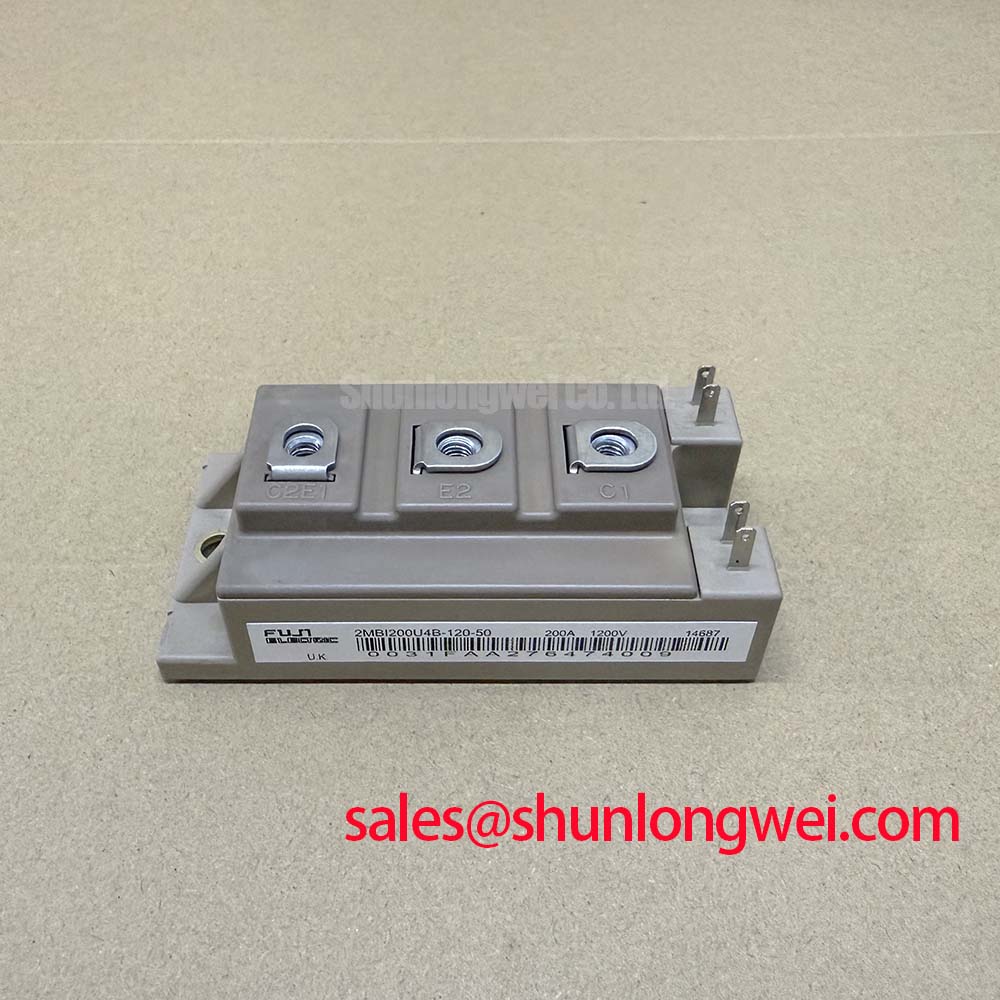
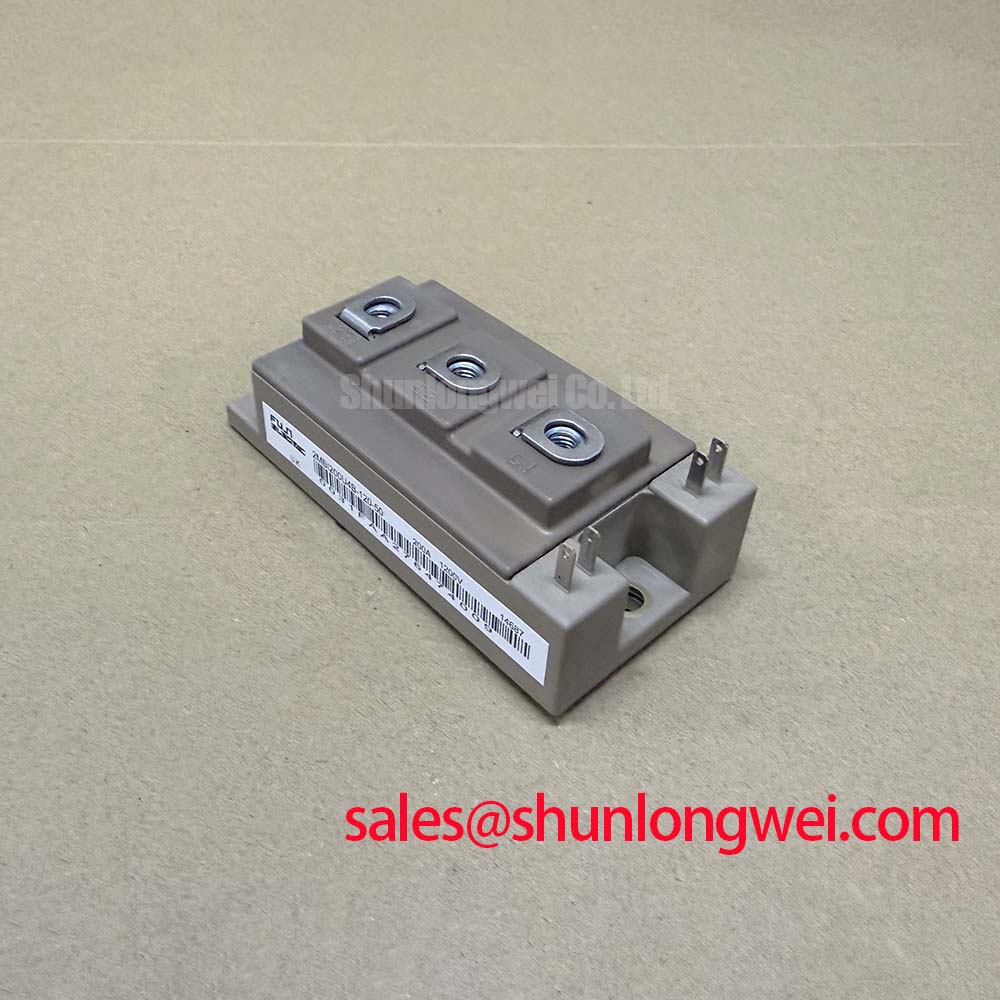
Technical Analysis: Precision Through Trench Gate Evolution
The architectural foundation of the 2MBI200U4B-120-50 lies in its trench gate evolution. Traditional planar gates suffer from higher on-state resistance due to the JFET effect. In contrast, the trench structure used here increases cell density and eliminates the JFET resistance, allowing for a typical $V_{CE(sat)}$ of just 1.70V at $125^circ C$. This reduction in conduction loss is critical for maintaining system efficiency under heavy loads.
To understand the engineering impact, one can imagine the collector-emitter saturation voltage as the “friction” within a power pipe. A lower $V_{CE(sat)}$ value means current flows with less resistance, resulting in less energy being wasted as heat. This allows engineers to utilize smaller heatsinks or increase the output current without exceeding thermal limits. Furthermore, the module features an improved FWD (Free Wheeling Diode) with soft recovery characteristics, which helps in IGBT overvoltage protection during high-speed turn-off transients.
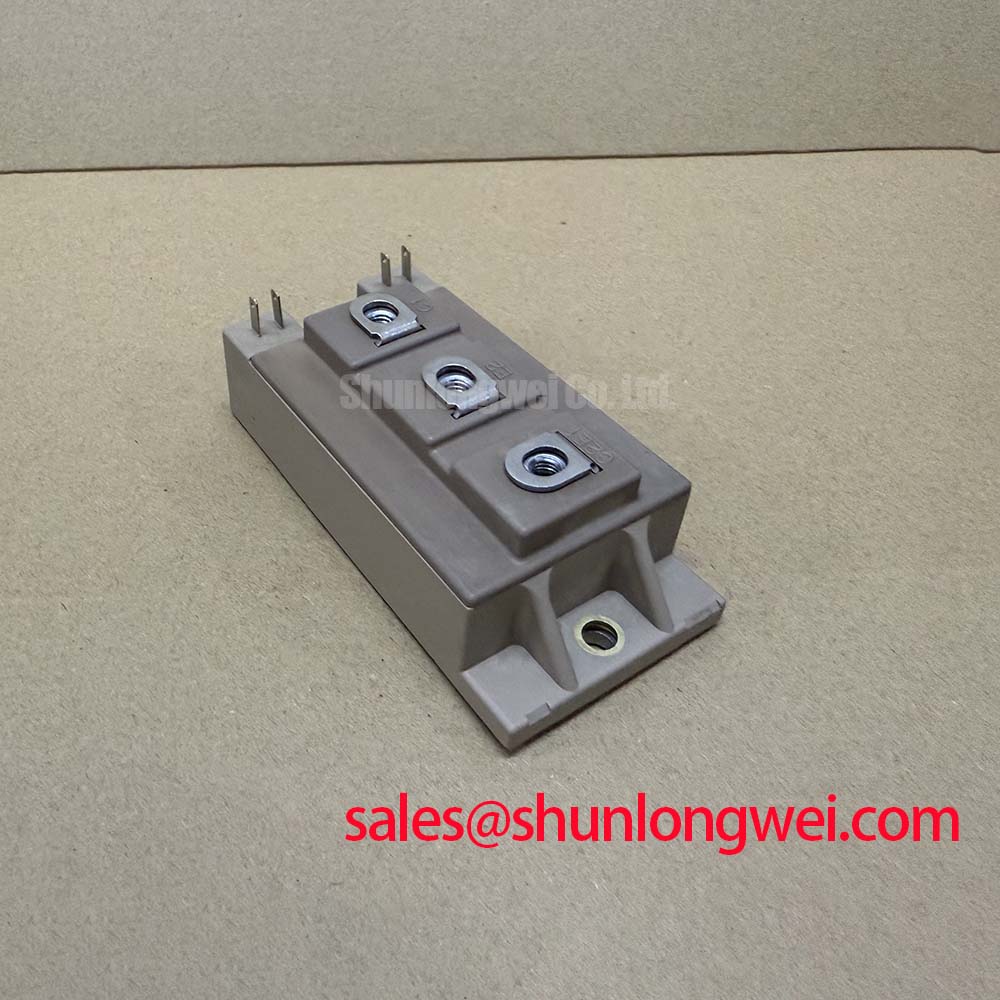
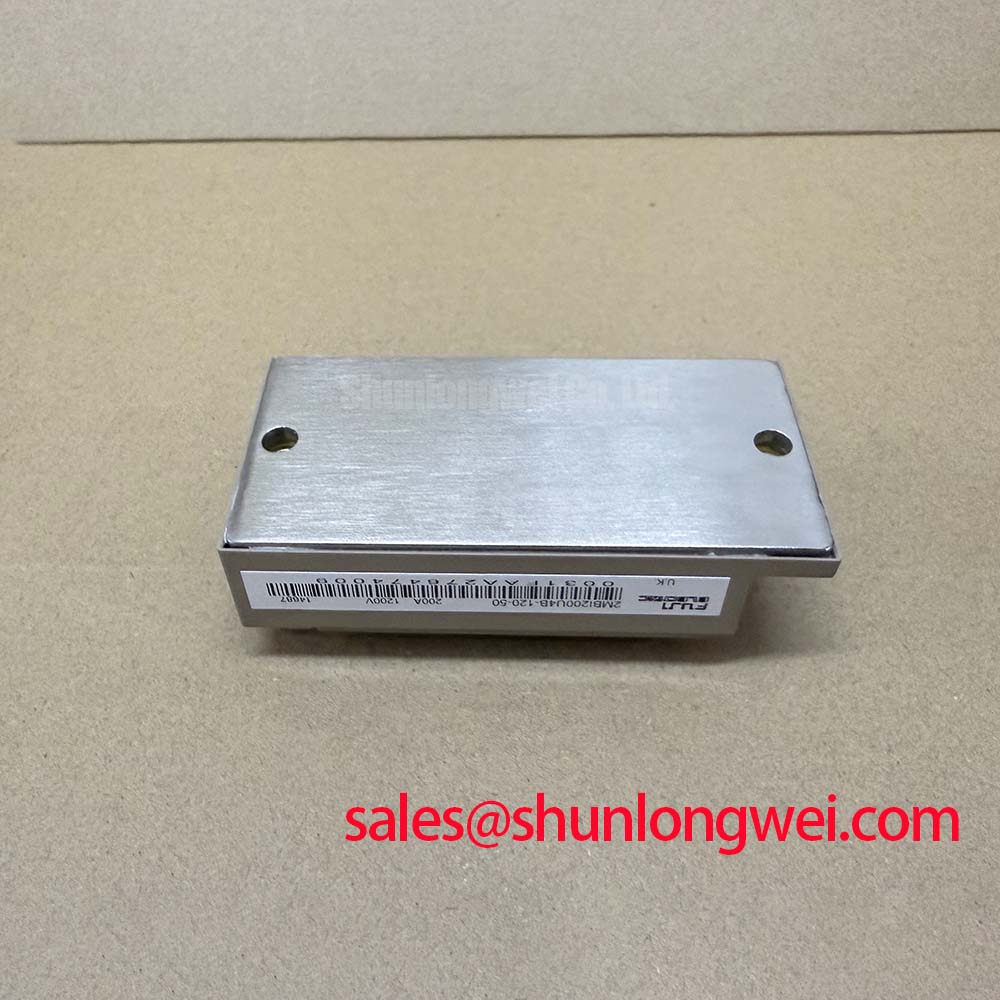
Thermal management is further refined by the module’s low thermal resistance ($R_{th(j-c)}$). Proper thermal design is essential to prevent IGBT failures. The 2MBI200U4B-120-50 provides a robust copper baseplate that ensures efficient heat transfer to the cooling medium, maintaining junction temperatures within safe limits even during rigorous power cycling.
Optimized Application Scenarios
- Industrial AC/DC Inverters: The 200A rating and low switching losses make it ideal for high-power industrial drives where energy conservation is a priority.
- Uninterruptible Power Supplies (UPS): Its ability to handle high-frequency PWM switching ensures clean sine wave output with minimal harmonic distortion.
- Renewable Energy Converters: Specifically suited for wind and solar power systems requiring reliable 1200V operation and high surge current handling.
- Welding Power Supplies: High durability against short-circuit events allows for stable operation in the extreme current fluctuations typical of arc welding.
Conclusion: This module is the best match for high-frequency industrial power systems requiring a compact, low-loss half-bridge solution with proven short-circuit robustness.
Key Specification Parameters
| Category | Parameter | Typical Value |
|---|---|---|
| Maximum Ratings | Collector-Emitter Voltage ($V_{CES}$) | 1200V |
| Continuous Collector Current ($I_C$) | 200A (at $T_c = 80^circ C$) | |
| Junction Temperature ($T_j$) | Up to $150^circ C$ | |
| Electrical Specs | VCE Saturation ($V_{CE(sat)}$) | 1.70V (at $T_j = 125^circ C$) |
| Gate Threshold Voltage ($V_{GE(th)}$) | 4.5V to 8.5V | |
| Input Capacitance ($C_{ies}$) | 34nF | |
| Thermal Data | Thermal Resistance (IGBT) | $0.12^circ C/W$ |
Engineer FAQ
Q1: What is the impact of parasitic inductance on the switching performance of this module?
A1: High parasitic inductance can cause significant voltage spikes during the turn-off phase. Designers should use low-inductance busbars and place snubber capacitors as close to the 2MBI200U4B-120-50 terminals as possible to mitigate these effects.
Q2: How does the module handle short-circuit conditions?
A2: The 2MBI200U4B-120-50 is rated for a short-circuit withstand time of 10μs at $V_{CC}=800V$ and $V_{GE}=15V$. This provides a sufficient window for protection circuits to detect and isolate the fault without destroying the module.
Q3: Can this module be paralleled for higher current requirements?
A3: Yes, however, because of the $V_{CE(sat)}$ variation between units, careful matching and symmetrical PCB layout are required to ensure balanced current sharing. Using integrated NTC resistors for temperature monitoring is highly recommended to manage thermal balance across paralleled modules.
Final Engineering Summary
The Fuji Electric 2MBI200U4B-120-50 represents a refined approach to high-power switching, offering engineers a reliable path to high efficiency through its U4 Trench technology. By addressing the critical balance between conduction and switching energy, it empowers the design of more compact and thermally efficient power systems. Its robust 1200V platform and 200A capability make it a versatile asset for the next generation of industrial energy conversion.