Fuji Electric 2MBI200VB-120-50: A Comprehensive Guide to High-Efficiency 1200V 200A IGBT Modules
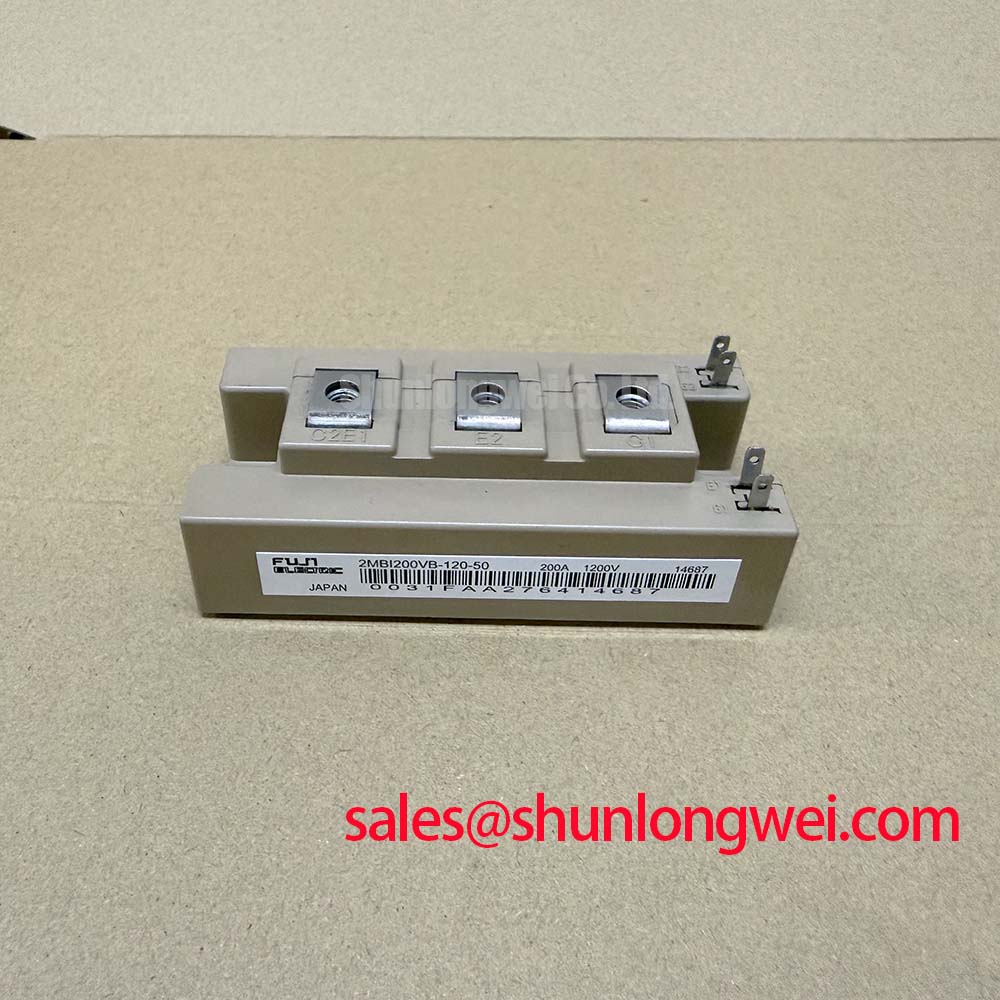
Fuji Electric 2MBI200VB-120-50 1200V 200A IGBT Module
Introduction to High-Efficiency Power Switching
The 2MBI200VB-120-50 is a high-performance Dual IGBT (Insulated Gate Bipolar Transistor) module belonging to Fuji Electric’s V-Series. This 1200V, 200A power component is engineered to bridge the gap between high-frequency operation and low conduction losses. By utilizing advanced trench-gate technology, the module achieves an ultra-low collector-emitter saturation voltage ($V_{CE(sat)}$), making it a cornerstone for modern Power Semiconductors applications where efficiency is non-negotiable. This module provides engineers with a robust solution for medium-to-high power conversion, specifically addressing the industry’s need for reduced cooling requirements and higher power density.
- Core Specifications: 1200V | 200A | $V_{CE(sat)}$ 1.70V (Typical at 25°C)
- Key Advantages: Minimized conduction losses through V-series trench architecture and simplified thermal management due to a low junction-to-case thermal resistance.
- Design Reliability: Optimized for 3-phase inverter topologies where reducing parasitic inductance on IGBT switching is critical for system longevity.
Download Official Datasheet (PDF)
Technical Analysis: Efficiency through Trench-Gate Architecture
The 2MBI200VB-120-50 leverages Fuji Electric’s 6th Generation trench-gate technology. The engineering significance of this architecture lies in its ability to decrease the thickness of the drift layer while increasing cell density. In practical terms, this results in a typical $V_{CE(sat)}$ of just 1.70V. You can think of $V_{CE(sat)}$ as the “energy tax” paid during the conduction phase; a lower tax means more power reaches your motor or load, and less is wasted as heat within the silicon wafer itself. This reduction in internal dissipation is what enables the module to maintain a high current rating within a compact VB-package footprint.

Thermal management is another area where the 2MBI200VB-120-50 excels. With a junction-to-case thermal resistance ($R_{th(j-c)}$) of 0.085 °C/W for the IGBT portion, the device ensures efficient heat transfer to the heatsink. To visualize this, imagine thermal resistance as the width of a drain pipe; a lower value represents a wider pipe that allows heat to flow out of the semiconductor “reservoir” much faster. This prevents localized hotspots that could lead to premature root cause analysis of IGBT failures, especially during transient overloads. Efficient cooling is vital for maintaining the module’s 200A rating at elevated operating temperatures.

Optimized Application Scenarios
The 2MBI200VB-120-50 is particularly well-suited for industrial environments requiring precision and durability. Its electrical characteristics make it ideal for the following applications:
- Inverters for Motor Drives: The low $V_{CE(sat)}$ and high-speed switching capabilities allow for efficient variable frequency control in 3-phase motors.
- Uninterruptible Power Supplies (UPS): High power density and reliability ensure stable output during critical power transitions.
- Renewable Energy Systems: Excellent for solar inverters where maximizing every watt of energy conversion is a primary design goal.
- Industrial Welding Machines: The module’s robust RBSOA (Reverse Bias Safe Operating Area) handles the harsh inductive load characteristics of welding power stages.
Best Match Conclusion: This module is the optimal choice for designs prioritizing power efficiency and thermal headroom in 1200V industrial inverter applications.
Key Specifications Parameter Table
| Category | Parameter | Value (Typical/Max) |
|---|---|---|
| Absolute Maximum Ratings | Collector-Emitter Voltage ($V_{CES}$) | 1200V |
| Collector Current (Continuous $I_C$) | 200A (at $T_c=80$°C) | |
| Junction Temperature ($T_{j}$) | -40 to +150 °C | |
| Electrical Characteristics | $V_{CE(sat)}$ at $I_C=200A$ | 1.70V (Typ) / 2.15V (Max) |
| Gate-Emitter Threshold Voltage ($V_{GE(th)}$) | 6.0V to 7.5V | |
| Input Capacitance ($C_{ies}$) | 31.0 nF (Typ) | |
| Thermal Characteristics | Thermal Resistance ($R_{th(j-c)}$) | 0.085 °C/W (IGBT) |

Engineer’s FAQ
Q1: What is the recommended gate resistance for the 2MBI200VB-120-50?
According to the datasheet, the standard testing condition uses a gate resistance ($R_g$) of 3.0 $Omega$. However, engineers should tune this value to balance switching speed against EMI and voltage overshoot, depending on the system’s busbar inductance.
Q2: How do I calculate the heatsink requirements based on the $R_{th(j-c)}$?
The total thermal resistance is the sum of $R_{th(j-c)}$ (junction to case), $R_{th(c-f)}$ (case to heatsink/fin), and $R_{th(f-a)}$ (heatsink to ambient). Using the typ value of 0.085 °C/W for 2MBI200VB-120-50, ensure your heatsink’s $R_{th(f-a)}$ keeps the junction temperature below 150°C under peak power dissipation. For more details, refer to our guide on IGBT thermal design.
Q3: Is this module capable of sustained operation at high switching frequencies?
Yes, the V-series trench gate is designed for high-speed operation. However, switching losses ($E_{on}$ and $E_{off}$) increase linearly with frequency. For operations above 15kHz, careful calculation of total power dissipation ($P_{total} = P_{conduction} + P_{switching}$) is required to ensure thermal compliance.
The Fuji Electric 2MBI200VB-120-50 stands as a highly efficient and rugged solution for industrial power conversion. By integrating 6th generation trench silicon with a thermally optimized package, it empowers engineers to achieve higher performance benchmarks in motor control and renewable energy applications while ensuring long-term operational stability.