MCC501-18io2 Thyristor Module: A Technical Review for High-Power Applications
## MCC501-18io2 Thyristor Module for High Power AC Control
This MCC501-18io2 Thyristor Module, manufactured by IXYS (now Littelfuse), provides robust and reliable performance for high-power AC applications, centered on its high isolation voltage and excellent thermal management capabilities. It integrates two thyristors in a series configuration within an industry-standard package, simplifying the design of power control circuits. The module’s construction is optimized for long-term stability in demanding industrial environments.
* **Core Specifications**: 1800V | 585A (IT(AV)M) | 3000V~ Isolation
* **Key Advantages**: High electrical isolation enhances system safety, and the use of a DCB ceramic base plate improves thermal performance.
* **Engineering Value**: The module’s standard footprint facilitates straightforward mechanical integration and mounting to heatsinks, allowing for effective thermal resistance calculation and management.
Download Official Datasheet (PDF)
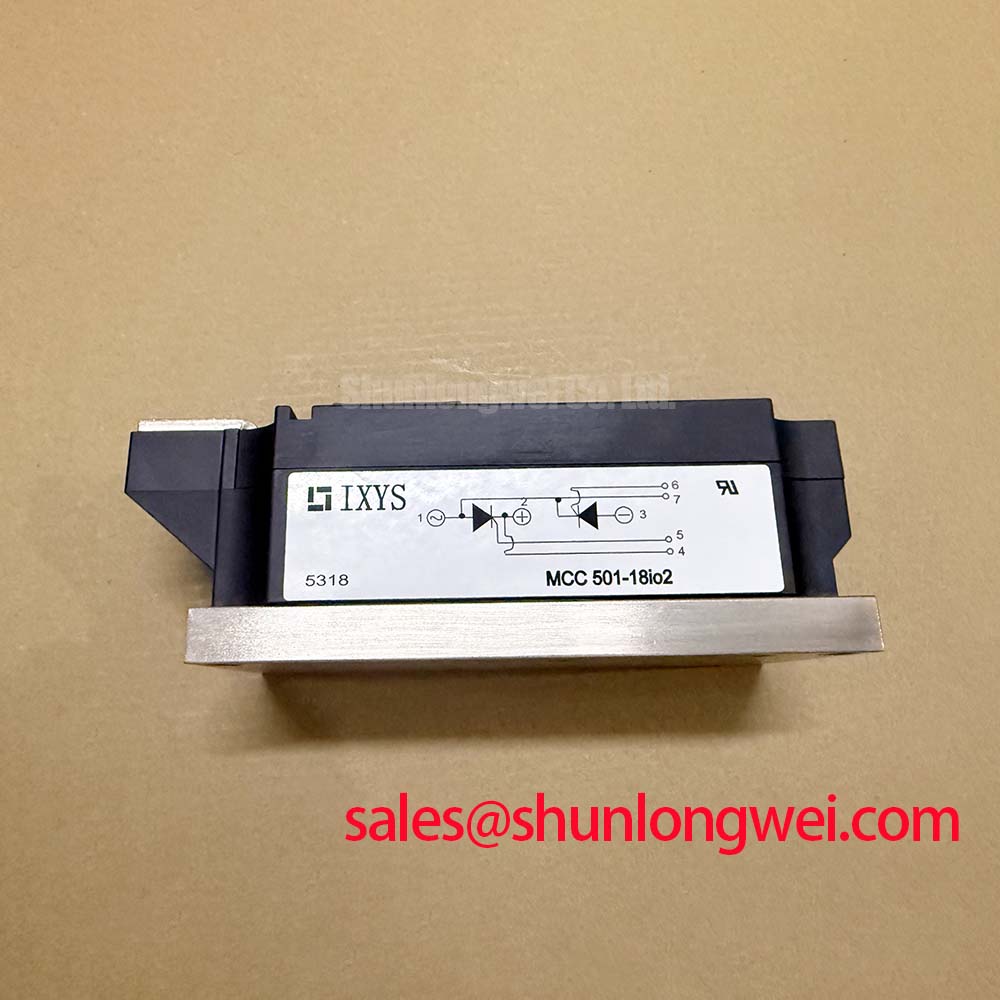

Technical Analysis for System Integration
The MCC501-18io2 is built upon a foundation of reliability. One of its defining features is the 3000V~ AC isolation voltage between the terminals and the baseplate. This high isolation capability is critical for safety in systems connected directly to the mains, providing a substantial barrier that protects control electronics and operators from hazardous voltages. This feature allows designers to meet stringent safety standards without requiring complex external isolation arrangements.
Effective thermal management is achieved through the use of a Direct Copper Bonded (DCB) aluminum oxide (Al2O3) ceramic baseplate. This construction provides very low thermal impedance. Think of thermal impedance as the width of a pipe for heat; a lower value means a wider pipe, allowing heat to flow away from the semiconductor junctions more easily. This efficient heat transfer to an external heatsink is essential for maintaining operational stability and ensuring a long service life under high-current loads.
The core of the module utilizes planar passivated chips. This technology ensures stable blocking voltage characteristics over the component’s lifetime and across its full operating temperature range (-40°C to 125°C). For engineers, this translates to predictable and dependable performance, reducing the risk of premature failure in applications like industrial inverters and soft starters where voltage stability is paramount.
Optimized Application Scenarios
This module’s specifications make it a strong candidate for several high-power control applications.
* **AC Motor Soft Starters**: The module’s high surge current rating (ITSM up to 13,000 A) allows it to safely manage the high inrush currents typical of large AC motor startups.
* **Industrial Power Controllers**: With a repetitive peak off-state voltage (VDRM) of 1800V, the MCC501-18io2 offers a significant safety margin for line-powered AC control systems, including furnace and lighting controls.
* **High Power Rectifier Bridges**: Its high average forward current capacity makes it suitable for constructing efficient and robust single-phase or three-phase controlled rectifiers.
* **DC Motor Control**: The phase control capabilities of the thyristors are well-suited for regulating power to DC motors, providing precise speed and torque control.
With its high voltage rating and robust thermal design, this module is an excellent match for AC power control systems operating up to the megawatt level.
Key Specifications of the MCC501-18io2
| Absolute Maximum Ratings (T_C = 25°C unless otherwise specified) | ||
|---|---|---|
| V_RRM / V_DRM | Repetitive Peak Reverse/Off-State Voltage | 1800 V |
| I_T(AV)M | Max. Average On-State Current (T_C = 85°C) | 585 A |
| I_TSM | Max. Surge Current (t=10ms, 50Hz, sine) | 13000 A |
| V_ISOL | Isolation Voltage (50/60Hz, RMS, t=1min) | 3000 V~ |
| Thyristor Electrical Characteristics (T_vj = 125°C) | ||
| V_T0 | Threshold Voltage | 0.85 V |
| r_T | Slope Resistance | 0.55 mΩ |
| I_GT | Gate Trigger Current (T_vj = 25°C) | < 200 mA |
| Thermal and Mechanical Characteristics | ||
| R_thJC | Thermal Resistance, Junction to Case (per thyristor) | 0.048 K/W |
| T_vj op | Operating Junction Temperature | -40 to +125 °C |
| Mounting Torque | Terminals (M6) / Module (M6) | 4-6 Nm / 4-6 Nm |
Engineer’s FAQ
1. What is the recommended mounting procedure to ensure proper thermal contact?
To achieve the specified thermal resistance, the module baseplate must have a flat, clean, and rigid mounting surface. A thin layer of thermal compound should be applied evenly. The module should be secured using all four M6 mounting bolts, tightened incrementally in a cross pattern to the recommended torque of 4-6 Nm to ensure even pressure distribution.
2. Can these modules be used in parallel for higher current output?
Yes, but careful design is required. For parallel operation, it’s essential to match device characteristics (especially on-state voltage) and ensure symmetrical busbar layout to promote equal current sharing. Using devices from the same manufacturing batch is recommended. Further guidance on paralleling power modules is crucial for reliable designs.
3. How does the gate trigger current (IGT) change with temperature?
The datasheet specifies a maximum IGT of 200 mA at 25°C. For thyristors, IGT typically decreases as junction temperature increases. The gate drive circuit must be designed to supply sufficient current to reliably trigger the device under all operating conditions, especially at the lowest specified operating temperature of -40°C where IGT will be highest.
4. What does the 3000V~ isolation rating imply for system compliance?
The 3000V~ isolation rating simplifies meeting safety standards like IEC and UL. It ensures a robust dielectric barrier between the electrically live parts of the module and the grounded heatsink, which is a fundamental requirement for system safety and operator protection in high-voltage industrial equipment.
Design Enablement
The MCC501-18io2 offers a well-documented, industry-standard solution for high-power phase control. The combination of its high voltage rating, proven thermal performance, and long-term stability from planar passivated chips provides engineers with a reliable component to build efficient and durable power semiconductor assemblies for demanding applications.