Powerex KS221K10 (100V, 110A) Thyristor/Diode Module: A Technical Review
Powerex KS221K10 Thyristor/Diode Module | 100V 110A
Introduction and Core Highlights
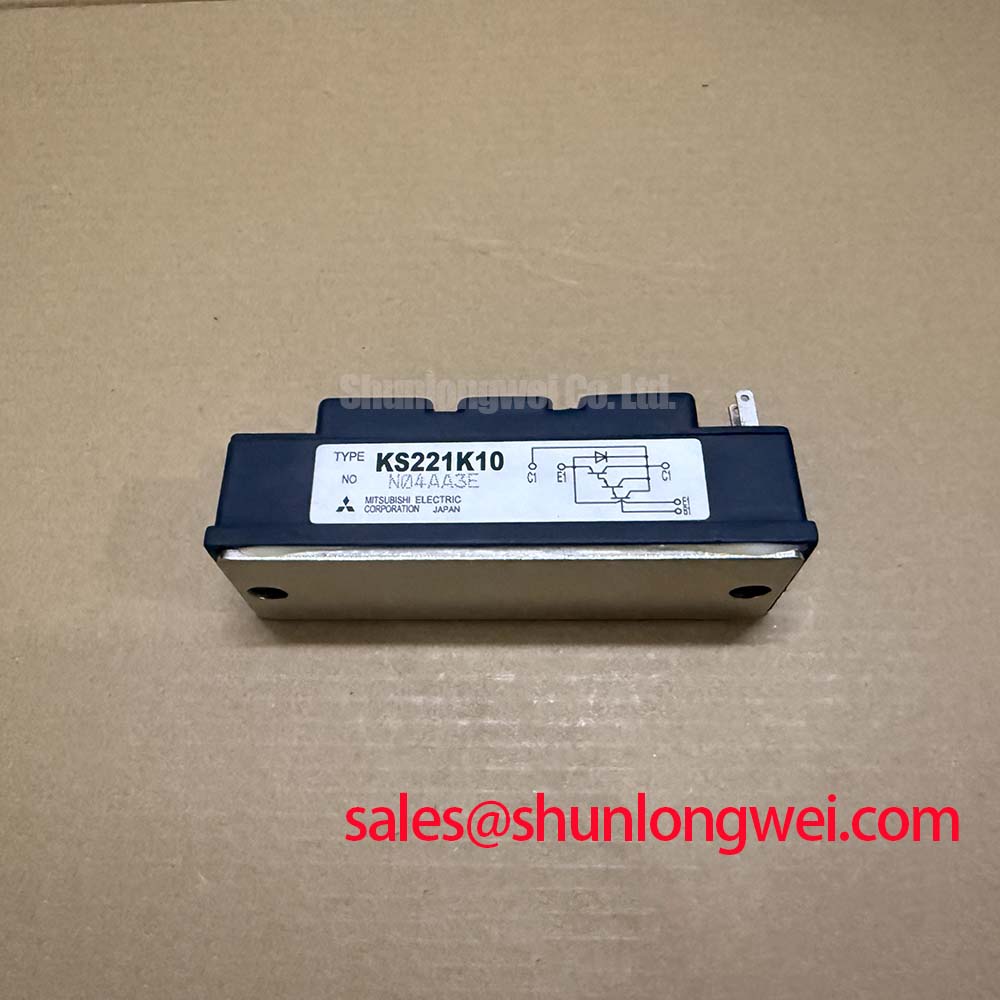
The Powerex KS221K10 is a POW-R-BLOK™ module integrating a silicon-controlled rectifier (SCR) and a diode in a single, robust package. Its primary engineering value lies in a high-current capability combined with an electrically isolated baseplate, which significantly simplifies thermal design and system assembly. This module provides a streamlined solution for AC control and rectification in low-voltage industrial systems.
- Core Specifications: 100V | 110A RMS | 70A Average
- Key Advantages: Simplifies heatsink mounting with 2500V isolation; low thermal resistance enhances reliability.
- Design Consideration: The integrated isolation allows direct mounting of multiple modules onto a single, non-isolated heatsink, reducing component count and assembly time.
Download Official Datasheet (PDF)


Technical Analysis of Core Features
The engineering advantage of the KS221K10 module is centered on its construction. The internal components are mounted on an alumina ceramic substrate that provides 2500V of electrical isolation between the active silicon and the metal baseplate. This architecture eliminates the need for external insulating pads, which can increase thermal resistance and assembly complexity. Engineers can mount the KS221K10 and other similar modules directly onto a common, grounded heatsink, streamlining the mechanical layout and improving overall thermal management.
Effective heat dissipation is further supported by the module’s low junction-to-case thermal resistance (Rth(j-c)). For the SCR, this value is specified at 0.24 °C/W. This parameter can be compared to the width of a pipeline for heat flow; a lower value signifies a wider, more efficient path for thermal energy to travel from the semiconductor junction to the module’s baseplate. This efficiency allows for smaller heatsink designs or greater operational margin at higher current loads, contributing directly to the long-term reliability of the power system.
Optimized Application Scenarios
The specific ratings and isolated package of the KS221K10 make it well-suited for several industrial applications:
- AC Phase Control: Its SCR component allows for precise control of AC power, ideal for industrial heating controls and soft starters for small AC motors.
- Controlled Rectifiers: The SCR/diode combination is a fundamental building block for single-phase controlled bridge circuits used in DC power supplies and battery charging systems.
- Welding Power Supplies: The high surge current capability (ITSM = 1550A) ensures robustness in demanding applications like low-voltage resistance welders.
- Lighting Control: Suitable for high-power theatrical and industrial lighting dimmers that require controlled AC voltage.
This module provides an optimal balance for low-voltage, high-current AC control and rectification systems where simplified, reliable thermal design is a priority.
Key Specification Parameters
| Absolute Maximum Ratings (Tj = 25°C unless otherwise specified) | |
|---|---|
| Repetitive Peak Reverse Voltage (VRRM) | 100 V |
| RMS On-State Current (IT(RMS)) | 110 A |
| Average On-State Current (IT(AV)) | 70 A |
| Surge Current (ITSM) | 1550 A (at 60Hz) |
| I²t for Fusing | 10,000 A²s |
| Thermal and Mechanical Characteristics | |
| Operating Junction Temperature (Tj) | -40 to 125 °C |
| Isolation Voltage (VISOL) | 2500 VRMS |
| Thermal Resistance, Junction to Case (Rth(j-c)), SCR | 0.24 °C/W |
| Thermal Resistance, Junction to Case (Rth(j-c)), Diode | 0.36 °C/W |
| Mounting Torque (Terminals) | 25-35 in-lb (2.8-4.0 N-m) |
Engineer’s FAQ
What is the primary benefit of the KS221K10’s electrically isolated baseplate?
The 2500VRMS isolated baseplate allows the module to be mounted directly to a heatsink without requiring a separate, thermally resistive insulating pad. This simplifies mechanical assembly, improves heat transfer, and allows multiple modules to share a single, common heatsink, reducing overall system size and cost.
What is the recommended mounting torque, and why is it critical?
The datasheet specifies a mounting torque of 25-35 in-lb for the module’s terminals. Applying the correct torque is essential to ensure a low-resistance electrical connection and optimal thermal contact. Insufficient torque can lead to overheating at the terminal, while excessive torque can damage the module’s internal structure.
Can the KS221K10 be used in a three-phase application?
Yes, but it would require multiple modules. For example, a three-phase controlled bridge rectifier would typically require three such SCR/Diode modules (or a dedicated six-device module). The KS221K10 itself is a single-phase building block.
How does the low thermal resistance impact heatsink selection?
The low Rth(j-c) of 0.24 °C/W (SCR) means that heat generated at the silicon junction is transferred very efficiently to the module case. This allows an engineer to use a smaller heatsink for a given power dissipation compared to a module with higher thermal resistance, or to operate at higher currents with the same heatsink, thereby improving power density and reliability.
Design Enablement
The KS221K10 module provides a direct path to creating more compact and reliable power control systems. Its integration of an isolated baseplate with efficient thermal characteristics addresses key challenges in mechanical and thermal design. This allows engineers to focus on system performance, knowing that the core power-switching component is built for simplified assembly and robust heat dissipation.