Mitsubishi CM300DU-12H IGBT Module: A Technical Analysis for System Integration
## Mitsubishi CM300DU-12H Dual IGBT Module Technical Review
The Mitsubishi CM300DU-12H is a dual IGBT module engineered for reliability in high-power switching applications. This module integrates two IGBTs in a half-bridge configuration, providing a robust building block for inverter and converter designs that require a balance of low conduction losses and efficient switching performance.
* **Core Specifications**: 600V | 300A | VCE(sat) 2.7V (Max)
* **Key Advantages**: Features low collector-emitter saturation voltage (VCE(sat)) and an isolated baseplate to simplify thermal management.
* **Design Focus**: The module’s characteristics facilitate straightforward thermal design, enabling effective heat dissipation crucial for maintaining operational stability and longevity in demanding industrial systems.
Download the Official CM300DU-12H Datasheet (PDF)
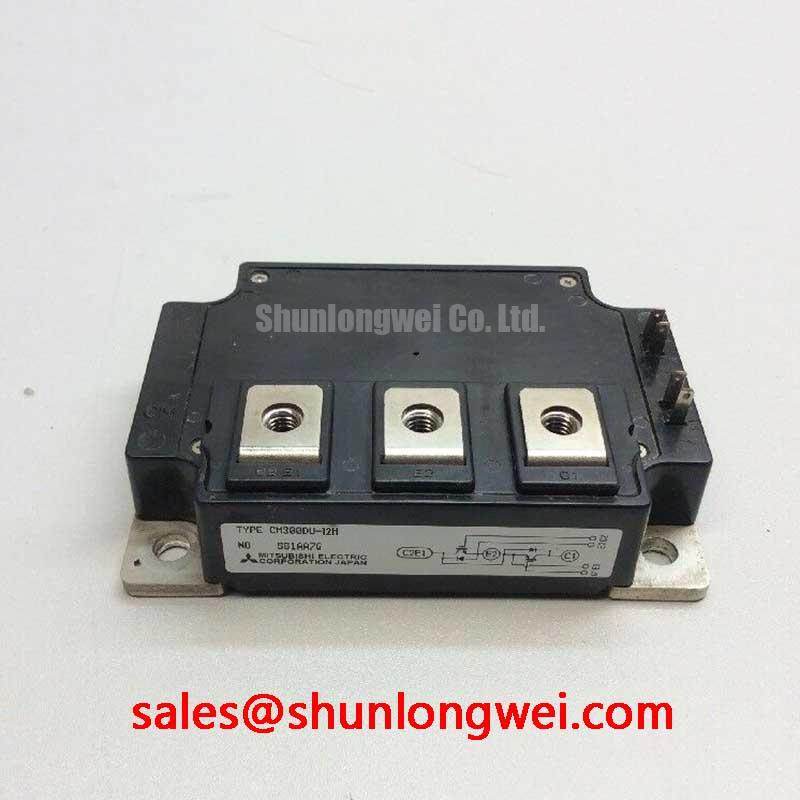
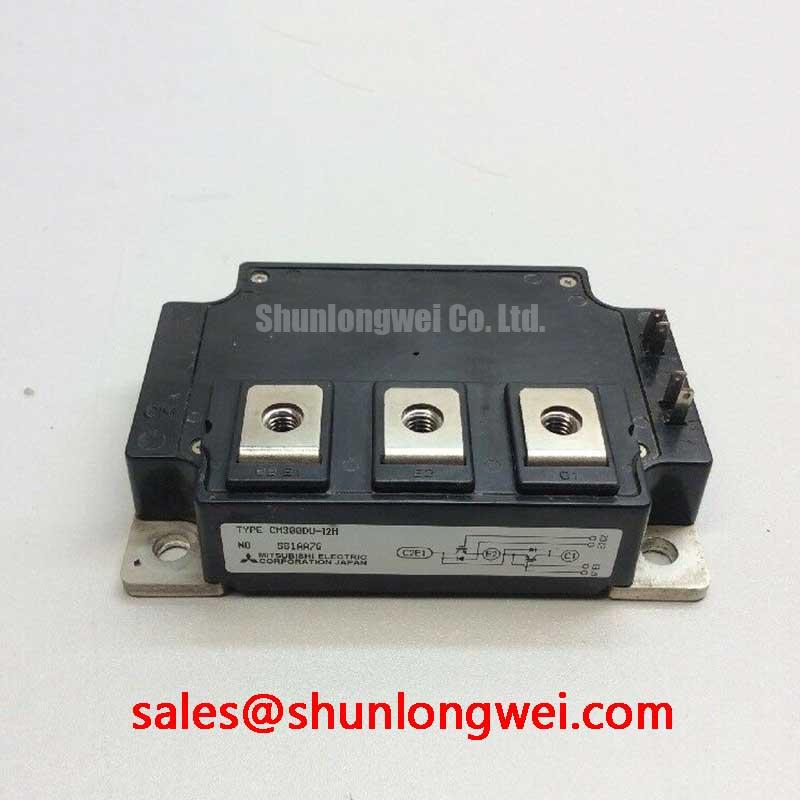
Technical Analysis for System Integration
The CM300DU-12H provides a well-balanced performance profile essential for industrial power conversion. Its maximum collector-emitter saturation voltage (VCE(sat)) is specified at 2.7V at a junction temperature of 125°C. This parameter is a primary contributor to conduction losses. A controlled VCE(sat) ensures that energy dissipated as heat during the on-state is managed, which directly impacts the overall efficiency and thermal load of the system. Engineers can leverage this characteristic to design systems with predictable power loss, reducing the complexity of the required cooling solution.
Effective thermal management is fundamental to the reliability of any power semiconductor system. The CM300DU-12H datasheet specifies the thermal resistance from junction to case (Rth(j-c)) as 0.14 °C/W for the IGBT and 0.24 °C/W for the free-wheeling diode. This value can be thought of like the width of a pipe for heat flow; a lower thermal resistance indicates a wider path, allowing heat to escape more efficiently from the active silicon to the module’s baseplate. This efficient heat transfer capability is critical for preventing the device from exceeding its maximum junction temperature of 150°C, ensuring robust performance under sustained loads. The module’s isolated baseplate further simplifies mounting and heat sinking procedures.
Optimized Application Scenarios
The electrical and thermal characteristics of the CM300DU-12H make it a suitable component for a range of medium-to-high power applications:
* **AC Motor Control**: The 300A current rating and dual configuration are ideal for constructing inverter legs in three-phase Variable Frequency Drives (VFDs).
* **Motion/Servo Control**: Fast and controlled switching is necessary for the precise current regulation required in servo drives, and this module provides the foundational switching performance.
* **Uninterruptible Power Supplies (UPS)**: Its robust current handling and thermal stability are critical for the reliability demanded by UPS systems during power conversion.
* **Welding Power Supplies**: The module can handle the high-current pulses characteristic of welding applications, supported by its peak collector current rating of 600A.
This module is best matched for industrial inverter designs where reliable thermal performance and a standard half-bridge configuration simplify system development.
Key Specifications of the CM300DU-12H
| Absolute Maximum Ratings (Tj = 25°C) | ||
|---|---|---|
| Parameter | Symbol | Rating |
| Collector-Emitter Voltage | VCES | 600V |
| Gate-Emitter Voltage | VGES | ±20V |
| Collector Current (DC) | IC | 300A |
| Peak Collector Current | ICM | 600A |
| Maximum Collector Dissipation | Pc | 890W |
| Junction Temperature | Tj | -40 to +150°C |
| Isolation Voltage (AC, 1 min.) | Viso | 2500Vrms |
| Electrical Characteristics (Tj = 25°C) | ||
| Collector-Emitter Saturation Voltage (Tj=125°C) | VCE(sat) | 2.6V (Typ) |
| Gate-Emitter Threshold Voltage | VGE(th) | 4.5V (Typ) / 7.5V (Max) |
| Input Capacitance | Cies | 26.4nF (Typ) |
Engineer’s FAQ
**Q1: What are the primary thermal design considerations when using the CM300DU-12H?**
The most critical factor is ensuring the junction temperature (Tj) remains below the 150°C maximum rating. This requires selecting a heatsink with sufficiently low thermal resistance. The calculation should account for the module’s junction-to-case thermal resistance (Rth(j-c) = 0.14 °C/W per IGBT) and the case-to-heatsink thermal resistance (Rth(c-f) = 0.020 °C/W per module), which depends on the thermal interface material used. Proper mounting torque (3.5-4.5 N·m) is also essential for optimal thermal contact.
**Q2: What is the recommended gate drive voltage for this module?**
The datasheet’s electrical characteristics are specified with a positive gate-emitter voltage of +15V (VGE) for the on-state. A negative voltage is typically used for a hard turn-off to improve noise immunity, though specific values are application-dependent. The absolute maximum VGES is ±20V. Driving the gate outside this range can damage the device. For further reading, consult resources on robust gate drive design.
**Q3: How does the collector-emitter saturation voltage (VCE(sat)) behave at different operating temperatures?**
Based on the typical performance curves in the datasheet, the VCE(sat) of the CM300DU-12H exhibits a positive temperature coefficient. This means that as the junction temperature increases from 25°C to 125°C, the on-state voltage drop across the device will also increase for a given collector current. This characteristic is beneficial for paralleling modules, as it helps promote current sharing between devices.
**Q4: Can this module be used in a high-frequency switching application?**
The CM300DU-12H is designated for general high-power switching. Its switching times (td(on), tr, td(off), tf) are specified in the datasheet, allowing for operation in typical industrial inverter frequencies. However, for applications requiring very high frequencies (e.g., >20-30 kHz), designers must carefully calculate switching losses, as these become the dominant source of heat generation and can limit performance.
This module’s documented electrical and thermal specifications offer engineers a clear path to developing reliable and efficient power conversion systems for a variety of industrial applications. Its standard packaging and balanced performance simplify both design and manufacturing processes.