Sanrex MDF250A20L: A Technical Analysis of a High-Efficiency Fast Recovery Diode Module
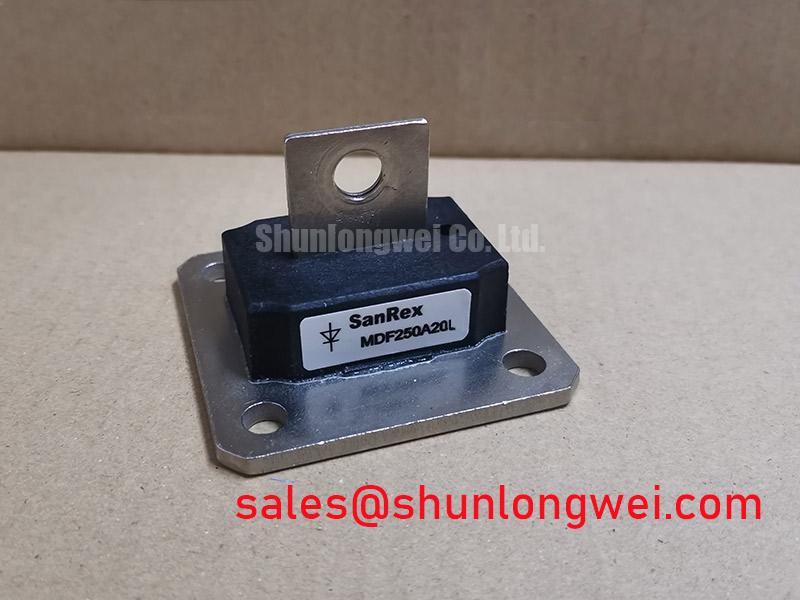
Sanrex MDF250A20L 200V 250A Fast Recovery Diode Module
Introduction and Core Highlights
The Sanrex MDF250A20L is a Fast Recovery Diode Module engineered for high-frequency power conversion systems requiring both high current capacity and operational efficiency. Its defining characteristic is an exceptionally fast reverse recovery time, which directly contributes to lower switching losses and improved thermal performance. This enables engineers to develop more compact and reliable power solutions. By minimizing the energy dissipated during the diode’s turn-off phase, the MDF250A20L allows for higher operating frequencies without excessive heat generation.
- Core Specifications: 200V | 250A | trr 0.2µs
- Key Engineering Advantages:
- Significantly reduces switching losses in high-frequency circuits.
- Enhances system reliability with high surge current immunity.
Download Official MDF250A-L Series Datasheet (PDF)

Technical Analysis for System Design
A primary performance metric for this module is its maximum reverse recovery time (trr) of 0.2 microseconds. This parameter is critical in applications like switch-mode power supplies and inverters. The reverse recovery time can be thought of like the closing speed of a check valve in a plumbing system. A slow-closing valve allows a brief, wasteful backflow of water before sealing; similarly, a diode with a long trr allows a brief flow of reverse current during turn-off. This transient current spike generates significant power loss in the form of heat and contributes to electromagnetic interference (EMI). The ultra-fast 0.2µs trr of the MDF250A20L minimizes this effect, enabling higher system efficiency and reducing the need for extensive thermal management hardware.
The module’s robustness is underscored by its non-repetitive surge forward current (IFSM) rating of 4950A (at 60Hz). This high surge immunity is vital for surviving fault conditions, inrush currents at startup, and unexpected load transients without component failure. For engineers designing systems like welding power supplies or motor drives, this provides a substantial reliability margin, preventing catastrophic failures that could otherwise occur from momentary overcurrent events. The isolated mounting base, with an isolation voltage (VISO) of 2500V, further enhances system safety and simplifies assembly by allowing the module to be mounted directly to a common heatsink with other components without needing additional insulating materials.


Optimized Application Scenarios
The specifications of the MDF250A20L make it a strong candidate for specific power applications:
- High-Frequency Welding Inverters: The fast 0.2µs trr is critical for minimizing switching losses and heat generation, allowing for more compact and efficient welder designs.
- Uninterruptible Power Supplies (UPS): Its high average forward current (250A) and exceptional surge capability (4950A) ensure reliable power delivery and system survivability during load changes or fault events.
- Industrial Motor Drives: The robust current handling and electrically isolated base simplify integration into variable frequency drives, offering dependable performance for motor control.
- Chopper and SMPS Circuits: Low reverse recovery losses directly improve the efficiency of DC-DC converters and switch-mode power supplies operating at high frequencies.
This module is best matched for high-power applications where minimizing switching losses is a primary design objective for achieving superior efficiency and thermal stability.
Key Specifications of the MDF250A20L
| Electrical and Thermal Characteristics (Tj=25°C unless otherwise specified) | |
|---|---|
| Repetitive Peak Reverse Voltage (VRRM) | 200V |
| Average Forward Current (IF(AV)) | 250A |
| Peak Forward Surge Current (IFSM) | 4500A (50Hz), 4950A (60Hz) |
| Peak Forward Voltage (VFM) | 1.0V (max) @ 250A |
| Peak Reverse Current (IRRM) | 30mA (max) @ VRRM |
| Reverse Recovery Time (trr) | 0.2µs (max) |
| Thermal Resistance (Rth(j-c)) | 0.12 °C/W (max, per diode) |
| Isolation Voltage (VISO) | 2500V (AC, 1 minute) |
Engineer’s FAQ
How does the 0.2µs reverse recovery time (trr) of the MDF250A20L impact system efficiency?
A fast trr of 0.2µs significantly reduces reverse recovery loss (Prec), a major component of switching losses in high-frequency applications. This loss occurs during the brief moment the diode transitions from forward conduction to reverse blocking. By minimizing both the duration and magnitude of the reverse recovery current, the MDF250A20L generates less heat, leading directly to higher overall system efficiency.
What are the recommended mounting torque specifications for this module?
According to the datasheet, the recommended torque for the main terminals (M8) is 8.0 ± 1.0 N·m. For mounting the module to a heatsink (using M6 screws), the recommended torque is 4.0 ± 0.5 N·m. Applying the correct torque is critical for ensuring reliable electrical and thermal connections.
How should the junction-to-case thermal resistance (Rth(j-c)) of 0.12°C/W be used for heatsink selection?
The Rth(j-c) value is a key parameter for thermal calculations. To select an appropriate heatsink, you must first calculate the power dissipation (PD) of the diode under your operating conditions. The maximum allowable junction temperature (Tj(max)) is 150°C. The case temperature (Tc) can be calculated as Tc = Tj(max) – (PD * Rth(j-c)). The required thermal resistance of your heatsink (Rth(c-a)) must then be low enough to keep Tc below this calculated value at your maximum ambient temperature (Ta).
Enabling Efficient Power System Design
The Sanrex MDF250A20L provides the core performance characteristics required for modern high-frequency power electronics. Its combination of fast switching, high current density, and robust surge handling empowers engineers to design systems that are not only powerful but also efficient and reliable under demanding industrial conditions. The module’s specifications directly address the challenges of managing switching losses and ensuring long-term operational stability. More information can be found in our articles on power semiconductors.