Fuji 6DI50C-050: A Technical Analysis of the 6-in-1 Darlington Module
6DI50C-050: Fuji 500V/50A 6-in-1 Darlington Transistor Module
Integrated Power Stage for Three-Phase Motor Control
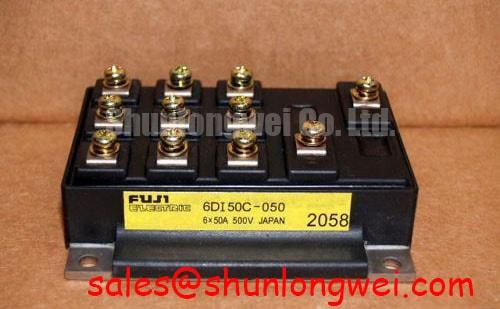
The Fuji Electric 6DI50C-050 is a power transistor module that integrates six NPN Darlington bipolar junction transistors (BJTs) with corresponding freewheeling diodes into a single, compact package. This high level of integration provides a robust foundation for three-phase inverter circuits. Its core specifications are tailored for effective power conversion in motor control systems and similar applications.
- Core Specifications: 500V | 50A | hFE min of 80
- Key Advantages: Simplifies power stage layout, reduces base drive requirements.
By consolidating the essential components of a three-phase bridge, the 6DI50C-050 streamlines the design process, which can be critical for developing compact and reliable power semiconductors systems.
Download the 6DI50C-050 Datasheet (PDF)
Technical Analysis for System Integration
The primary value of the 6DI50C-050 lies in its integrated six-pack configuration. Housing six Darlington transistors and six freewheeling diodes in one module significantly reduces the parasitic inductance that occurs with discrete component layouts. This integration simplifies the PCB design, minimizes assembly effort, and contributes to more predictable switching performance by controlling the physical layout of the power stage internally. The module’s structure is a practical solution for achieving a more compact and electrically consistent three-phase inverter design.
A notable parameter is the DC current gain (hFE), specified with a minimum value of 80 at a collector current of 50A. You can think of hFE as a lever’s mechanical advantage; a higher gain means a smaller input base current is needed to control a large collector current. This characteristic reduces the complexity and power requirements of the base drive circuitry. A less powerful driver stage can be used, which may lower system cost and simplify the control board design, a key factor in cost-sensitive industrial applications.
Optimized Application Scenarios
The architecture of the 6DI50C-050 is well-suited for specific power conversion tasks. Its strengths are most apparent in the following areas:
- AC Motor Controllers: The 6-in-1 topology directly forms a three-phase inverter bridge, making it a straightforward building block for variable frequency drives (VFDs).
- General-Purpose Inverters: The 50A current rating provides sufficient capacity for a range of inductive and resistive loads.
- DC Servo Amplifiers: The module’s high gain and integrated nature support the creation of compact and efficient servo drive power stages.
This module is an optimal match for inverter designs up to approximately 15 kW that prioritize a simplified, reliable, and consolidated power stage.
Key Specifications of the 6DI50C-050
| Absolute Maximum Ratings (Tc=25°C) | |
|---|---|
| Collector-Emitter Voltage (VCEO(sus)) | 500 V |
| Collector Current (IC) | 50 A |
| Collector Power Dissipation (PC) per Transistor | 230 W |
| Operating Junction Temperature (Tj) | +150 °C |
| Electrical Characteristics (Tc=25°C) | |
| Collector-Emitter Saturation Voltage (VCE(sat)) | 2.0 V (Max) at IC=50A |
| DC Current Gain (hFE) | 80 (Min) at IC=50A, VCE=2V |
| Forward Voltage Drop (VF) of FWD | 2.5 V (Max) at IF=50A |
| Turn-On Time (ton) | 3.0 µs (Typ) |
| Turn-Off Time (toff) | 4.0 µs (Typ) |
Engineer’s FAQ
1. What is the primary benefit of using a 6-in-1 module like the 6DI50C-050?
The main advantage is design simplification. By integrating six transistors and six freewheeling diodes, it reduces component count, simplifies the PCB layout, minimizes assembly time, and lowers the parasitic inductance associated with discrete solutions, leading to a more compact and reliable inverter.
2. What are the key considerations for the base drive circuit for this Darlington module?
The module’s high hFE of at least 80 at 50A means the required base current is relatively low (under 1A). However, the base driver must be able to sink the reverse current required to achieve the specified turn-off time. The datasheet provides curves for switching times versus base currents (IB1 and IB2), which are essential for optimizing the gate drive design for efficiency and speed.
3. How should heat be managed for the 6DI50C-050?
Effective thermal management is critical. The module has a maximum collector power dissipation of 230W per transistor. It must be mounted on a properly sized heatsink using a thin, uniform layer of thermal grease. The datasheet specifies a maximum case temperature of 100°C and provides a transient thermal impedance curve to help calculate junction temperature under pulsed loads.
4. Does this module include over-temperature protection?
Based on the official datasheet, the 6DI50C-050 does not include an integrated temperature sensor (like an NTC thermistor). Any thermal protection must be implemented externally, for example, by placing a temperature sensor on the heatsink near the module.
Enabling Compact Power Conversion
The 6DI50C-050 power transistor module gives engineers a clear path to developing straightforward and compact three-phase power stages. By integrating a full inverter bridge and offering high current gain, it allows for a reduction in external components and simplifies the associated control and drive circuits, supporting the efficient design of motor controls and power supplies.