Semikron SKM111AR: A Technical Guide to the 1200V 125A NPT IGBT Brake Chopper Module
Semikron SKM111AR | 1200V 125A NPT IGBT Brake Chopper Module
Introduction to the High-Reliability SKM111AR Chopper Module
The Semikron SKM111AR is an industrial-grade IGBT module utilizing Non-Punch Through (NPT) technology, specifically configured for brake chopper applications. It provides a robust solution for managing DC-link overvoltage in inverter systems. This module is characterized by its high-voltage endurance and thermal stability. It is rated for a 1200V collector-emitter voltage and a continuous collector current ($I_C$) of 125A at $T_c = 25^circ C$, or 90A under typical operating conditions ($T_c = 80^circ C$). Engineers seeking 1200V IGBTs for heavy-duty industrial braking will find the SKM111AR specifically engineered to handle high-peak power dissipation with minimal electrical fatigue.
Download Official SKM111AR Datasheet (PDF)
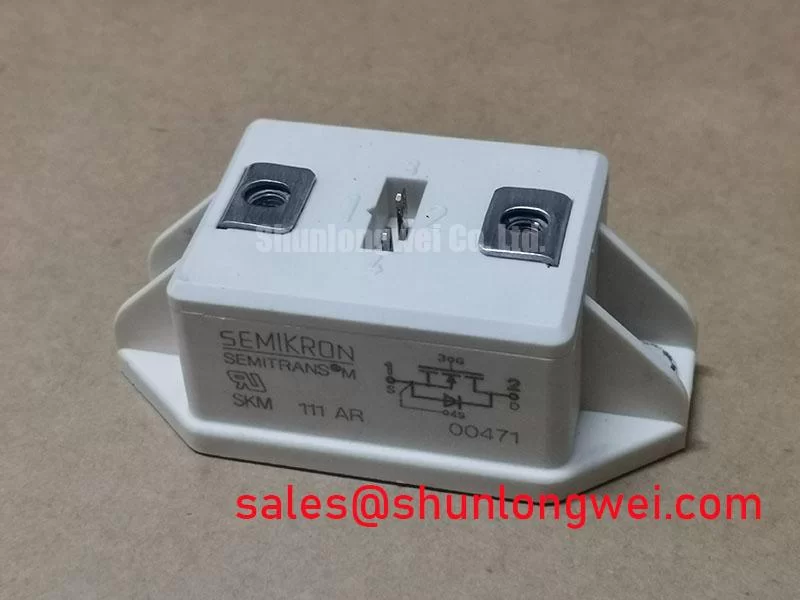
Technical Analysis: Thermal Efficiency and Switching Ruggedness
The core of the SKM111AR’s value lies in its NPT structure. Unlike Trench-gate alternatives that focus purely on low conduction losses, NPT technology prioritizes a robust short-circuit Safe Operating Area (SOA) and a positive temperature coefficient for $V_{CE(sat)}$. This positive coefficient is vital for system reliability; it ensures that if multiple modules are used, they naturally balance current sharing rather than succumbing to thermal runaway. With a typical $V_{CE(sat)}$ of 2.7V at 100A, the module balances conduction efficiency with the ability to withstand harsh industrial transients.
Thermal management is another critical area where this module excels. The SKM111AR features a low junction-to-case thermal resistance ($R_{th(j-c)}$) of just 0.22 K/W for the IGBT section. You can imagine thermal resistance as the width of a highway; a lower value means heat “traffic” can exit the silicon chip and move toward the heatsink much faster, keeping the internal temperatures within safe limits even during rapid braking cycles. Effective thermal design using the Zth curve provided in the datasheet is essential for maximizing the lifespan of the copper baseplate assembly.
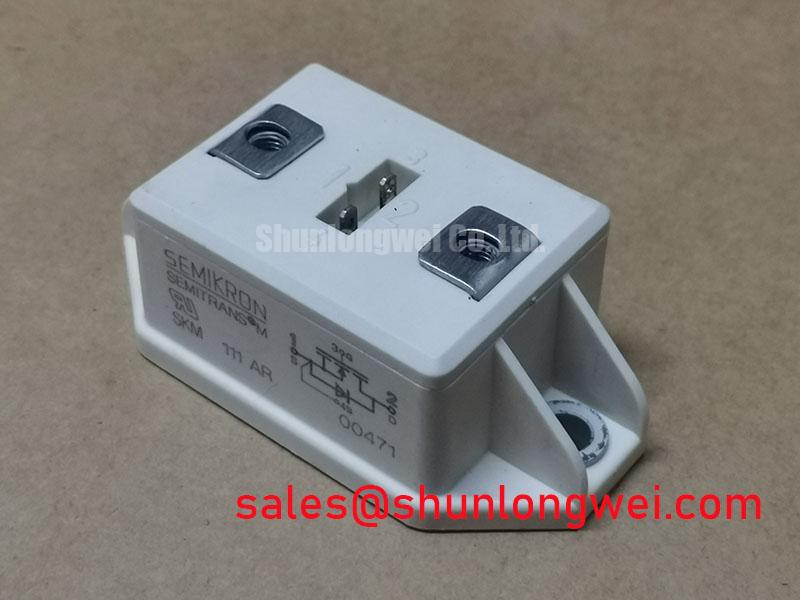
The integration of the CAL (Controlled Axial Lifetime) soft-recovery free-wheeling diode is a standout feature for power semiconductors in this class. In high-speed switching environments, the diode’s reverse recovery behavior dictates the level of electromagnetic interference (EMI) and voltage overshoots. The CAL diode in the SKM111AR is designed for a “soft” recovery, which significantly reduces the $dv/dt$ stress on surrounding components. Understanding how the free-wheeling diode dictates performance is key to optimizing the gate drive circuit for this module.
Optimized Application Scenarios
- Motor Braking Choppers: Ideal for Variable Frequency Drives (VFDs) where regenerative energy must be dissipated safely. The high pulse current capability ($I_{CRM} = 200A$) ensures stability during peak deceleration.
- High-Frequency Induction Heating: The low turn-off switching energy ($E_{off} = 12mJ$) allows the module to operate at higher frequencies without excessive heat buildup.
- Uninterruptible Power Supplies (UPS): Used in the battery charging or discharge stages where 1200V isolation and high current density are required.
- Solar Inverter DC-Stops: Acts as a reliable safety switch to handle overvoltage conditions in large-scale photovoltaic arrays.
Best Match: The SKM111AR is best suited for 400V-690V AC drive systems requiring integrated braking functionality with high short-circuit tolerance and moderate switching frequencies.
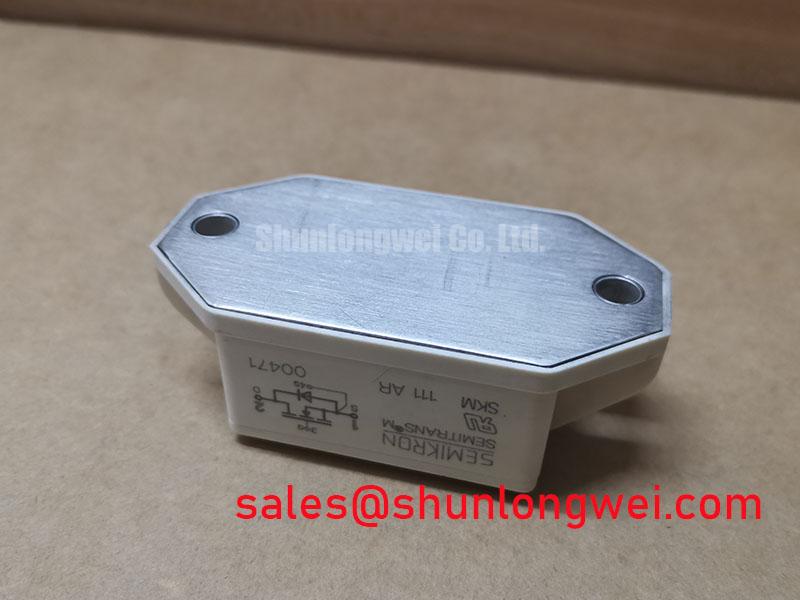
SKM111AR Key Specifications
| Category | Parameter | Value (Typical/Max) |
|---|---|---|
| Absolute Maximum Ratings | Collector-Emitter Voltage ($V_{CES}$) | 1200 V |
| Collector Current ($I_C$) @ $80^circ C$ | 90 A | |
| Pulsed Collector Current ($I_{CRM}$) | 200 A | |
| Electrical Characteristics | Saturation Voltage ($V_{CE(sat)}$) | 2.7 V (at 100A) |
| Turn-off Energy ($E_{off}$) | 12 mJ | |
| Gate Threshold Voltage ($V_{GE(th)}$) | 4.5 V to 6.5 V | |
| Thermal Characteristics | Thermal Resistance Junction-to-Case | 0.22 K/W |
| Operating Temperature Range | -40 to +150 °C |
Engineer FAQ
Q1: What is the primary advantage of using the SKM111AR in a chopper circuit compared to a standard half-bridge?
A: The SKM111AR is internally optimized for braking. It features a single IGBT and a powerful CAL free-wheeling diode designed to handle the inductive energy of motor windings during sudden stops, whereas a standard half-bridge may have asymmetrical diode ratings not suitable for continuous braking stress.
Q2: How should the gate resistor ($R_{Gon}/R_{Goff}$) be selected for this module?
A: According to the datasheet, the test condition uses an $R_{G}$ of 15Ω. While lower values may reduce switching losses, they increase EMI. For most industrial applications, a value between 10Ω and 22Ω is recommended to balance efficiency with $dv/dt$ control.
Q3: Can this module be mounted in any orientation?
A: Yes, the SEMITRANS 2 package is versatile, but mounting torque is critical. Ensure the M5 terminals are tightened to 2.5–5 Nm and the baseplate to 3–5 Nm to maintain proper thermal contact and prevent mechanical stress on the internal ceramic substrate.
The Semikron SKM111AR provides a technically sound foundation for power electronic designers who prioritize long-term durability in high-voltage braking and switching environments. By combining NPT stability with the advanced CAL diode, it empowers engineers to achieve precise energy management with reduced cooling overhead.