SKD160/16 Technical Review: A Robust 1600V Rectifier for Industrial Applications
SKD160/16 | 1600V 160A Three-Phase Bridge Rectifier Module
Introduction and Core Highlights
The Semikron SKD160/16 is a Power Bridge Rectifier module engineered for robust and reliable AC-to-DC conversion in high-power industrial systems. Its key design feature is the combination of a high 1600V reverse voltage capability with a substantial 160A DC output current, all housed in a thermally efficient, isolated package. This allows engineers to build highly reliable front-end rectifiers for equipment connected to volatile industrial mains, where voltage transients are a common concern.
- Core Specifications: 1600V VRRM | 161A Id (@ Tc=80°C) | 1800A IFSM
- Key Advantages: Provides a large safety margin against line voltage spikes. Efficiently transfers heat to simplify thermal management.
- Primary Function: Delivers reliable, uncontrolled three-phase rectification for the DC link in motor drives and high-power supplies.
Download the Official SKD160/16 Datasheet (PDF)
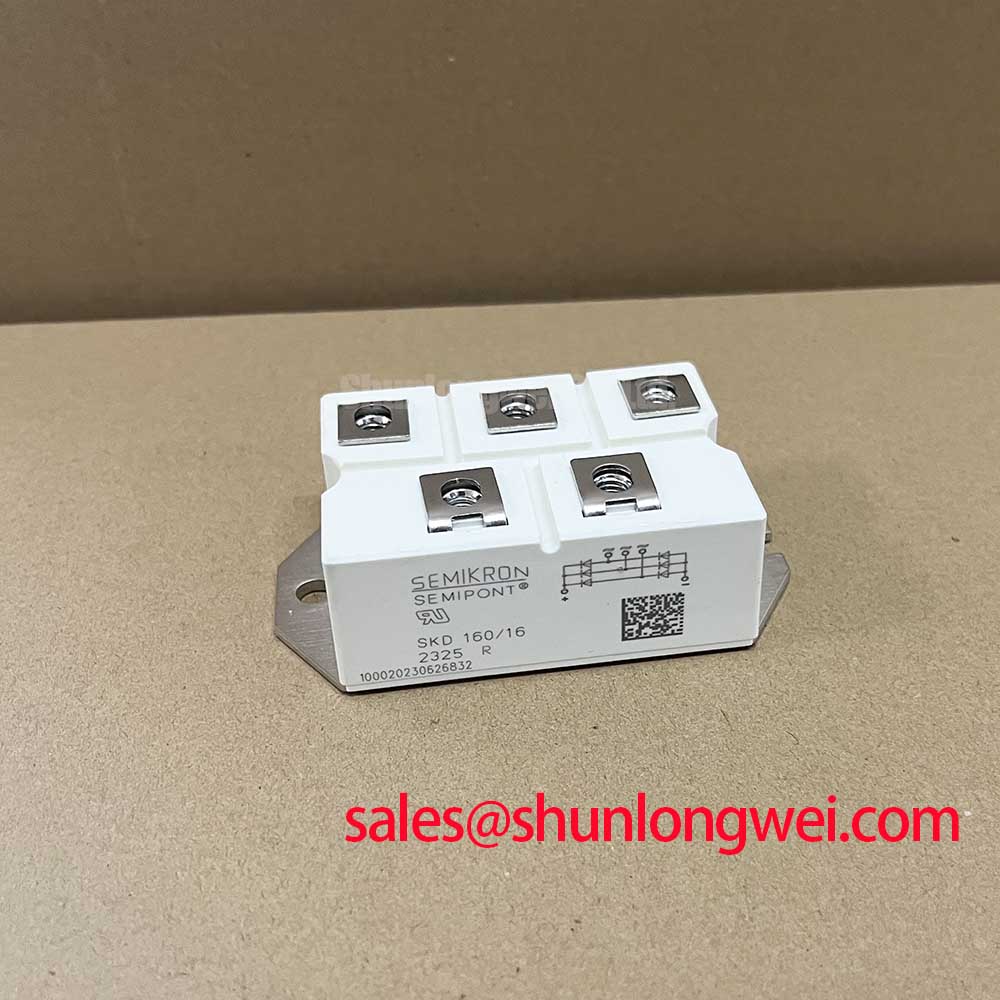

Technical Analysis for System Reliability
The SKD160/16 module’s high repetitive peak reverse voltage (VRRM) of 1600V is a critical parameter for industrial applications. It provides substantial headroom for power supplies operating on 400V or 480V three-phase systems, ensuring the diodes are not damaged by common line voltage surges and transients. This built-in robustness reduces the need for extensive upstream transient voltage suppression circuitry, streamlining the overall system design. The module also features a 3000V AC isolation voltage between the terminals and the baseplate for one minute, enhancing operational safety.
Effective thermal management is crucial for achieving the maximum output current of 161A. The module’s thermal resistance from junction to case (Rth(j-c)) is specified at 0.16 K/W per diode. Think of thermal resistance as the width of a pipe for heat; a lower value indicates a wider pipe, allowing heat to flow away from the active silicon more easily. This efficient heat transfer, enabled by the large isolated metal baseplate, prevents the diode junctions from exceeding their maximum operating temperature of 150°C and ensures long-term reliability.


Optimized Application Scenarios
The electrical and thermal characteristics of the SKD160/16 make it a suitable component for several demanding applications:
- Input Rectifiers for Variable Frequency Drives (VFDs): Its high current and voltage ratings are ideal for the front-end AC/DC conversion stage that powers the drive’s DC bus.
- Industrial Power Supplies: The module’s robust design and high surge current (IFSM) rating of 1800A withstands the inrush currents typical in large power supply units.
- DC Motor Field Supplies: Provides reliable and straightforward rectification for generating the field current required by DC motors.
- Battery Charger Rectifiers: Well-suited for high-power battery charging systems where a durable and efficient AC-to-DC front end is necessary.
This module is an optimal choice for industrial systems requiring a reliable front-end rectifier with high voltage tolerance and efficient thermal performance.
Key Specification Parameters for the SKD160/16
| Absolute Maximum Ratings (Tj = 25°C unless otherwise specified) | |
|---|---|
| Repetitive Peak Reverse Voltage (VRRM) | 1600 V |
| DC Output Current (Id) at Tcase = 80°C | 161 A |
| Surge Forward Current (IFSM), t = 10 ms, Tj = 25°C | 1800 A |
| I²t value, t = 10 ms, Tj = 25°C | 16000 A²s |
| Electrical & Thermal Characteristics | |
| Forward Voltage (VF) max, IF = 300 A, Tj = 25°C | 1.5 V |
| Threshold Voltage (VT0) | 0.85 V |
| Slope Resistance (rT) | 1.8 mΩ |
| Thermal Resistance, Junction to Case (Rth(j-c)) per diode | 0.16 K/W |
| Operating Junction Temperature (Tj op) | -40 to +150 °C |
| Isolation Test Voltage (Visol), AC, 1 min. | 3000 V |


Engineer’s FAQ
1. What are the heatsink mounting requirements for the SKD160/16?
To achieve optimal thermal performance, the module must be mounted to a heatsink with a flatness tolerance better than 50 µm. A thin, uniform layer of thermal compound (around 0.1-0.2 mm) should be applied. The two M6 mounting screws should be tightened to the torque specified in the datasheet to ensure low thermal contact resistance.
2. What is the significance of the 16000 A²s I²t rating?
The I²t rating, or fusing rating, quantifies the thermal energy the diodes can withstand during a short, non-repetitive surge event before failure. This value is critical for coordinating with input fuses or circuit breakers to ensure the protective device opens before the rectifier module is damaged during a fault condition.
3. Can this three-phase module be used in a single-phase application?
Yes, it is possible by using two of the three AC input terminals for the single-phase input and taking the output from the DC terminals. However, the maximum DC output current will be significantly lower than the three-phase rating. The datasheet provides specific output current curves for single-phase operation that should be consulted for proper derating.
4. What does the UL recognition (File E 63 532) signify?
The UL recognition indicates that the SKD160/16 has been tested and certified by Underwriters Laboratories to meet specific safety standards. This simplifies the process of obtaining safety certification for the end-product in which the module is used, particularly for equipment intended for the North American market.
System Design Enablement
The Semikron SKD160/16 offers a dependable foundation for high-power AC/DC conversion. Its combination of high blocking voltage for transient immunity, an industry-standard package for straightforward mounting, and a design optimized for efficient thermal management empowers engineers to develop durable and safe industrial power systems with simplified designs.