Mitsubishi PM75CS1E120: An Integrated Power Stage for Compact Motor Drives
Mitsubishi PM75CS1E120 CIB Intelligent Power Module
Integrated Power Stage for Compact Motor Drives
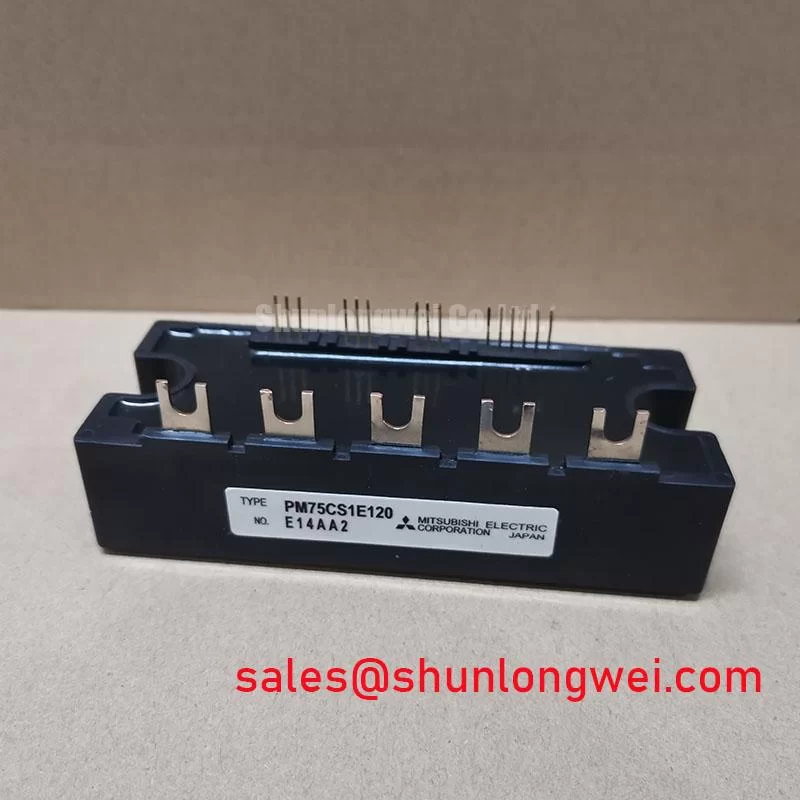
The Mitsubishi PM75CS1E120 is a CIB (Converter-Inverter-Brake) Intelligent Power Module (IPM) that consolidates a complete three-phase motor drive power stage into a single component. This module’s primary value is its ability to reduce system complexity and size by integrating a three-phase converter, a three-phase inverter, and a brake chopper circuit. It leverages Mitsubishi’s advanced chip technology to provide an efficient and reliable solution for power conversion systems.
- Core Specifications: 1200V | 75A | Three-Phase CIB Configuration
- Key Advantages: Reduces component count and simplifies PCB layout; integrated protection circuits enhance operational reliability.
By incorporating the essential power elements into one package, the PM75CS1E120 helps engineers accelerate the design cycle for compact and robust power control systems.
Download the PM75CS1E120 Datasheet (PDF)

Technical Analysis of the CIB Architecture
The defining feature of the PM75CS1E120 is its high level of integration. The CIB architecture combines a three-phase diode bridge for AC-to-DC conversion, a three-phase IGBT inverter stage for motor control, and an IGBT brake chopper with a freewheeling diode. This integration eliminates the need for multiple discrete power components, which directly translates to a smaller PCB footprint, simplified thermal management, and reduced assembly costs. For engineers, this means fewer interconnects, which mitigates issues related to parasitic inductance and improves overall system reliability.
The module incorporates protection functions including short circuit (SC), over temperature (OT), and under-voltage (UV) lock-out. These built-in safeguards protect the IGBTs from destructive fault conditions, reducing the need for extensive external monitoring and protection circuitry. The thermal resistance from junction to case (Rth(j-c)) for the inverter IGBT is specified at 0.21°C/W. This value can be thought of like the width of a pipe for heat removal; a lower number indicates a wider pipe, allowing heat to flow away from the silicon chip to the heatsink more effectively and preventing thermal overload.


Optimized Application Scenarios
The electrical and functional characteristics of the PM75CS1E120 are well-suited for several specific industrial applications:
- AC Motor Drives: The all-in-one CIB design provides the complete power stage for Variable Frequency Drives (VFDs), enabling the creation of smaller and more cost-effective motor controllers.
- Servo Drives: In precision motion control systems, the integrated brake chopper facilitates rapid and controlled deceleration, while the module’s protection features ensure high reliability.
- General Purpose Inverters: The 1200V blocking voltage and 75A current rating make it a robust choice for industrial inverters and small-scale renewable energy systems.
- Uninterruptible Power Supplies (UPS): The integrated converter and inverter sections are ideal for the power conversion stages within online UPS systems.
This module is an optimal match for applications requiring a compact, reliable, and highly integrated power solution up to approximately 22kW.
Key Specifications of the PM75CS1E120
| Absolute Maximum Ratings (Tj = 25°C unless otherwise noted) | ||
|---|---|---|
| Parameter | Part | Value |
| Collector-Emitter Voltage (VCES) | Inverter, Brake | 1200V |
| Collector Current (IC) | Inverter, Brake | 75A |
| Collector Power Dissipation (PC) | Inverter | 357W |
| Repetitive Peak Reverse Voltage (VRRM) | Converter | 1600V |
| Isolation Voltage (Visol) | AC 60Hz, 1 min | 2500Vrms |
| Electrical Characteristics (Tj = 25°C) | ||
| Collector-Emitter Saturation Voltage (VCE(sat)) | Inverter | 2.30V (typ.) |
| Forward Voltage (VF) | Converter Diode | 1.1V (typ.) |
| Short Circuit Trip Level (ISC) | Inverter | 120A (typ.) |
| Thermal Characteristics | ||
| Junction-to-Case Thermal Resistance (Rth(j-c)) | Inverter IGBT | 0.21 °C/W |
| Operating Junction Temperature (Tj) | – | -20 to +150°C |
Engineer’s FAQ
1. What are the recommended mounting torque specifications for the PM75CS1E120?
According to the datasheet, the recommended mounting torque for the M5 mounting screws is between 2.5 and 3.5 N·m. Applying the correct torque is critical for ensuring proper thermal contact between the module’s baseplate and the heatsink.
2. How do the integrated protections simplify system design?
The PM75CS1E120 includes built-in protection for short-circuits, over-temperature, and control supply under-voltage. This integration means designers do not need to implement these complex protection circuits externally. The module provides a fault signal (Fo) output, which can be directly interfaced with a system microcontroller to initiate a safe shutdown, simplifying the control logic and improving overall system robustness.
3. What type of thermal interface material should be used with this module?
The datasheet specifies thermal resistance based on a thermally conductive grease with a typical thickness of 100μm. It is essential to apply a thin, uniform layer of a high-quality thermal compound to minimize the thermal resistance between the module and the heatsink, thereby ensuring efficient heat dissipation.
4. What is the purpose of the integrated NTC thermistor?
The module contains an NTC (Negative Temperature Coefficient) thermistor. This component allows for real-time monitoring of the module’s baseplate temperature. This data can be used by the system controller for thermal management, such as adjusting fan speed or derating the output current to prevent overheating.
Enabling Efficient Power Conversion Designs
The PM75CS1E120 intelligent power module provides a functionally dense and reliable foundation for modern power conversion systems. Its CIB configuration and built-in protection circuits offer a clear path for engineers to reduce design complexity, shrink physical footprints, and improve the overall reliability of motor drives and inverters. This integration streamlines the development process from concept to production.