SKKD 162/16: A Technical Analysis of a High-Reliability Diode Module
SKKD 162/16: SEMIKRON Diode Module for Power Rectifiers
Introduction and Core Highlights
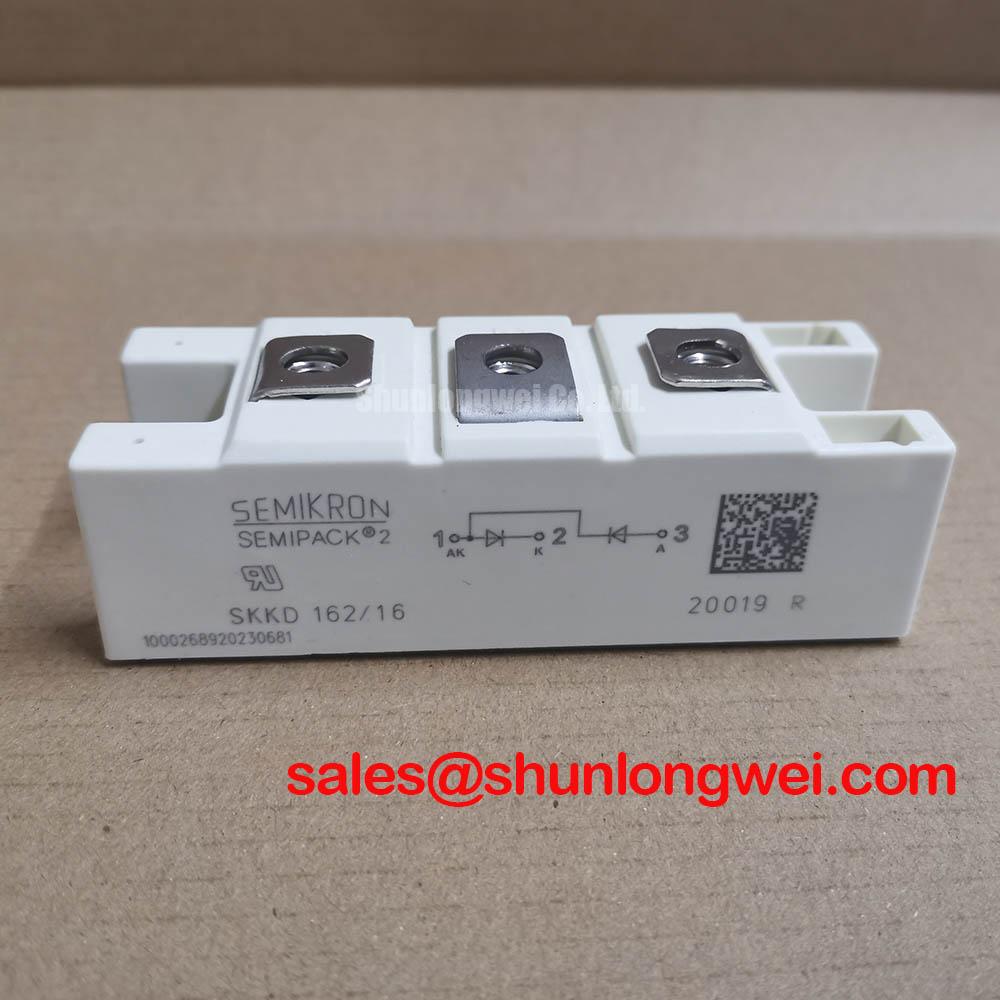
The SKKD 162/16 is a SEMIPACK® 2 Diode Module from Semikron that provides a robust solution for power rectification. Its unique value is derived from a construction that prioritizes thermal efficiency and long-term reliability. This is achieved through hard-soldered joints and an aluminum oxide ceramic insulated baseplate, ensuring dependable performance in demanding industrial power systems. This module is engineered for systems requiring high-current, non-controllable rectification with a focus on operational stability and simplified thermal management.
- Core Specifications: 1600V VRRM | 160A Id | 6000A IFSM
- Key Advantages: High thermal cycling capability, simplified mechanical mounting, and UL recognized reliability.
- Primary Function: Delivers efficient and stable rectification for high-power industrial applications.
Download the Official SKKD 162/16 Datasheet (PDF)


Technical Analysis for System Reliability
The engineering focus of the SKKD 162/16 is on creating a component that withstands the thermal and electrical stresses of industrial environments. A key parameter is its low thermal resistance from junction to case (Rth(j-c)), specified at 0.18 K/W per diode. Think of thermal resistance as the width of a pipe for heat; a lower value means a wider pipe, allowing heat to flow away from the active semiconductor junction more easily. This efficient heat dissipation, facilitated by the aluminum oxide ceramic baseplate, is critical for preventing overheating and ensuring the module operates reliably under continuous high-current loads.
Further contributing to its robustness are the hard-soldered joints within the module. Unlike standard solder, this technique creates a more durable bond between the silicon chip and the substrate, significantly improving the module’s resilience to the mechanical stress caused by repeated temperature fluctuations (thermal cycling). Combined with a high surge current rating (IFSM) of 6000 A, the SKKD 162/16 is well-equipped to survive the inrush currents and fault conditions common in motor drives and power supplies, supporting a longer operational lifespan.
Optimized Application Scenarios
The characteristics of the SKKD 162/16 make it a suitable component for specific high-power rectification tasks. Its design choices provide clear advantages in the following systems:
- Line Rectifiers for Motor Controllers: The module’s high voltage (1600V) and current (160A) ratings are ideal for the input stage of transistorized AC motor controllers.
- DC Power Supplies: Efficiently converts AC to DC for industrial equipment, with its robust thermal design ensuring stability during continuous operation.
- Field Supply for DC Motors: Provides a reliable DC source for motor field windings, where consistent and dependable power is essential.
- AC/AC Converters: Serves as a non-controllable rectifier, a fundamental building block in various power conversion topologies.
This module is an optimal component for systems requiring high-current rectification with proven long-term reliability and straightforward thermal design.
Key Specifications of the SKKD 162/16
| Absolute Maximum Ratings (Tc = 25°C unless otherwise specified) | ||
|---|---|---|
| VRSM, VRRM | Repetitive Peak Reverse Voltage | 1600 V |
| Id | Continuous DC Forward Current (Tc = 85°C) | 160 A |
| IFSM | Max. Surge Forward Current (10 ms, Tvj = 150°C) | 6000 A |
| i2t | I2t-value (10 ms, Tvj = 150°C) | 180000 A2s |
| Electrical & Thermal Characteristics | ||
| VF | Forward Voltage (IF = 500 A, Tvj = 25°C) | max. 1.5 V |
| V(TO) | Threshold Voltage (Tvj = 150°C) | 0.85 V |
| Rth(j-c) | Thermal Resistance, Junction to Case (per diode) | 0.18 K/W |
| Visol | Insulation Test Voltage (1 min.) | 3000 V |
| Tvj | Operating Junction Temperature | -40 to +150 °C |
Engineer’s FAQ for the SKKD 162/16
1. How is the SKKD 162/16 configured internally?
This module contains two diodes connected in a series configuration (common cathode/anode connection at terminal 1). This “dual series” setup makes it versatile for use in various single-phase and three-phase rectifier bridge designs.
2. What is the recommended mounting procedure for optimal thermal performance?
The datasheet specifies a mounting torque for the electrical terminals (M6) and the mechanical mounting screws (M6). It is critical to apply the correct torque to ensure a low-resistance thermal path between the module’s baseplate and the heatsink. A thin layer of thermal compound should be applied to the clean, flat baseplate before mounting.
3. What does “hard-soldered joints” mean for reliability?
Hard-soldered joints refer to a high-temperature soldering process that creates a more robust mechanical and thermal connection than conventional soldering. This enhances the module’s ability to withstand repeated temperature changes without fatiguing, directly contributing to a longer service life in applications like industrial inverters or motor drives.
4. Is this module suitable for high-frequency applications?
The SKKD 162/16 is a standard rectifier diode module intended for line-frequency applications (e.g., 50/60 Hz). Its recovery characteristics are not optimized for high-frequency switching. For applications requiring fast switching, a different class of diodes, such as fast recovery or SiC diodes, would be necessary.
Enabling Robust Power System Design
The SKKD 162/16 diode module provides engineers with a foundational component for reliable power rectification. Its design prioritizes thermal stability and mechanical robustness, addressing two of the most common failure points in power semiconductor systems. By integrating a component with a proven record of durability, designers can simplify thermal management and enhance the overall reliability of the end equipment.