GT080S0M-N11-1QP0 Technical Review: A Durable Display for Demanding Environments
## GT080S0M-N11-1QP0 8.0-inch SVGA Industrial TFT-LCD Module
The GT080S0M-N11-1QP0 is an 8.0-inch a-Si TFT-LCD module engineered for industrial applications requiring consistent performance across a wide range of operating conditions. This display’s primary value is its operational robustness, combining a wide temperature range with reliable optical characteristics suitable for demanding human-machine interface (HMI) and monitoring systems.
* **Core Specifications:** 8.0-inch | 800×600 SVGA | -20°C to +70°C Operating Temp.
* **Key Advantages:** Delivers stable operation in fluctuating industrial temperatures; provides clear imagery for typical operator viewing distances.
* **Application Focus:** A pragmatic choice for control panels and embedded systems where functional reliability is a primary design criterion.
Access Official Datasheet (Login May Be Required)
### Technical Analysis for System Integration
The GT080S0M-N11-1QP0 is built with a focus on durability and functional visual performance for industrial environments. Its specification set provides a dependable component for a variety of systems.
The module’s most significant engineering attribute is its operating temperature range of -20°C to 70°C, with a storage range of -30°C to 80°C. This tolerance allows the display to be integrated into systems deployed in environments without stringent climate control, such as factory floors, warehouses, or enclosed outdoor panels. This wide thermal threshold can simplify system design by potentially reducing the need for auxiliary heating or cooling components, contributing to lower bill-of-materials costs and reduced system complexity.

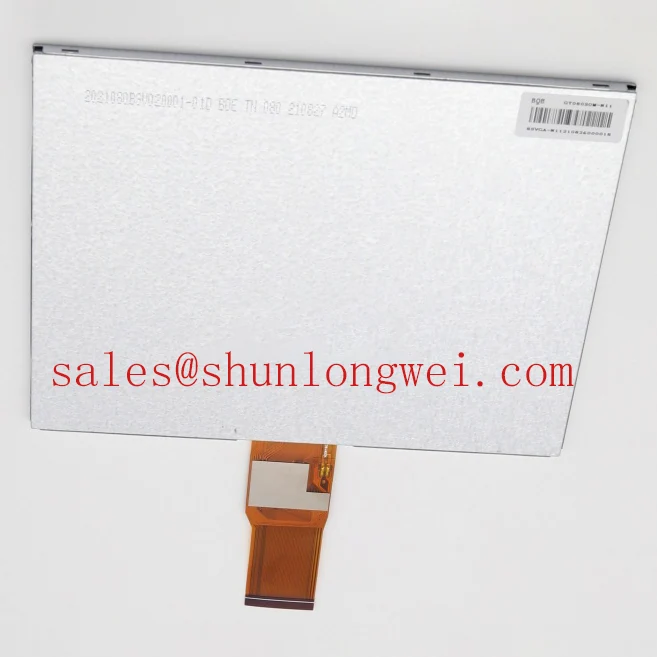
Optically, the display features a typical luminance of 250 cd/m² and a contrast ratio of 500:1. While not intended for direct sunlight readability, this brightness level is well-suited for indoor industrial settings. The 500:1 contrast ratio ensures clear differentiation between light and dark elements, which is critical for displaying GUIs, text, and schematics accurately. The use of a TN panel provides a typical viewing angle of 75/75/75/70 degrees (L/R/U/D), suitable for applications where the operator is positioned directly in front of the HMI. For more on display technologies, see our guide to LCD Core Technology.
### Optimized Application Scenarios
This display is specified for applications where durability and functional clarity are key requirements.
* **Industrial Control Panels:** The wide operating temperature and standard parallel RGB interface make it a reliable drop-in component for manufacturing equipment HMIs.
* **Embedded Systems:** Its 8.0-inch footprint and 800×600 resolution offer a good balance of screen real estate and information density for embedded diagnostic and control tools.
* **Building Automation:** Suitable for integration into climate control panels, security system monitors, and other fixed-position interfaces within commercial buildings.
* **Test and Measurement Equipment:** Provides a clear and stable display for data readouts and instrument control in laboratory or workshop settings.
Its specifications make it a strong match for indoor industrial systems where operational temperature fluctuates but direct sunlight exposure is not a factor.
### Key Specifications of the GT080S0M-N11-1QP0
| Feature | Specification | Notes |
| :— | :— | :— |
| **Panel Characteristics** | | |
| Manufacturer | BOE | |
| Model Name | GT080S0M-N11-1QP0 | |
| Screen Size | 8.0 inch | |
| Resolution | 800(RGB)×600 [SVGA] | 125 PPI |
| Panel Type | a-Si TFT-LCD, LCM | |
| **Optical Characteristics** | | |
| Brightness | 250 cd/m² (Typ.) | |
| Contrast Ratio | 500:1 (Typ.) | |
| Viewing Angle | 75/75/75/70 (Typ.)(CR≥10) | |
| Display Mode | TN, Normally White, Transmissive | |
| Display Colors | 262K / 16.7M (6-bit / 6-bit + Dithering) | 50% NTSC |
| **Environmental Ratings** | | |
| Operating Temperature | -20 ~ 70 °C | |
| Storage Temperature | -30 ~ 80 °C | |
| **Interface & Electrical** | | |
| Signal Interface | Parallel RGB (1 ch, 6/8-bit), 50 pins FPC | |
| Backlight | WLED | Driver not included |
| Supply Voltage | 3.3/10/21/-7.78V (Typ.)(VDD/AVDD/VGH/VGL) | |
### Engineer FAQ
**1. Is the GT080S0M-N11-1QP0 suitable for outdoor, direct sunlight applications?**
No. With a typical brightness of 250 cd/m², this display is designed for indoor industrial environments. For outdoor use, a display with a brightness of 800 cd/m² or higher is typically recommended to ensure readability in high ambient light.
**2. What are the key considerations for managing the backlight?**
The GT080S0M-N11-1QP0 is supplied with a WLED backlight system but without a dedicated driver. System designers must implement an external constant current LED driver circuit to power the backlight. Careful thermal management is also crucial to ensure the display operates within its specified temperature range to maximize backlight lifespan.
**3. How does the Parallel RGB interface impact system design?**
The 50-pin Parallel RGB interface is a standard for embedded displays but requires attention to signal routing. Designers should keep trace lengths from the host processor to the display’s FPC connector as short and direct as possible to maintain signal integrity, especially for the clock and data lines.
**4. What does the “TN, Normally White” display mode mean for an industrial application?**
“TN” (Twisted Nematic) is a mature liquid crystal technology known for fast response times. “Normally White” means that if a pixel fails, it will default to a white or bright state. This is a consideration for systems where failure modes are critical; in some applications, a “Normally Black” screen (like IPS) is preferred, as a failed pixel becomes dark and less noticeable.
This BOE 8.0-inch module offers a practical solution for industrial designers who need a durable and reliable display for systems operating within its specified environmental and optical parameters. Its construction is focused on providing functional clarity and thermal resilience for long-term deployment in factory automation and embedded control systems.