SKKT57/16E Technical Analysis: A High-Reliability Thyristor Module for AC Control
“`html
SKKT57/16E | SEMIKRON 1600V Thyristor/Diode Module
Efficient AC Control with an Isolated, High-Reliability Design
The SEMIKRON SKKT57/16E is a Thyristor/Diode module engineered for robust AC power control. It leverages glass-passivated thyristor chips and an industry-proven isolated baseplate to ensure high reliability and simplified thermal management in demanding applications. Its SEMIPACK® 1 package features an integrated aluminum oxide ceramic base, which removes the need for separate insulating materials between the module and the heatsink, streamlining mechanical assembly and improving thermal transfer.
- Core Specifications: 1600V VDRM/VRRM | 55A ITAV (Tc = 85°C) | 1300A ITSM
- Key Engineering Advantages: Simplified heatsink mounting due to the isolated baseplate, and high long-term stability from glass-passivated silicon.
Download the SKKT57/16E Datasheet (PDF)
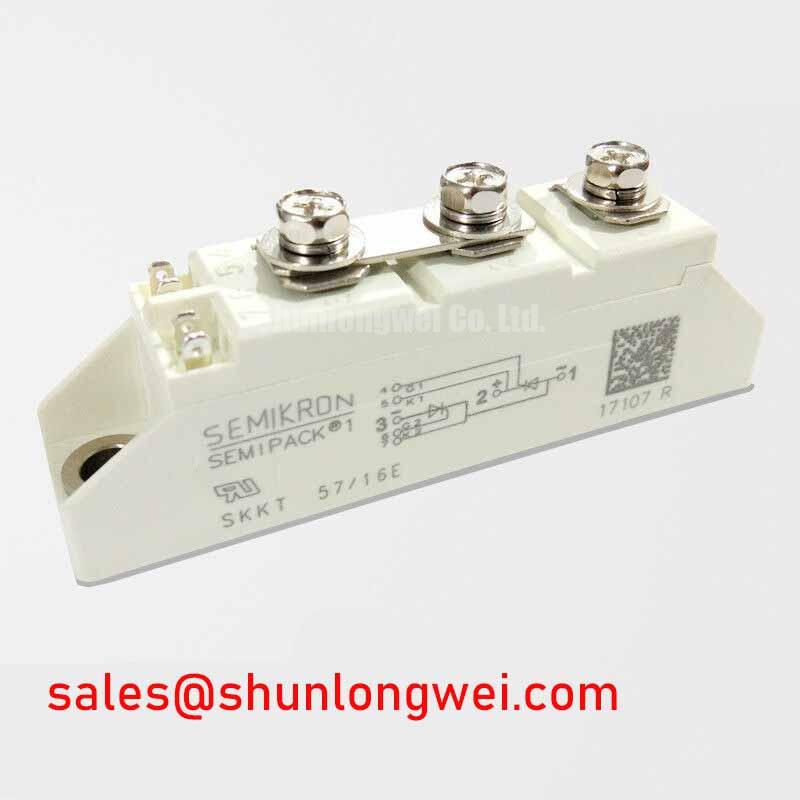

Technical Analysis of the SKKT57/16E
Simplified Thermal Design with an Isolated Baseplate
A key feature of the SKKT57/16E is its construction within a SEMIPACK® 1 housing, which incorporates a robust aluminum oxide (Al2O3) ceramic insulator between the power semiconductors and the metal baseplate. This design provides a high isolation voltage (VISOL) of 3000V. For design engineers, this integrated isolation simplifies the entire assembly process. It eliminates the need to source and install separate, fragile insulating foils and reduces the number of components in the final bill of materials. This approach directly contributes to more consistent and reliable thermal management across production units.
Robustness Through Glass Passivation
The datasheet specifies the use of glass-passivated thyristors. This manufacturing process is critical for long-term device stability. A layer of glass hermetically seals the sensitive p-n junctions of the thyristor from ambient humidity and contaminants. This protection ensures stable blocking voltage characteristics (VDRM and VRRM) throughout the component’s operational life, particularly in harsh industrial environments with fluctuating temperatures. For systems requiring consistent performance over many years, this feature is a fundamental contributor to overall reliability and reduced maintenance.

Optimized Application Scenarios
The SKKT57/16E is well-suited for a range of AC control applications where reliability and efficient thermal performance are paramount.
- AC Motor Soft-Starters: The high surge current capability (ITSM = 1300A) allows the module to safely manage the high inrush currents typical of motor startup.
- Industrial Heater and Temperature Control: Its precise phase-angle firing control is ideal for regulating power to resistive heating elements in furnaces and process control systems.
- Controlled Rectifiers: The common cathode configuration is a standard building block for single-phase and three-phase controlled bridge rectifiers used in DC power supplies and battery chargers.
- High-Power Light Dimmers: Provides reliable AC voltage control for large-scale architectural and theatrical lighting installations.
This module is an optimal match for AC control systems requiring high voltage blocking, robust surge handling, and simplified thermal assembly.
Key Technical Specifications for SKKT57/16E
| Key Parameters | |
|---|---|
| Repetitive Peak Reverse Voltage (VRRM) | 1600 V |
| Average On-State Current (ITAV) | 55 A (Case Temperature Tc = 85 °C) |
| RMS On-State Current (ITRMS) | 90 A |
| Surge Current (ITSM) | 1300 A (10 ms, Tvj = 25 °C) |
| I²t Value for Fusing | 8500 A²s (10 ms, Tvj = 25 °C) |
| Threshold Voltage (VT(TO)) | 0.85 V |
| On-State Slope Resistance (rT) | 5 mΩ |
| Gate Trigger Current (IGT) | max. 150 mA (Tvj = 25 °C) |
| Thermal Resistance, Junction to Case (Rth(j-c)) | 0.24 K/W (per thyristor) |
| Isolation Test Voltage (VISOL) | 3000 V (RMS, 1 min.) |
| Operating Junction Temperature (Tvj op) | -40 to +130 °C |
Engineer’s FAQ
What are the mounting recommendations for the SKKT57/16E?
The datasheet specifies a mounting torque of 5 Nm (M6 screws) for securing the module to a heatsink. The electrical terminals require a torque of 2.5 Nm (M5 screws). It is critical to apply a thin, uniform layer of thermal grease to the baseplate before mounting to ensure minimal thermal resistance and effective heat dissipation.
What is the purpose of the common cathode configuration?
The SKKT57/16E contains two thyristors whose cathodes are connected to a single terminal. This arrangement is ideal for building AC controllers (phase control) or controlled rectifiers. In an AC controller, one thyristor controls the positive half-cycle of the AC waveform, and the other controls the negative half-cycle, allowing for full-wave power regulation.
How is the I²t rating used in system design?
The I²t rating of 8500 A²s is essential for protective fuse selection. To properly protect the thyristor module, you must select a fuse with an I²t let-through value that is lower than the module’s rating under fault conditions. This ensures that the fuse will open and interrupt the current before the thyristor itself is permanently damaged.
What does the glass passivation of the thyristor chips achieve?
Glass passivation is a crucial process that protects the high-voltage junctions of the thyristor from environmental factors and electrical stresses. This enhances the long-term stability of the device’s blocking voltage capability, a key factor for reliability in industrial power semiconductors that operate for extended periods.
Enabling Reliable Power System Design
The SKKT57/16E thyristor module provides a dependable component for power control systems. Its architecture, combining a rugged, electrically isolated package with proven glass-passivated silicon, empowers engineers to develop durable and thermally efficient AC controllers and rectifiers for a wide array of industrial applications.
“`