DD260N18KHPSA1: A Deep Dive into a High-Reliability 1800V Diode Module
DD260N18KHPSA1 | 1800V 260A High Reliability Diode Module
Introduction and Core Highlights
The Infineon DD260N18KHPSA1 is a high-power Diode Module engineered for robust performance in demanding industrial applications. Its core value stems from combining a high 1800V blocking voltage with pressure contact technology, delivering exceptional operational reliability and an extended service life by mitigating common solder fatigue failure modes. This design facilitates efficient thermal management, crucial for maintaining system stability under heavy loads.
- Core Specifications: 1800V | 260A | 4300A IFSM
- Key Advantages: Superior power cycling capability, simplified thermal design due to low thermal resistance.
For detailed specifications, Download the Official DD260N18KHPSA1 Datasheet (PDF).
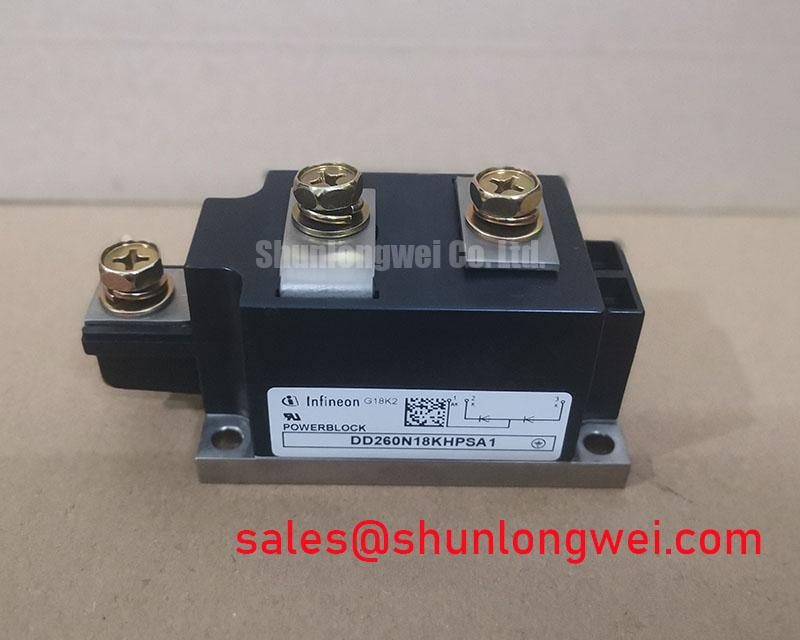

Technical Analysis of Core Features
Pressure Contact Technology for Enhanced Reliability
Unlike conventional soldered modules, the DD260N18KHPSA1 utilizes pressure contact technology. This construction method eliminates large-area solder joints, which are often susceptible to fatigue and cracking after repeated temperature fluctuations. By pressing the silicon die between molybdenum discs and copper contacts, the module achieves a more resilient thermal interface. This significantly enhances its power cycling capability, making it a durable component for applications with frequent load changes, such as DC motor drives. This robust design is a key factor in the module’s long-term operational stability.
Superior Thermal Performance
Effective heat dissipation is critical for high-power semiconductors. This module specifies a low maximum thermal resistance from junction to case (RthJC) of 0.100 K/W per diode. Thermal resistance can be thought of like the width of a pipe for heat; a lower value signifies a wider pipe, allowing heat to escape the semiconductor die more easily. This efficiency in heat transfer, combined with an electrically isolated baseplate providing 3000V of isolation, simplifies heatsink selection and overall thermal management. It ensures the device operates reliably within its specified maximum junction temperature of 150°C, even when handling substantial forward currents.
Optimized Application Scenarios
The DD260N18KHPSA1 is well-suited for a range of high-power rectification tasks where reliability is paramount.
- High Power Rectifiers: Its high surge current rating (IFSM) of 4300A provides a substantial safety margin against line faults and inrush currents.
- DC Motor Drives: The module’s excellent power cycling durability, enabled by its pressure contact design, withstands the demanding start-stop and variable load cycles common in motor control.
- Industrial Welding and Heating: The combination of high current handling (260A average forward current) and efficient thermal dissipation ensures stable operation under continuous high-load conditions.
- Uninterruptible Power Supplies (UPS): High blocking voltage (1800V) and robust construction contribute to the reliability required for critical backup power systems.
With its high voltage and current ratings, this module is an optimal match for industrial rectifier circuits requiring high reliability and simplified thermal design.

Key Specification Parameters for DD260N18KHPSA1
| Absolute Maximum Ratings (TC = 25°C unless otherwise specified) | |
|---|---|
| Repetitive Peak Reverse Voltage (VRRM) | 1800 V |
| Average Forward Current (IFAVM) | 260 A (TC = 85°C) |
| Surge Forward Current (IFSM) | 4300 A (t=10ms, Tvj=25°C) |
| I²t-value | 92.5 x 10³ A²s (t=10ms, Tvj=25°C) |
| Electrical & Thermal Characteristics | |
| Forward Voltage (VF) | max. 1.45 V (at IF = 800A, Tvj = 150°C) |
| Threshold Voltage (VT(TO)) | 0.93 V (Tvj = 150°C) |
| Slope Resistance (rT) | 0.65 mΩ (Tvj = 150°C) |
| Thermal Resistance, Junction to Case (RthJC) | max. 0.100 K/W per diode |
| Operating Junction Temperature (Tvj op) | -40°C to 150°C |
| Insulation Test Voltage (VISOL) | 3000 V (RMS, t=1min) |
Engineer’s Frequently Asked Questions (FAQ)
1. What is the recommended mounting torque for the DD260N18KHPSA1?
According to the datasheet, the recommended mounting torque for the M6 mounting screws is between 3 and 5 Nm. Applying the correct torque is critical to ensure a low thermal resistance path to the heatsink. Insufficient torque can lead to poor thermal contact and overheating, while excessive torque can damage the module’s baseplate.
2. How does the pressure contact design benefit system reliability?
Pressure contact technology eliminates large soldered connections between the semiconductor chip and the baseplate. Solder layers are prone to fatigue and cracking over many thermal cycles. By using a mechanical pressure system, the DD260N18KHPSA1 offers significantly higher resistance to this type of wear-out, leading to a longer operational lifetime, particularly in applications like power semiconductors used in motor drives or renewable energy converters.
3. What is the main consideration when designing a heatsink for this module?
The primary consideration is ensuring the junction temperature (Tvj) remains below its 150°C maximum limit under worst-case operating conditions. To do this, calculate the total thermal resistance required (Rth(j-a)). This involves using the module’s specified RthJC (0.1 K/W), estimating the thermal resistance of the thermal interface material (RthCS), and then determining the required thermal resistance of the heatsink (RthSA). A detailed analysis can be performed using the thermal impedance curves provided in the datasheet for transient conditions.
4. Can two of these modules be used to create a single-phase bridge rectifier?
Yes. Since each DD260N18KHPSA1 module contains two series-connected diodes, two modules can be configured to form a full single-phase bridge rectifier. This configuration would be capable of handling high voltage and current levels suitable for demanding industrial power supplies and chargers.
Enabling Robust High-Power Designs
The DD260N18KHPSA1 Diode Module provides engineers with a high-performance component for building reliable and thermally stable high-power converters. Its combination of a high 1800V blocking voltage, substantial current ratings, and the inherent durability of pressure contact technology directly supports the development of systems with extended operational lifespans and predictable performance.