SKB100/16 Technical Review: A Robust Rectifier for Industrial Power Systems
SKB100/16 | 1600V 100A Three-Phase Power Bridge Rectifier
Introduction and Core Highlights
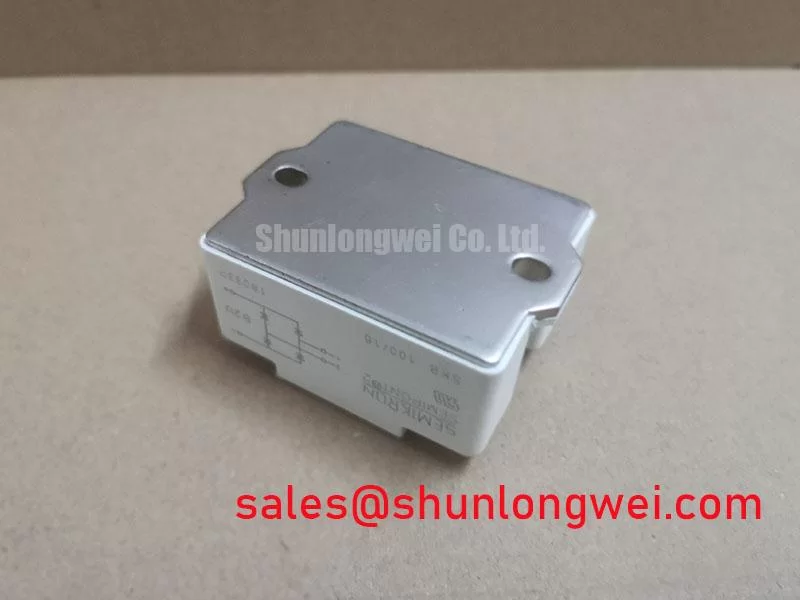
The Semikron SKB100/16 is a three-phase power bridge rectifier engineered for high-reliability AC-to-DC power conversion in demanding industrial applications. Its unique value is rooted in a robust design that combines high surge current immunity with excellent thermal performance, facilitated by an isolated metal baseplate. This ensures dependable operation under heavy electrical and thermal loads, simplifying the design of robust power systems.
- Core Specifications: 1600V | 100A | IFSM 1300A
- Key Advantages: High tolerance to inrush currents, simplified thermal management with an isolated baseplate.
For engineers designing the input stage of a motor drive or a high-power supply, the SKB100/16 provides a durable and thermally efficient rectification solution.
Download Official Datasheet (PDF)


Technical Analysis for System Reliability
The engineering value of the SKB100/16 is evident in its electrical and thermal characteristics, which are specified for long-term industrial reliability. The module’s high surge forward current (IFSM) rating of 1300A for a 10 ms duration is a critical parameter. This capacity ensures the rectifier can withstand the significant inrush currents often encountered when powering on systems with large capacitive loads, such as the DC link in a Variable Frequency Drive (VFD). This robustness prevents component failure during startup sequences, a common point of stress in power conversion systems.
Effective thermal management is directly addressed by the module’s construction. The SKB100/16 features a low thermal resistance from junction to case (Rth(j-c)) of 0.2 K/W per diode. This specification can be thought of like the width of a pipe for heat flow; a lower value indicates a wider pipe, allowing heat to be evacuated from the semiconductor junction more efficiently. This, combined with its isolated metal baseplate, allows for direct and simplified mounting to a heatsink, optimizing heat dissipation and maintaining a safe operating temperature, which is essential for achieving a long operational lifespan.
Optimized Application Scenarios
The SKB100/16 is specified for applications where reliable, high-current rectification is a primary design requirement. Its parameters make it a strong candidate for:
- Input Rectifiers for VFDs: Its 1600V blocking voltage provides a significant safety margin for three-phase 400V/480V AC systems, and the 100A output current is suitable for drives controlling motors up to approximately 45 kW.
- Industrial Power Supplies: The module’s high surge capability and UL recognition (file no. E 63 532) make it ideal for building reliable, certified power systems for factory automation and process control.
- DC Motor Field Supplies: Provides the stable DC voltage required for the field windings of large DC motors, where reliability is paramount.
- Battery Charger Rectifiers: Efficiently converts AC line voltage to the DC required for high-capacity industrial battery charging systems.
This module is best matched for industrial power systems requiring a robust, easily mountable three-phase rectifier with high tolerance to line-side electrical stress.
Key Specification Parameters
| Absolute Maximum Ratings (Tc = 25 °C unless otherwise noted) | |
|---|---|
| Repetitive Peak Reverse Voltage (VRRM) | 1600 V |
| DC Output Current (Id) | 100 A (at Tc = 80 °C) |
| Surge Forward Current (IFSM) | 1300 A (10 ms, 50 Hz, sin) |
| I²t Value (I²t) | 8450 A²s (10 ms, 50 Hz, sin) |
| Electrical & Thermal Characteristics | |
| Forward Voltage (VF) | max. 1.7 V (at IF = 100 A, Tj = 25 °C) |
| Threshold Voltage (V(TO)) | 0.85 V (Tj = 150 °C) |
| Forward Slope Resistance (rT) | 6 mΩ (Tj = 150 °C) |
| Thermal Resistance, Junction to Case (Rth(j-c)) | max. 0.2 K/W (per diode) |
| Operating Junction Temperature (Tj) | -40 to +150 °C |
| Isolation Test Voltage (Visol) | 3000 V (AC, r.m.s., 1 min) |
Engineer’s FAQ
1. How should I calculate the heatsink required for the SKB100/16?
To properly size a heatsink, first calculate the total power dissipation (Ptot) of the module under your load conditions. You can approximate this using the forward voltage characteristics (V(TO) and rT) from the datasheet curves. Then, use the thermal resistance from junction to case (Rth(j-c)) to find the case temperature. The required heatsink thermal resistance (Rth(c-a)) is determined by the maximum allowable case temperature and the ambient temperature. A detailed guide can be found in resources about IGBT thermal design.
2. What is the correct mounting torque for the SKB100/16 terminals and baseplate?
According to the datasheet, the mounting torque for the heat sink (M6 screw) is 5 Nm ± 15%. The torque for the electrical terminals (M5 screw) is 3 Nm ± 15%. Applying the correct torque is critical for ensuring low thermal and electrical resistance without causing mechanical stress to the module.
3. What does the 3000V isolation voltage signify for my design?
The 3000V AC isolation voltage means the electrical terminals are safely isolated from the metal baseplate. This allows you to mount the module directly onto a grounded chassis or heatsink without needing additional insulating layers, which simplifies mechanical assembly and improves heat transfer efficiency.
4. Can this rectifier be used for single-phase applications?
While the SKB100/16 is a three-phase bridge, it can be adapted for single-phase use by connecting the AC input to two of the three phase terminals and leaving the third unconnected. However, this configuration will derate the maximum output current capability. For dedicated single-phase designs, a single-phase bridge rectifier might be a more space- and cost-effective choice.
Design Enablement
The Semikron SKB100/16 is a foundational component for building reliable power conversion systems. Its specified resilience against electrical surges and its thermally efficient package empower engineers to design robust, long-lasting industrial equipment. The combination of high performance and simplified integration provides a direct path to a more durable and dependable final product.