MCD501-16IO2: A Technical Review for Robust AC Power Control
## MCD501-16IO2: 1600V Thyristor/Diode Module for AC Control
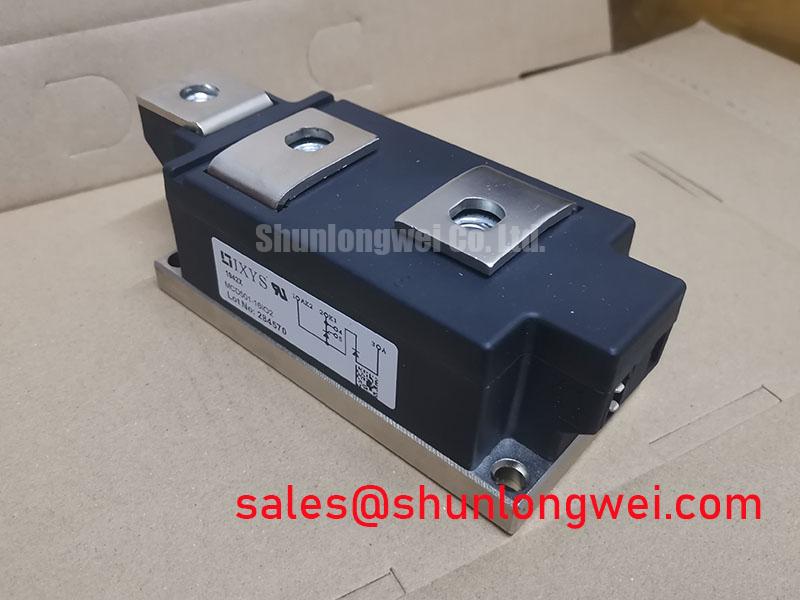
The MCD501-16IO2 is a Thyristor/Diode Module from IXYS engineered for high-reliability AC power control applications. It leverages a robust industrial package with an isolated baseplate, delivering high voltage blocking capabilities and efficient thermal performance. This combination allows for simplified system design and enhanced operational longevity in demanding power systems.
* **Core Specifications**: 1600V | 503A (IT(AV)M) | 3000V Isolation
* **Key Advantages**: High surge current survivability, excellent thermal cycling capability, and a standard footprint for straightforward integration.
* **Design Consideration**: The module’s low thermal resistance simplifies heatsink selection and thermal management, crucial for maintaining reliability under heavy loads.
Download Official Datasheet (PDF)

### Technical Analysis for System Reliability
The MCD501-16IO2 is constructed with features that directly contribute to its operational robustness. The use of planar passivated chips ensures long-term stability of the 1600V blocking voltage, providing a significant safety margin in applications connected to 400V and 690V AC lines. This stability is critical for preventing device failure due to transient overvoltage events common in industrial grids.
A key element of its design is the Direct Copper Bonded (DCB) aluminum oxide substrate. This technology provides excellent electrical isolation while ensuring efficient heat transfer from the semiconductor chips to the baseplate. The junction-to-case thermal resistance is specified at a low 0.062 K/W. Think of thermal resistance as the width of a pipe; a lower value is like a wider pipe, allowing heat to flow away from the junction more easily. This efficiency minimizes junction temperature rise, a primary factor in extending the power cycling lifetime of the module.
Furthermore, the module’s substantial surge current capability, with a non-repetitive peak rating (ITSM) of 14.5 kA, allows it to withstand significant inrush currents. This is particularly valuable in motor control applications, where starting currents can be many times the nominal operating current. This inherent ruggedness reduces the need for oversized components, enabling more compact and cost-effective system designs.
### Optimized Application Scenarios
The electrical and thermal characteristics of the MCD501-16IO2 make it a strong fit for several high-power AC control applications:
* **AC Motor Soft Starters**: The high surge current rating (14.5 kA) effectively manages the large inrush currents typical of motor startup, protecting both the motor and the power electronics.
* **Industrial Heating and Welding**: Its ability to handle high average currents (503A at TC=85°C) and its robust thermal cycling performance ensure reliability in applications with continuous or pulsed high-power delivery.
* **Controlled Bridge Rectifiers**: The thyristor-diode configuration is ideal for phase-angle control in rectifiers, providing adjustable DC output for battery chargers and DC power supplies.
* **Lighting Control**: In large-scale systems like stadium or theatre lighting, the module provides efficient and reliable power regulation for high-intensity lamps.
With its high isolation voltage and excellent surge handling, this module is an optimal choice for industrial applications requiring robust and reliable AC power switching.
### Key Specification Parameters
| Parameter | Symbol | Value | Unit |
|---|---|---|---|
| Absolute Maximum Ratings (Tvj = 125°C unless otherwise specified) | |||
| Repetitive Peak Reverse Voltage | VRRM / VDRM | 1600 | V |
| Maximum Average On-state Current (TC=85°C) | IT(AV)M | 503 | A |
| Nominal RMS On-state Current (TC=55°C) | IT(RMS)M | 1195 | A |
| Peak Non-repetitive Surge Current (10 ms, 60% VRRM) | ITSM | 14.5 | kA |
| Electrical & Thermal Characteristics | |||
| Gate Trigger Current (Tvj=25°C) | IGT | 250 (Max) | mA |
| Thermal Resistance, Junction to Case | RthJC | 0.062 | K/W |
| Isolation Voltage (AC RMS, 50 Hz, 1 min test) | VISOL | 3000 | V |
| Operating Junction Temperature Range | Tvj op | -40 to +125 | °C |
### Engineer FAQ
**1. What are the primary considerations for mounting the MCD501-16IO2 to a heatsink?**
For effective thermal management, ensure the heatsink surface is flat to within 0.05mm and clean. A thin, uniform layer of thermal grease (typically 50-100 µm) should be applied to the module’s baseplate to minimize contact thermal resistance. The datasheet specifies using lubricated M6 screws for the mounting holes and M10 screws for the power terminals, tightened to the recommended torque values to ensure proper thermal and electrical contact without inducing mechanical stress.
**2. How is total power dissipation calculated for this module in a rectifier application?**
Total power loss is the sum of conduction loss and switching loss. For phase control applications, conduction loss can be approximated using the on-state voltage drop parameters (VT0 and rT) provided in the datasheet charts. The formula is Pcond = VT0 * IT(AV) + rT * IT(RMS)2. Switching losses are generally less significant at line frequencies (50/60 Hz) but should be considered in higher-frequency designs.
**3. What does the configuration of one thyristor and one diode in the MCD501-16IO2 enable?**
This “thyristor-diode” or SCR-diode pair is a common building block for AC controllers and half-controlled rectifiers. It allows for control over one half-cycle of the AC waveform (via the thyristor’s gate) while the other half-cycle conducts freely through the diode. This configuration is often used in applications like single-phase AC voltage regulators and the controlled leg of a three-phase half-controlled bridge rectifier.
**4. What is the significance of the 3000V isolation voltage?**
The 3000V AC RMS isolation voltage (VISOL) rating indicates the module’s ability to safely withstand high potential differences between the live electrical terminals and the metal baseplate. This is a critical safety feature, as it allows the baseplate to be mounted directly to a grounded heatsink while the power terminals operate at high voltage, simplifying the overall system construction and enhancing safety.
This module’s integration of high voltage capability, robust surge handling, and proven packaging provides a reliable foundation for developing efficient and durable power control systems.