Fuji 7MBI40N-120: A Technical Analysis of a 7-in-1 IGBT Module
Fuji 7MBI40N-120 IGBT Module | 1200V 40A 7-in-1 Pack
Introduction and Core Highlights
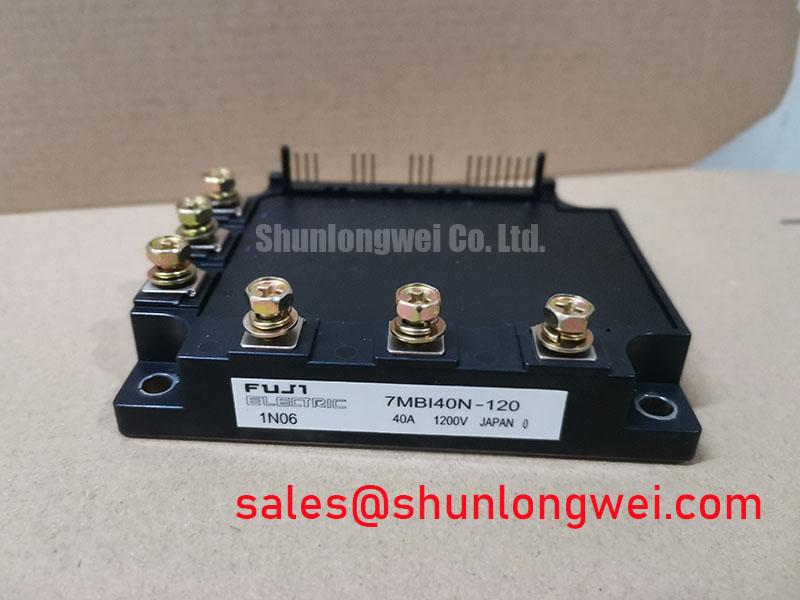
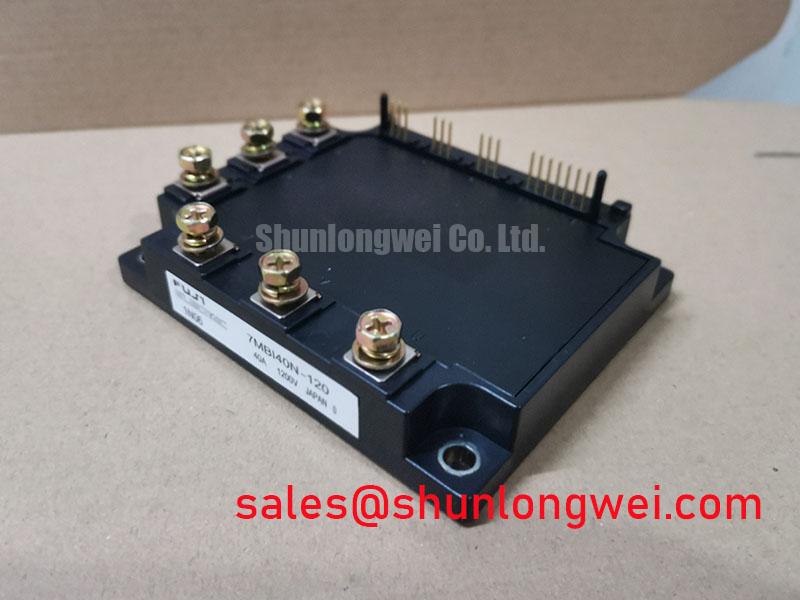
The Fuji Electric 7MBI40N-120 is a highly integrated IGBT module that streamlines the design of motor drives and inverters. Its defining feature is a 7-in-1 configuration, combining a full three-phase inverter bridge and a brake chopper circuit into a single, compact package. This level of integration significantly reduces component count and simplifies PCB layout for power stages. An integrated NTC thermistor allows for direct, real-time temperature monitoring, forming a critical component of a robust system protection strategy.
- Core Specifications: 1200V | 40A | 7-in-1 Configuration
- Key Advantages: Reduces assembly complexity and time, enables precise thermal management with an on-board sensor.
For complete performance curves and specifications, please refer to the official datasheet.
Download Official Datasheet (PDF)
Technical Analysis of the Integrated Design
The primary engineering value of the 7MBI40N-120 lies in its high-density integration. By co-packaging the six IGBTs for the inverter and one for the brake chopper, designers can minimize the physical size of the power conversion stage. This architecture also inherently reduces parasitic inductance in the power circuit loops compared to a solution built from discrete components. Lower parasitic inductance is critical for minimizing voltage overshoots during high-speed switching, which enhances overall system reliability. This approach contrasts with designs that require separate modules or discrete devices, which you can learn more about in our guide to PIM vs. discrete IGBT strategies.
Enabling Robust Thermal Management
Effective thermal management is fundamental to the long-term reliability of any power module. The 7MBI40N-120 directly addresses this by incorporating an NTC thermistor into the package. This provides a direct feedback path to the system’s microcontroller, allowing for precise monitoring of the module’s baseplate temperature. This data enables the implementation of critical safety functions like over-temperature warnings or shutdowns, protecting the IGBTs from thermal runaway. Think of the module’s thermal resistance (Rth(j-c)) as the width of a pipe for heat to escape; the 0.38 K/W value for each IGBT indicates an efficient path for dissipating heat away from the silicon. The NTC acts as a pressure gauge in this pipe, giving the system constant awareness of the thermal load. Explore the importance of this feature in our article on the role of the integrated NTC.
Optimized Application Scenarios
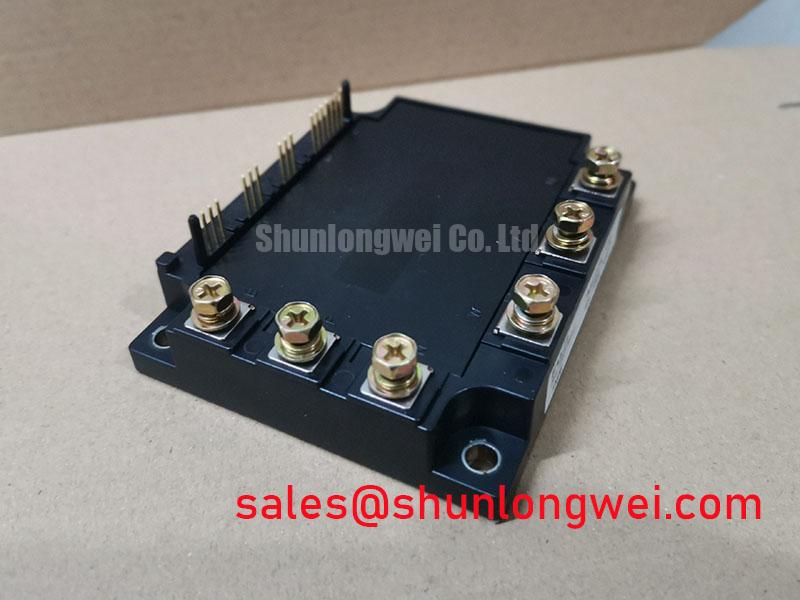
The specific characteristics of this module make it well-suited for several applications:
- Compact Motor Drives: The 7-in-1 package is ideal for space-constrained motor control applications, where integrating the inverter and brake circuit simplifies the overall mechanical design.
- General Purpose Inverters: The module’s straightforward configuration and 40A current rating are a solid foundation for industrial inverters driving pumps, fans, and conveyors.
- Servo Drives: In precision motion control, the compact footprint allows for smaller, more integrated servo drive designs without sacrificing power handling for the brake circuit.
- HVAC Systems: Its reliability and integrated thermal sensing are valuable for driving compressors and air handling units, where long operational life is expected.
This module is an optimal match for low-to-mid power motor control systems requiring high integration density and reliable thermal performance.
Key Specification Parameters for the 7MBI40N-120
| Absolute Maximum Ratings (Tc=25°C unless otherwise specified) | |
|---|---|
| Collector-Emitter Voltage (VCES) | 1200 V |
| Continuous Collector Current (IC) @ Tc=80°C | 40 A |
| Max Power Dissipation (PC) – Per IGBT | 220 W |
| Operating Junction Temperature (Tj) | +150 °C |
| Electrical Characteristics (Inverter Part, Tj=125°C) | |
| Collector-Emitter Saturation Voltage (VCE(sat)) @ IC=40A | 2.7 V (Max) |
| FWD Forward Voltage (VF) @ IE=40A | 2.2 V (Max) |
| Thermal and NTC Characteristics | |
| Thermal Resistance, Junction to Case (Rth(j-c)) – IGBT | 0.38 K/W (Max) |
| NTC Resistance (R25) @ 25°C | 5 kΩ ± 5% |
Engineer’s FAQ
- What are the primary thermal design considerations for the 7MBI40N-120?
- The primary goal is to ensure the junction temperature (Tj) does not exceed its 150°C maximum. This requires selecting a heatsink with sufficiently low thermal resistance to dissipate the calculated power loss. The datasheet specifies a maximum case temperature (Tc) of 125°C and a thermal resistance from junction to case (Rth(j-c)) of 0.38 K/W per IGBT. Critically, the integrated NTC thermistor should be used for active temperature monitoring to enable protective measures in the control logic.
- What does the “7-in-1” configuration in this module include?
- The 7-in-1 configuration integrates a complete three-phase inverter bridge and a brake chopper into a single module. This consists of six IGBTs with six corresponding anti-parallel free-wheeling diodes for the inverter, plus one IGBT with its anti-parallel diode for the braking circuit. This simplifies sourcing, assembly, and power stage layout.
- What is the recommended gate drive voltage for this module?
- According to the datasheet, the recommended gate drive voltage (VGE) is a positive +15V for turning the IGBT on. For a secure turn-off and noise immunity, a negative voltage between -5V and -10V is typical. The absolute maximum rating for gate-emitter voltage is ±20V, and exceeding this can cause permanent damage to the device. For more on this topic, see our guide on robust gate drive design.
Final Engineering Statement
The 7MBI40N-120 provides a robust, highly integrated foundation for power conversion systems. Its 7-in-1 configuration simplifies the mechanical and electrical layout, accelerating development time for motor control applications. Furthermore, the embedded NTC thermistor delivers the essential feedback needed for building reliable, thermally-aware systems that can operate consistently under demanding industrial conditions.