VVZ 175-14 iO7: An Integrated 1400V Rectifier and Brake Chopper Module for AC Drives
VVZ 175-14 iO7: 1400V Rectifier + Brake Chopper Module
Integrated Power Stage for AC Motor and Power Conversion
The IXYS VVZ 175-14 iO7 is a Three-Phase Bridge Rectifier with an integrated IGBT Brake Chopper, consolidating the front-end power stage for AC drives into a single, robust module. This integration of a 1400V rectifier and brake chopper simplifies system design by reducing component count and streamlining the thermal management architecture. By combining these essential functions, the module provides a compact and reliable solution for power conversion systems.
- Core Specifications: 1400V VRRM | 175A IdAVM | 160A IC25 IGBT
- Key Advantages: Simplifies PCB and busbar layout, improves thermal efficiency with an isolated baseplate.
For complete electrical and thermal characteristics, consult the official manufacturer’s documentation. Download the Official VVZ 175-14 iO7 Datasheet (PDF).
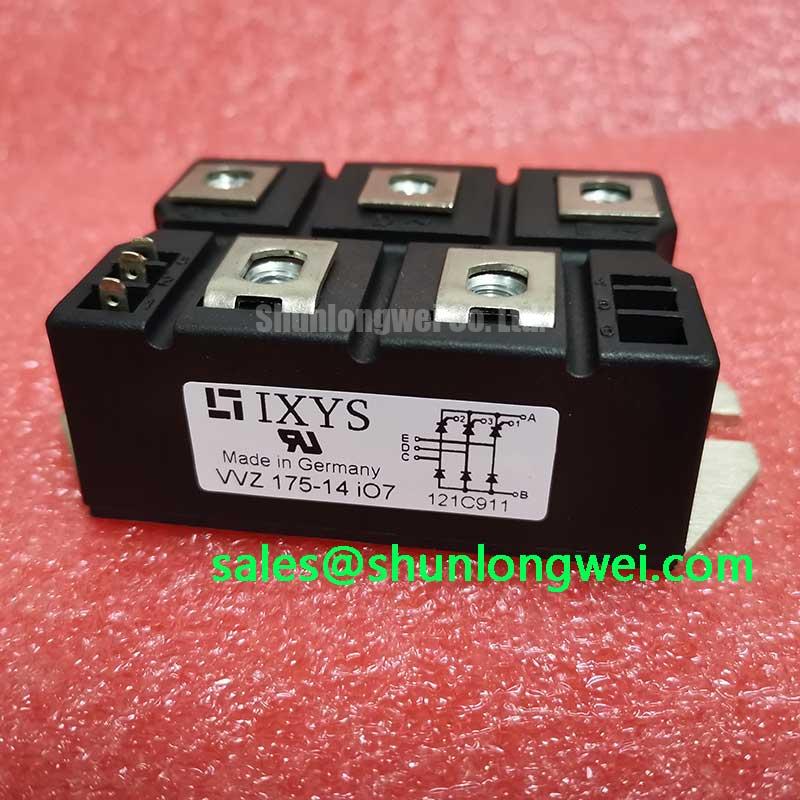


Technical Analysis of the Integrated Design
The primary engineering value of the VVZ 175-14 iO7 lies in its consolidated topology. By integrating a three-phase, six-diode rectifier bridge (B6U) with a single IGBT brake chopper, the module replaces multiple discrete components. This approach significantly reduces the physical footprint and simplifies the power stage layout, minimizing parasitic inductance that can arise from complex wiring between separate rectifier and chopper circuits. This streamlined design is a key factor in achieving both compact and electrically stable systems.
The module’s construction is centered around effective thermal management. It features an industry-standard E2-Pack with a copper baseplate, which is electrically isolated from the terminals using an Aluminium Oxide (Al2O3) Direct Bonded Copper (DBC) substrate. This ensures high dielectric strength (3000V~ isolation voltage) while providing a low thermal resistance path for heat dissipation. Think of the module’s thermal resistance (RthJC) as the width of a heat escape tunnel. The specified 0.08 K/W value for the IGBT provides a wide tunnel, allowing heat to evacuate efficiently from the silicon to a heatsink.
Optimized Application Scenarios
The specific feature set of the VVZ 175-14 iO7 makes it a strong candidate for several demanding applications:
- AC Motor Drives: The integrated brake chopper is essential for managing the regenerative energy produced during motor deceleration, protecting the DC bus from overvoltage conditions.
- Power Supply Units: Its high blocking voltage of 1400V provides a robust front-end rectifier for high-power switched-mode power supplies (SMPS).
- DC Motor Drives: Simplifies the input stage for four-quadrant DC drives that require dynamic braking capabilities for precise motor control.
- Inverters and Converters: The module’s consolidated nature is beneficial in general-purpose inverters where space is constrained and a reliable power input stage is necessary.
This module is best matched for systems requiring a compact, UL-recognized power stage with integrated rectification and regenerative braking control up to 1400V.
Key Technical Specifications
| Parameter | Symbol | Value | Unit |
|---|---|---|---|
| Rectifier Bridge (per Diode) | |||
| Repetitive Peak Reverse Voltage | VRRM | 1400 | V |
| Average Forward Current (Module) | IdAVM | 175 (TC = 85°C) | A |
| Brake Chopper (IGBT) | |||
| Collector-Emitter Voltage | VCES | 1400 | V |
| Continuous Collector Current @ TC=25°C | IC25 | 160 | A |
| Collector-Emitter Saturation Voltage (Typ.) | VCE(sat) | 1.9 (IC = 100 A, TVJ = 125°C) | V |
| Module Characteristics | |||
| Operating Junction Temperature | TVJ | -40 to +150 | °C |
| Isolation Test Voltage (RMS, 50/60 Hz) | VISOL | 3000 | V~ |
Engineer FAQ
What are the primary advantages of using an integrated module like the VVZ 175-14 iO7 versus discrete components?
An integrated module offers several key benefits: reduced component count which simplifies inventory and assembly; a more compact physical footprint; optimized internal connections that lower parasitic inductance compared to discrete wiring; and a single, unified thermal interface for simplified heatsink design and thermal modeling.
What is the recommended mounting torque for the VVZ 175-14 iO7, and why is it important?
The datasheet specifies a mounting torque of 5 Nm ± 15% for the M6 mounting screws and 5 Nm ± 15% for the M5 terminal screws. Applying the correct torque is critical for ensuring a low thermal resistance path to the heatsink and reliable electrical connections. Overtightening can damage the module’s baseplate or terminals, while under-tightening can lead to poor thermal contact or high-resistance electrical joints, both of which can cause premature failure.
How does the internal brake chopper function in a typical motor drive application?
During motor deceleration or when an overhauling load occurs, the motor acts as a generator, sending current back to the DC bus. This regenerative energy causes the DC bus voltage to rise. The drive’s control circuit monitors this voltage and, upon reaching a set threshold, activates the IGBT in the brake chopper. The IGBT then diverts the excess energy into a braking resistor, where it is dissipated as heat, thus preventing the DC bus voltage from reaching damaging levels.
The VVZ 175-14 iO7 module empowers engineers to develop more compact and reliable power conversion systems by providing a pre-validated, integrated solution. This approach accelerates the design cycle and enhances the thermal performance of the final application.