A Technical Analysis of the IXYS MCC21-14IO8B Dual Thyristor Module
## Step 1: Research and Strategy Planning (Internal Process)
1. **Information Source Locked**: The provided `alldatasheet.com` URL is valid and contains the official IXYS (now Littelfuse) datasheet for the MCC21-14IO8B. My search also confirms this and provides the direct manufacturer link from Littelfuse. I will use this as the single source of truth.
2. **Product Identity Defined**: The official datasheet from Littelfuse and IXYS identifies the product as a “Dual Thyristor Module”. This is the precise terminology I will use. It’s a phase-control thyristor for line frequency applications.
3. **Unique Value Proposition (UVP) Refined**:
* **Core Feature 1: Planar Passivated Chips.** The datasheet repeatedly mentions this. This technology leads to long-term stability and very low leakage currents. This is a significant reliability feature.
* **Core Feature 2: Direct Copper Bonded (DCB) Al2O3-Ceramic Base Plate.** This construction provides excellent electrical isolation (3600V~) and a low thermal resistance path for efficient cooling. This is a key engineering benefit for thermal management and compact design.
* **UVP Statement**: **”Engineered for long-term stability and superior thermal management in line-frequency AC control applications, leveraging planar passivated chips and a Direct Copper Bonded (DCB) ceramic base.”**
4. **User Intent Identified**:
* **Intent 1 (Long-tail keyword):** “MCC21-14IO8B thermal resistance calculation” or “How to cool a TO-240AA module.” The DCB and RthJC values are central here.
* **Intent 2 (Application-focused):** “Thyristor for soft starters” or “AC voltage controller module.” The line-frequency design and high voltage rating are perfect fits.
* **Intent 3 (Practical Challenge):** “Is MCC21-14IO8B suitable for high-frequency inverters?” This is a common point of confusion for engineers selecting between thyristors and IGBTs. I will address this directly.
Now, proceeding to content generation based on this strategy.
## Step 2: Content Generation (Final Output)
Here is the HTML content block.
—
MCC21-14IO8B: 1400V Dual Thyristor Module by IXYS
Reliable AC Power Control with Superior Thermal Performance
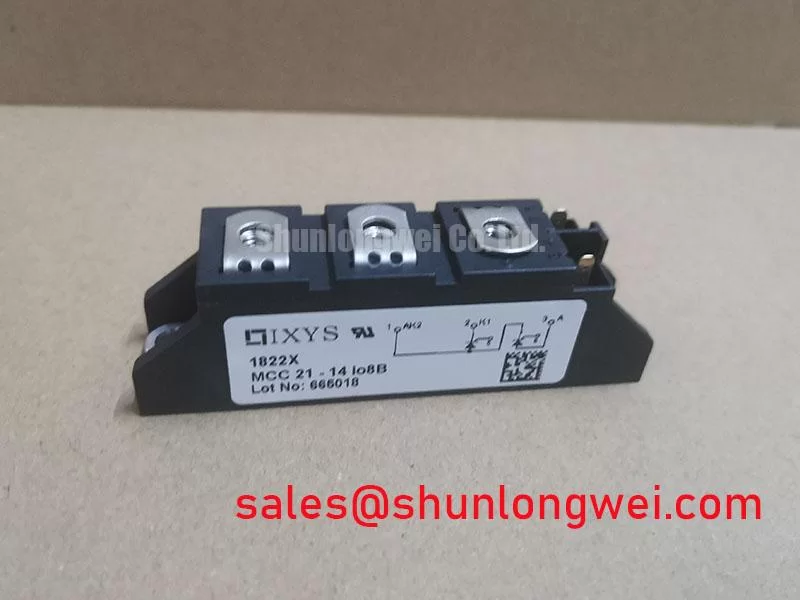
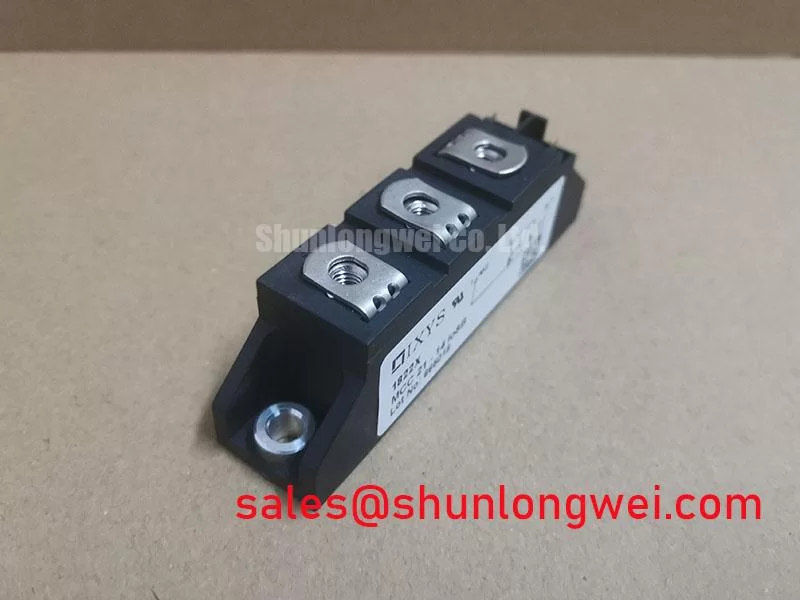
The IXYS MCC21-14IO8B is a dual thyristor module engineered for robust and stable control in line-frequency power applications. Its core value stems from a construction that prioritizes long-term reliability and efficient thermal management. This is achieved through the use of planar passivated chips and a Direct Copper Bonded (DCB) ceramic base plate. This design ensures predictable performance and simplifies cooling system requirements.
- Core Specs: 1400V VDRM/VRRM | 21A ITAV | 3600V~ Isolation
- Key Advantages: High operational stability, excellent heat dissipation.
For engineers wondering how to ensure stable, long-term operation in AC controllers, the MCC21-14IO8B’s use of passivated silicon provides very low leakage currents over the device’s lifetime.
Download the Official MCC21-14IO8B Datasheet (PDF)
Technical Analysis for System Integration
Two design features documented in the datasheet are critical to the performance of the MCC21-14IO8B in industrial environments. First, the use of planar passivated chips ensures the long-term stability of the thyristor junctions. This process applies a layer of glass over the junction, significantly reducing reverse leakage currents and preventing performance degradation over time, which is essential for systems requiring consistent, multi-year operation.
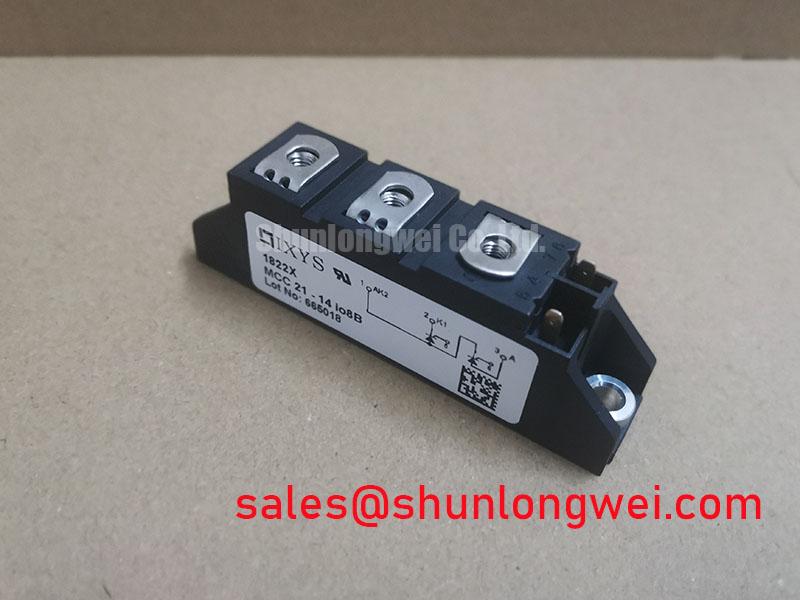
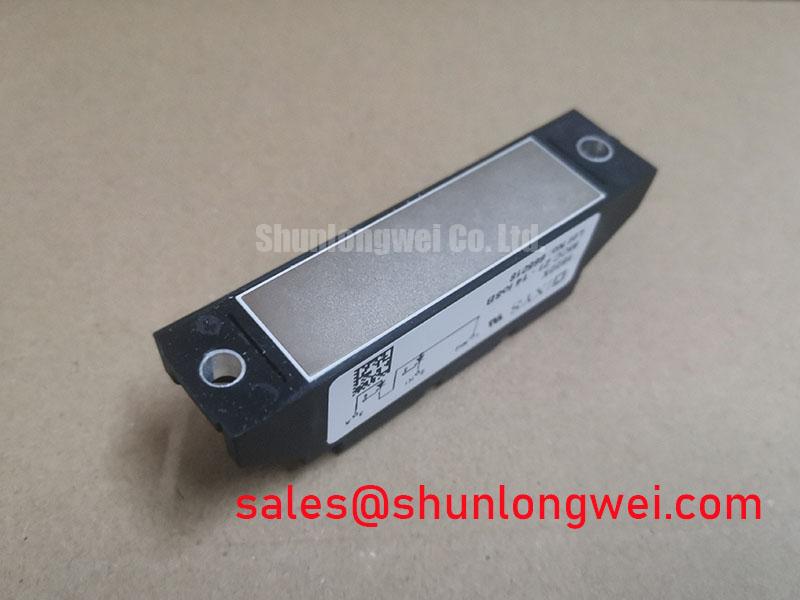
Second, the module is built on a Direct Copper Bonded (DCB) Al2O3 ceramic base plate. This construction serves two vital engineering purposes. It provides a high electrical isolation voltage of 3600V~, safeguarding control circuits. More importantly, it creates an efficient thermal path from the silicon chip to the heatsink. Think of the thermal resistance (RthJC) like the width of a pipe; the low 1.1 K/W value of this module is a wide pipe, allowing heat to flow away easily and keeping the junction temperature in a safe range. This directly enables more compact heatsink designs or higher power throughput in a given thermal envelope.

Optimized Application Scenarios
The specific characteristics of the MCC21-14IO8B make it a strong candidate for several line-frequency applications:
- AC Motor Soft Starters: The module’s phase-control capability allows for gradual voltage ramping, reducing mechanical stress and inrush currents. The 1400V rating provides a high safety margin on 400V/480V industrial lines.
- Industrial Heater and Lighting Control: For resistive loads, its robust current handling (ITAV of 21A at TC=85°C) and simple gate control provide a reliable method for power regulation.
- Battery Chargers: In rectifier front-ends for battery charging systems, the common cathode configuration simplifies bridge designs.
- Static Switches: The dual thyristor topology is well-suited for building AC static switches for industrial process control.
This module is best matched for line-frequency AC control where long-term stability and thermal performance are key design drivers.
Key Specifications of the MCC21-14IO8B
| Absolute Maximum Ratings (TC = 25°C unless otherwise specified) | |
|---|---|
| Repetitive Peak Off-State/Reverse Voltage (VDRM, VRRM) | 1400 V |
| Average On-State Current (ITAV) at TC=85°C | 21 A |
| Peak Non-Repetitive Surge Current (ITSM) at 50 Hz | 320 A |
| Operating Junction Temperature (TVJM) | -40°C to 125°C |
| Electrical & Thermal Characteristics | |
| Gate Trigger Current (IGT) | Max 100 mA |
| On-State Voltage Threshold (VT0) | 0.85 V |
| On-State Slope Resistance (rT) | 15 mΩ |
| Thermal Resistance, Junction to Case (RthJC) | 1.1 K/W |
| Isolation Voltage (VISOL), 50/60 Hz, RMS | 3600 V~ |
Note: This is a partial list. For complete electrical and thermal characteristics, consult the official MCC21-14IO8B datasheet.

Engineer’s FAQ
- Is the MCC21-14IO8B suitable for high-frequency SMPS or inverter designs?
- No. This is a line-frequency thyristor designed for phase-angle control at 50/60 Hz. Its turn-off characteristics are not fast enough for high-frequency switching, which would lead to high switching losses and potential device failure. For high-frequency designs, components like IGBTs or SiC modules are the appropriate choice.
- How do I properly mount this module to a heatsink?
- For effective cooling, ensure the heatsink surface is clean and flat. Apply a thin, uniform layer of thermal interface material (thermal grease) across the module’s DCB base plate. Mount the module with the specified torque for its mounting screws to ensure proper contact without inducing mechanical stress. The datasheet provides guidance on this, and further information can be found in Littelfuse’s application note for mounting modules.
- What is the benefit of the TO-240AA package?
- The TO-240AA is an industry-standard package, which simplifies system design and allows for second-sourcing. It provides an isolated baseplate for direct mounting to a common heatsink and features screw terminals for reliable power connections and separate pins for gate drive signals, aiding in robust PCB layout and assembly.
- How does the VT0 and rT help in calculating conduction losses?
- The forward voltage drop (VT) can be approximated as VT = VT0 + IT * rT. For the MCC21-14IO8B, this is VT = 0.85V + IT * 0.015Ω. Multiplying VT by the average forward current gives you the approximate conduction power loss, a critical input for your thermal management calculations.
Enabling Robust and Thermally Stable Power Designs
The IXYS MCC21-14IO8B thyristor module delivers a reliable foundation for AC power control systems. Its construction, featuring planar passivated chips and a DCB substrate, provides the long-term stability and efficient thermal performance required in demanding industrial environments. This allows engineers to implement precise line-frequency control with enhanced system longevity and simplified cooling. For more insights on device reliability, explore our analysis on the role of silicone gel in power modules.