Fuji 7MBI75N-060-10: A Technical Review of the 7-in-1 IGBT Power Module
Fuji 7MBI75N-060-10 7-in-1 IGBT Module Technical Review
Integrated Power Stage for Compact Motor Drives
The Fuji Electric 7MBI75N-060-10 is an integrated power module that consolidates a complete three-phase motor drive power stage into a single, compact package. This module’s primary value is its high level of integration, incorporating a three-phase rectifier, a three-phase inverter, and a brake chopper circuit. This 7-in-1 configuration simplifies system design for engineers developing low-to-medium power motor controls, reducing both component count and overall footprint.
- Core Specifications: 600V | 75A (Inverter) | 7-in-1 PIM Configuration
- Key Advantages: Reduces PCB complexity and assembly time, improves thermal management with a consolidated heat source.
- Design Benefit: The integrated nature inherently minimizes stray inductance between stages, contributing to more reliable switching performance compared to discrete solutions.
Download Official Datasheet (PDF)
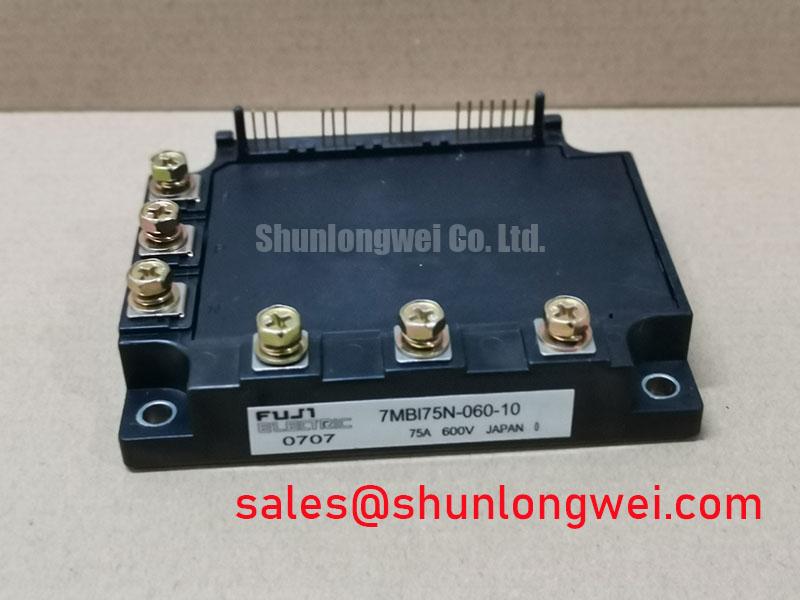
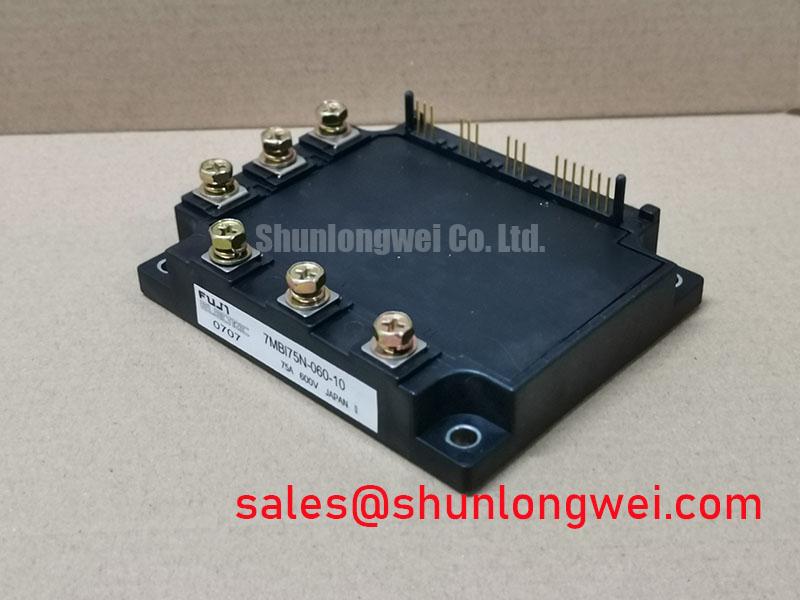
Technical Analysis of the 7-in-1 Integration
The core engineering advantage of the 7MBI75N-060-10 is its architecture. By combining a converter, inverter, and brake (CIB) circuit, it functions as a complete Power Integrated Module (PIM). This eliminates the need for multiple discrete components and the complex busbar or PCB layouts required to connect them. The result is a simplified manufacturing process and a reduction in potential points of failure associated with interconnects. The module’s layout is optimized to reduce the parasitic inductance that can cause voltage overshoots during high-speed switching, a common challenge in discrete designs.
Efficiency and Thermal Performance
Efficiency in an IGBT module is largely determined by its conduction and switching losses. The 7MBI75N-060-10 specifies a typical collector-emitter saturation voltage (VCE(sat)) of 2.2V at its nominal 75A current. A lower VCE(sat) directly translates to lower conduction losses and less heat generation. Think of VCE(sat) as a tollbooth for current; a lower voltage is like having more lanes open, allowing electrical current to flow with less resistance and energy waste. This efficient performance is critical for thermal management, as it reduces the demand on the cooling system. Furthermore, the inclusion of an integrated NTC thermistor provides a direct method for monitoring the module’s substrate temperature, enabling robust over-temperature protection.
Optimized Application Scenarios
The specific ratings and integrated topology of this module make it well-suited for several applications:
- AC Motor Drives (VFDs): Its 7-in-1 configuration provides the complete power stage for small to medium-sized VFDs, typically up to 15 kW, used for pumps, fans, and conveyors.
- Servo Drives: The compact package is advantageous in space-constrained servo applications where precise motion control is required. The integrated brake chopper is essential for managing regenerative energy.
- Uninterruptible Power Supplies (UPS): The module contains the necessary rectifier and inverter stages that form the core of an online UPS system.
- General-Purpose Inverters: For any application requiring conversion from three-phase AC to DC and then back to a controlled three-phase AC output.
This module is an optimal match for low-frequency (< 10 kHz) PWM applications where design simplicity, space savings, and reliable thermal performance are key priorities.
Key Specifications of the 7MBI75N-060-10
| Absolute Maximum Ratings (Tc=25°C) | ||
|---|---|---|
| Parameter | Rating | Part |
| Collector-Emitter Voltage (Vces) | 600V | Inverter & Brake IGBT |
| Continuous Collector Current (Ic) @ 80°C | 75A | Inverter IGBT |
| Total Power Dissipation (Pc) | 320W | Inverter IGBT |
| Repetitive Peak Reverse Voltage (VRRM) | 600V | Rectifier Diode |
| Operating Junction Temperature (Tj) | +150°C | All Parts |
| Electrical & Thermal Characteristics (Tj=25°C) | ||
| Collector-Emitter Saturation Voltage (VCE(sat)) Typ. | 2.2V (@ 75A) | Inverter IGBT |
| Forward Voltage (VF) Max. | 2.5V (@ 75A) | Inverter FWD |
| Thermal Resistance (Rth(j-c)) Max. | 0.39 °C/W | Inverter IGBT |
| NTC Thermistor Resistance (R25) | 5 kΩ ± 5% | Thermistor |
Engineer’s FAQ
What are the main benefits of using a 7-in-1 IGBT module like the 7MBI75N-060-10 in a VFD design?
The primary benefit is design simplification. It integrates the input rectifier, output inverter, and brake circuit, reducing the number of power components from at least seven discrete packages to just one. This saves significant PCB space, lowers assembly costs, and minimizes stray inductance, which can lead to better EMI performance and reliability.
What are the recommended mounting torque and thermal interface material for this module?
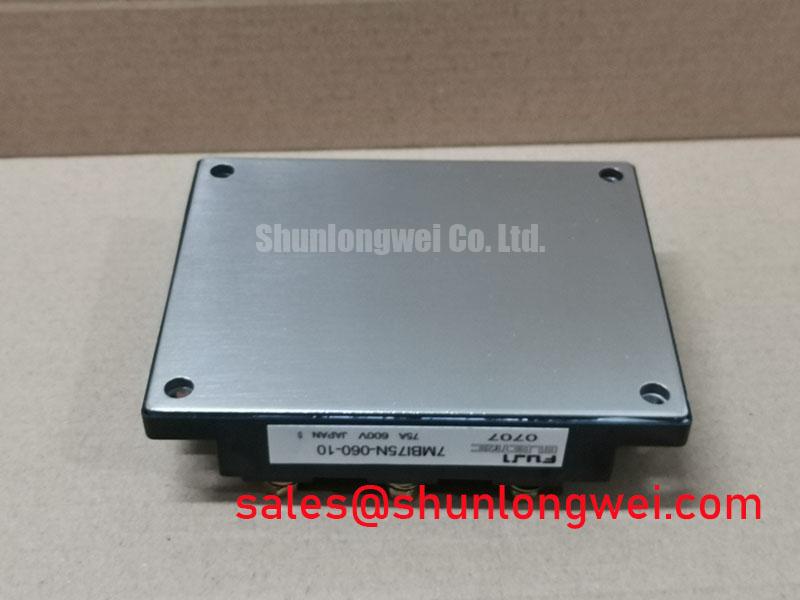
According to the datasheet, the recommended mounting screw torque is between 2.5 and 3.5 N·m. It is critical to apply this torque evenly to ensure proper contact with the heatsink. A high-quality thermal compound should be applied in a thin, uniform layer across the module’s baseplate to minimize contact thermal resistance (Rth(c-f)) and ensure efficient heat transfer.
How does the integrated NTC thermistor improve system safety?
The NTC thermistor provides a real-time analog of the module’s internal temperature. A gate driver or system controller can monitor this resistance value. If the temperature exceeds a safe limit (e.g., approaching the max junction temperature of 150°C), the controller can trigger a fault, reduce the output current, or shut down the system entirely, preventing catastrophic failure from overheating.
What is the maximum operating junction temperature (Tj) this module can handle?
The absolute maximum operating junction temperature specified in the datasheet is 150°C for all internal semiconductor devices. For long-term reliability, it is standard engineering practice to design the thermal system to keep the operating temperature well below this limit under worst-case load and ambient conditions.
Design Enablement
The Fuji 7MBI75N-060-10 offers a practical solution for engineers seeking to develop compact and cost-effective power conversion systems without sacrificing reliability. Its high level of integration provides a streamlined path from design concept to final assembly, simplifying thermal mechanics and board layout while delivering robust electrical performance for demanding industrial motor control applications.