Fuji Electric 1SI50A-050: 500V 50A 6-in-1 NPN Darlington Power Transistor Module
Fuji Electric 1SI50A-050 | 500V 50A 6-in-1 NPN Transistor Module
Introduction to High-Gain Industrial Power Modules
The 1SI50A-050 is a specialized 6-in-1 NPN Darlington power transistor module developed by Fuji Electric for low-to-medium frequency industrial switching applications. Engineered for robustness in legacy motor control and rectification systems, this module integrates six independent transistor stages into a single isolated package, providing a cohesive solution for three-phase bridge configurations. With a blocking voltage of 500V and a continuous collector current of 50A, it offers a reliable alternative for engineers maintaining or designing robust power stages that require high DC current gain ($h_{FE}$) and simplified drive requirements compared to modern high-speed MOSFETs.
- Core Specifications: 500V | 50A | $h_{FE}$ ≥ 100
- Key Advantage 1: High current gain reduces the drive stage complexity and power consumption of control circuitry.
- Key Advantage 2: Fully isolated mounting base facilitates multi-module thermal management on a single shared heatsink.
Download Official Datasheet (PDF)
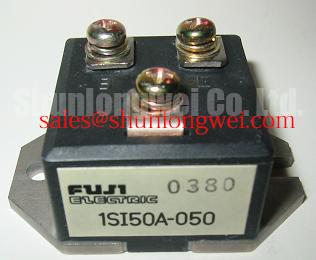
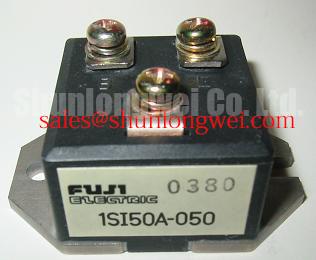
Technical Analysis of the 1SI50A-050 Architecture
The 1SI50A-050 utilizes a Darlington pair configuration within each of its six switches. This architecture is pivotal for industrial environments where the control logic might not possess the high-current drive capability required for standard bipolar transistors. By cascading two transistors, the module achieves a minimum DC current gain of 100, allowing it to act as a significant “current amplifier.” You can think of the current gain ($h_{FE}$) like a lever: a higher gain means you need much less effort (input current) to move a heavy load (collector current), which prevents the control board from becoming a bottleneck in the system design.
Thermal stability is a critical factor in the longevity of these components. The 1SI50A-050 features an isolated mounting baseplate, which is essential for preventing electrical leakage into the cooling system. In high-power applications, managing the junction temperature is paramount to avoiding catastrophic failure modes. Engineers should refer to established root cause analysis of power semiconductor failures to understand how thermal cycling impacts internal wire bonding. Because this module uses a 6-in-1 layout, the thermal flux is concentrated, necessitating a precision-machined heatsink surface to ensure uniform heat transfer across all six internal stages.
Furthermore, the integration of high-speed freewheeling diodes within the module protects the NPN stages from inductive kickback during turn-off. This integration minimizes parasitic inductance that would otherwise be present with discrete external diodes. While newer Trench-gate technologies have lowered $V_{CE(sat)}$, the 1SI50A-050 remains a staple in the power semiconductors market due to its predictable linear characteristics and robust secondary breakdown immunity, which are often preferred in specialized heavy-duty industrial applications like pulsed welding or legacy CNC spindle drives.
Optimized Application Scenarios
The 1SI50A-050 is specifically tailored for 200V-400V class industrial systems. Its NPN 6-pack configuration makes it an ideal fit for the following environments:
- AC Motor Drives: Perfect for small-to-medium VFDs where a three-phase bridge must be implemented in a space-constrained chassis.
- Uninterruptible Power Supplies (UPS): Used in the inverter stage to convert DC battery power into clean AC output with high reliability.
- CNC Machinery: Provides the switching power for axis movement and spindle control, benefiting from the module’s high gain and integrated protection.
- Static Power Converters: Ideal for industrial battery chargers and DC power supplies requiring isolated 6-pack rectification.
Best Match: The 1SI50A-050 is most efficient in applications requiring a compact 50A three-phase bridge with simplified drive circuitry and high thermal isolation.
Key Specifications Table
| Parameter | Symbol | Value |
|---|---|---|
| Absolute Maximum Ratings (at Tc=25°C) | ||
| Collector-Emitter Voltage | $V_{CEX}$ | 500V |
| Continuous Collector Current | $I_C$ | 50A |
| Pulse Collector Current | $I_{CP}$ | 100A |
| Isolation Voltage (1 min) | $V_{iso}$ | 2000V AC |
| Electrical Characteristics | ||
| DC Current Gain ($I_C=50A, V_{CE}=5V$) | $h_{FE}$ | Min 100 |
| Collector-Emitter Saturation Voltage | $V_{CE(sat)}$ | Max 2.0V |
| Base-Emitter Saturation Voltage | $V_{BE(sat)}$ | Max 2.5V |
Engineer FAQ for 1SI50A-050
Q: What is the recommended thermal mounting procedure for the 1SI50A-050?
A: To maintain optimal junction temperature, the module should be mounted with high-quality thermal grease (approx. 100μm thickness). For more details, see our guide on industrial thermal management. Ensure the mounting screws are tightened to the torque specified in the datasheet (typically 2.0 to 3.0 N·m) to avoid baseplate warping.
Q: Can the 1SI50A-050 be used for high-frequency PWM switching?
A: The 1SI50A-050 is an NPN Darlington module, which inherently has slower switching times than modern IGBTs. It is best suited for PWM frequencies below 10kHz. Exceeding these frequencies can lead to excessive switching losses and thermal runaway due to the “storage time” characteristic of bipolar transistors.
Q: How do I handle the pinout for a standard 3-phase bridge?
A: The 6-in-1 configuration provides six collector-emitter pairs. In a standard inverter design, the collectors and emitters are connected in series pairs (High-side and Low-side) for each of the three phases. Ensure that dead-time is programmed into your controller to prevent shoot-through currents across the Darlington stages.
The Fuji Electric 1SI50A-050 stands as a testament to proven power semiconductor design, offering the stability and high gain necessary for demanding industrial motor control. By leveraging its integrated 6-pack architecture and isolated mounting, engineers can achieve significant power density while ensuring electrical safety and simplified maintenance in long-lifecycle industrial systems.