CM50MX-24A Mitsubishi 1200V 50A NX IGBT Module: Technical Overview and Applications
CM50MX-24A Mitsubishi 1200V 50A NX IGBT Module
Introduction and Core Highlights
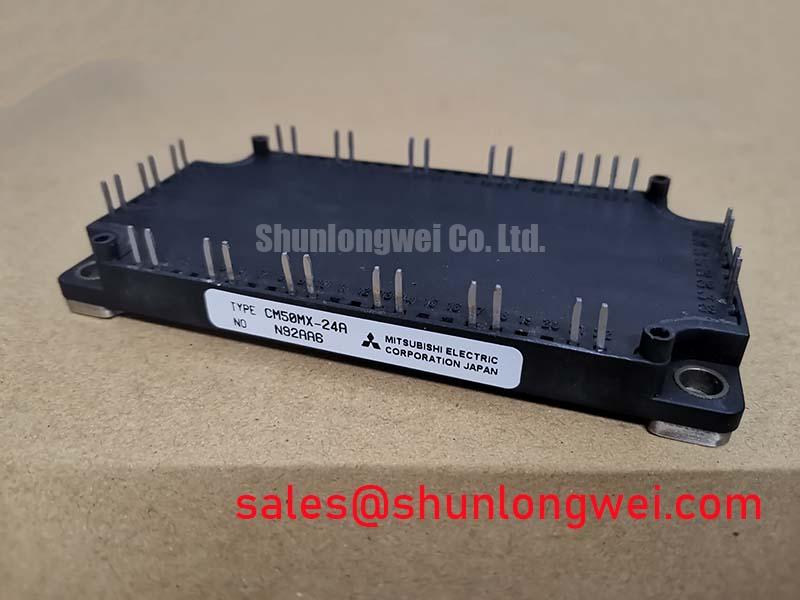
The CM50MX-24A is an industrial-grade, 1200V, 50A Converter-Inverter-Brake (CIB) module from Mitsubishi’s NX series of power semiconductors. This highly integrated 7-pack configuration consolidates a three-phase diode rectifier stage, a three-phase inverter bridge, and a dedicated brake chopper. Utilizing proprietary CSTBT™ technology, the module minimizes conduction and switching losses in a compact footprint.
- Core Ratings: 1200V collector-emitter voltage, 50A continuous collector current, and low conduction loss.
- Engineering Advantages: Lower parasitic package inductance and reduced heatsink sizing requirements.
- Design Efficiency: Consolidating discrete stages into a single module simplifies thermal routing.
For system designers analyzing the trade-offs of a consolidated PIM vs. discrete IGBT layout, this model provides a streamlined board routing solution with a significantly lower bill-of-materials count.
Download Official CM50MX-24A Datasheet (PDF)

Technical Analysis and Carrier Stored Technology
The integrated chip architecture inside the CM50MX-24A is built on carrier stored trench-gate technology. By optimizing the carrier distribution in the drift region, the collector-emitter saturation voltage ($V_{CE(sat)}$) is maintained at a typical value of 2.0V at rated current. This is highly effective at reducing static conduction losses.
You can visualize $V_{CE(sat)}$ as a narrow restriction in a physical pipe; a lower voltage drop represents a wider opening, allowing current to pass with minimal resistive drag and lower heat generation. This characteristic, detailed in our guide on trench gate evolution and lower VCE(sat), directly corresponds to thermal efficiency under continuous workloads.


Thermal dissipation is further managed by an isolated copper baseplate that reduces junction-to-case thermal resistance ($R_{th(j-c)}$). Proper thermal connection ensures switching transients do not cause localized hot spots, preventing premature module aging. Additionally, an integrated NTC thermistor provides analog temperature monitoring directly at the substrate level, allowing rapid controller-side fault mitigation.
Optimized Application Scenarios
- Variable Frequency Drives (VFDs): The integrated three-phase diode converter and inverter stage enable precise motor speed control with minimal switching harmonics.
- Industrial Servo Systems: High-speed CSTBT™ switches allow rapid dynamic positioning loops, maintaining stability under fluctuating load steps.
- Solar Inverters and UPS: The 1200V blocking rating handles elevated DC bus voltages reliably, while the built-in brake chopper simplifies dynamic braking designs.
Conclusion: The CM50MX-24A is a robust, highly integrated CIB module ideally suited for mid-range three-phase motor drives and solar power conversion systems.

Key Technical Specifications
| Category | Parameter | Typical Value / Limit |
|---|---|---|
| Absolute Maximum Ratings | Collector-Emitter Voltage ($V_{CES}$) | 1200 V |
| Collector Current ($I_C$) | 50 A | |
| Maximum Junction Temperature ($T_{jmax}$) | 150 °C | |
| Electrical Characteristics | Collector-Emitter Saturation Voltage ($V_{CE(sat)}$) | 2.0 V (typical at $I_C=50A$, $T_j=125^circ C$) |
| Gate-Emitter Threshold Voltage ($V_{GE(th)}$) | 6.0 V to 7.5 V | |
| Collector-Emitter Cut-off Current ($I_{CES}$) | 1.0 mA (maximum) | |
| Thermal & Insulation | Thermal Resistance ($R_{th(j-c)}$ – IGBT part) | 0.35 K/W (maximum) |
| Isolation Voltage ($V_{isol}$) | 2500 V (RMS, AC 1 minute) |
Engineers’ FAQ
Q1: What are the primary thermal interface requirements for mounting the CM50MX-24A module?
A1: A thin, uniform layer of thermal interface material (TIM) with a thermal conductivity of at least 1.0 W/m·K and a thickness of 60 to 80 microns must be applied to the baseplate. The mounting screws must be tightened symmetrically to the torque specifications outlined in the NX series application note.
Q2: Why are parasitic loop inductances lower in a CIB module than in discrete designs?
A2: The CM50MX-24A internally links the rectifier, inverter, and brake stages on a single ceramic DBC substrate. This proximity eliminates long external busbar runs, thereby minimizing stray inductance that can cause destructive overvoltage spikes during fast turn-off cycles.
Q3: How do you configure the integrated NTC thermistor for temperature protection?
A3: Connect the NTC terminals to a pull-up resistor circuit connected to the controller’s analog-to-digital converter (ADC). Calculate the temperature using the beta parameter value specified in the module’s datasheet to establish over-temperature threshold shutdown limits.
Closing Statement
The CM50MX-24A consolidates full three-phase conversion, inversion, and braking into a single, compact NX footprint. By integrating Mitsubishi’s CSTBT™ switches and direct thermal sensing, this module addresses the board layout challenges and component mismatch concerns of modern power system designs.