MTC135-16 1600V 135A Dual Thyristor Module: Technical Overview and Applications
MTC135-16 Thyristor Thyristor Module: 1600V 135A Dual Power Stage
Introduction and Core Highlights
The MTC135-16 is a dual phase-control thyristor module built to manage high-current AC loads in demanding industrial environments. Featuring two thyristors connected in series within a single isolated package, this module simplifies wiring in phase-control circuits. Systems requiring precise motor speed control or heating regulation can benefit from its high voltage blocking margins.
- Core Specifications: 1600V Repetitive Peak Voltage | 135A Average On-State Current | 2500V AC Insulation Voltage
- Engineering Benefits: Lowered thermal management requirements and reduced complexity in snubber design.
- System Design: Thermal performance can be modeled during transient states using the module’s thermal impedance ratings to prevent early component degradation.
Download Official MTC135-16 Datasheet (PDF)
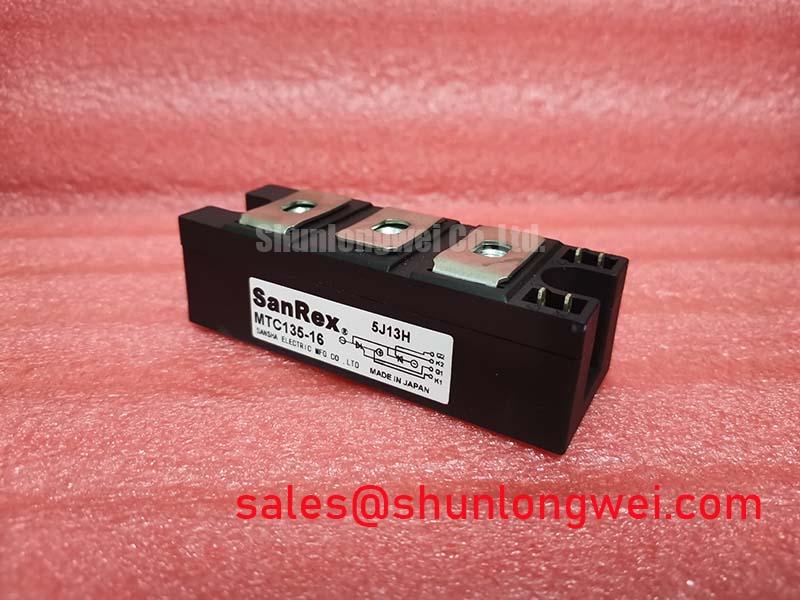


Technical Analysis of the MTC135-16
The MTC135-16 belongs to a critical segment of high-power power semiconductors. The module operates with a repetitive peak off-state voltage ($V_{DRM}$) of 1600V, ensuring safety against transients from noisy industrial AC mains. With an average on-state current ($I_{T(AV)}$) of 135A at a case temperature ($T_C$) of 85°C, this module provides high power handling capacity in a compact package.
Thermal management is vital for thyristor durability. The MTC135-16 features a low junction-to-case thermal resistance ($R_{th(j-c)}$) of 0.18 K/W per thyristor. You can visualize thermal resistance as the width of a physical pipe; a lower resistance represents a wider pipe, allowing heat to escape more easily from the semiconductor die to the heatsink. This keeps the internal junction temperature ($T_j$) safely below the 125°C threshold under nominal operating loads.
The module is constructed on an copper baseplate isolated up to 2500V AC. This allows multiple modules to share the same heatsink without electrical short-circuits. Isolating the live active semiconductor from the cooling chassis prevents voltage leaks, aligning with the reliability standards described in our overview of isolated baseplates. To protect the gate from accidental switching under fast voltage fluctuations, the module offers a high dv/dt rating of 1000 V/µs.
Optimized Application Scenarios
- Industrial Soft Starters: The high surge current capability ($I_{TSM}$ of 3200A) allows the module to withstand start-up currents of heavy industrial motors.
- Industrial Temperature Controllers: The 1600V rating allows safe phase-angle triggering in electric furnaces without the risk of overvoltage degradation.
- High-Power DC Power Supplies: Dual series configuration allows efficient bridge rectifier designs for battery charging and electroplating systems.
- Solid-State AC Switches: Provides maintenance-free replacement for mechanical contactors in high-vibration applications.
The MTC135-16 is optimized for industrial phase control requiring robust thermal isolation and surge tolerance up to 1600V.
Key Specifications Table
| Key Specifications of MTC135-16 | |||
|---|---|---|---|
| Absolute Maximum Ratings | |||
| Repetitive Peak Off-State / Reverse Voltage | VDRM / VRRM | 1600 | V |
| Average On-State Current (TC = 85°C) | IT(AV) | 135 | A |
| Surge On-State Current (10ms half-sine wave, Tj = 125°C) | ITSM | 3200 | A |
| Electrical Characteristics | |||
| Peak On-State Voltage Drop (ITM = 400A) | VTM | ≤ 1.70 | V |
| Critical Rate of Rise of Off-State Voltage (Tj = 125°C) | dv/dt | 1000 | V/µs |
| Critical Rate of Rise of On-State Current (Tj = 125°C) | di/dt | 150 | A/µs |
| Thermal & Mechanical Characteristics | |||
| Thermal Resistance (Junction to Case, per Thyristor) | Rth(j-c) | 0.18 | K/W |
| Isolation Voltage (AC, 1 minute) | Visol | 2500 | V |
Engineer FAQ
Q1: How do I select the right heatsink thermal resistance for the MTC135-16?
A: You must determine the total power dissipation ($P_d$) under your average load. Using the maximum junction temperature of 125°C and your ambient air temperature, size the heatsink thermal resistance ($R_{th(s-a)}$) such that $(T_{j} – T_{ambient}) / P_d$ minus the junction-to-case resistance (0.18 K/W) and interface resistance is not exceeded.
Q2: Why is the dv/dt rating of 1000 V/µs important in industrial environments?
A: Industrial lines frequently have voltage transients from inductive load switching. A high dv/dt rating ensures the MTC135-16 will not turn on spuriously due to fast-rising voltage spikes, preserving control over your load.
Q3: How should this thyristor module be protected against short circuits?
A: To protect the module, fast-acting semiconductor fuses should be selected. Their $I^2t$ rating must be lower than the surge handling limits of the thyristor module. For detailed protection circuit options, read our technical guide on mastering thyristor protection.
Q4: Can this device be operated at frequencies higher than grid frequency?
A: The MTC135-16 is a phase-control thyristor module optimized for line frequencies (50Hz/60Hz). Operating it at higher switching frequencies causes excessive switching losses and thermal stress due to turn-off time ($t_q$) limitations.
Conclusion
The MTC135-16 delivers high-voltage blocking margins and low thermal resistance in an industry-standard package. This dual-thyristor layout ensures reliable phase control and high isolation safety, allowing power system designers to create compact and efficient thermal control assemblies.