Fuji 2MBI1400VXB-120-50 Dual IGBT Module: Features, Specs, and Applications
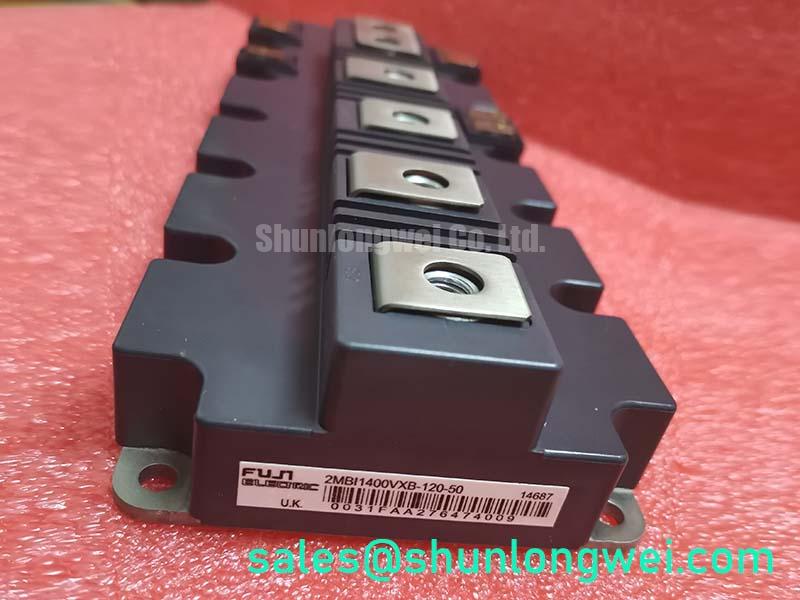
Fuji 2MBI1400VXB-120-50 1200V 1400A Dual IGBT Module
Introduction and Core Highlights
The Fuji Electric 2MBI1400VXB-120-50 is a high-power half-bridge module class of power semiconductors rated at 1200V and 1400A. It utilizes Fuji’s V-Series trench gate technology to achieve reduced conduction losses. Built with an integrated NTC thermistor, this module enables real-time thermal monitoring within compact layouts. This configuration reduces the overall footprint of megawatt-class converter designs.
- Core Specifications: 1200V collector-emitter voltage ($V_{CES}$), 1400A continuous collector current ($I_C$), and typical $V_{CE(sat)}$ of 1.75V.
- Key Benefits: Reduces cooling system overhead through low thermal resistance and lowers transient voltage overshoot under high-speed switching.
Engineers looking to optimize system efficiency under high cyclical thermal loads can evaluate this module’s electrical characteristics.
Download Official Datasheet (PDF)


Technical Analysis Around UVP
The 2MBI1400VXB-120-50 utilizes trench gate technology to optimize the tradeoff between switching speed and conduction losses. Its typical collector-emitter saturation voltage ($V_{CE(sat)}$) is rated at 1.75V under a 1400A load at $T_j = 125^circtext{C}$. This low value reduces power dissipation during the on-state, which direct-cooling systems can easily manage. The module incorporates isolated baseplates to isolate the power terminal layer from the cooling heatsink, rated for a dielectric test voltage of 4000V AC.
To prevent voltage spikes during fast switching turn-off transitions, the package layout minimizes internal stray inductance. To understand this, think of current flowing through the module as water rushing through a hose. If you abruptly shut off the valve, any bends or restrictors in the path create a water-hammer pressure spike. Similarly, internal parasitic inductance causes a voltage spike during turn-off, which the low-inductance packaging of this module mitigates.
Thermal cycling reliability is also improved by matching the thermal expansion coefficients of the internal DBC ceramic substrates and the copper baseplate. The integrated NTC thermistor sits close to the silicon dies, facilitating fast loop feedback for overtemperature protection circuits.
Optimized Application Scenarios
- Industrial Variable Frequency Drives (VFDs): Low conduction losses optimize the inverter stage in heavy industries under constant load conditions.
- Centralized Solar Inverters: High current capability permits a reduction in the number of parallel-connected modules, simplifying the busbar layout.
- Uninterruptible Power Supplies (UPS): Low internal inductance supports fast switching transitions, minimizing energy losses during system switchover.
- Wind Power Converters: The thermal cycling profile matches the thermal swings typical of variable wind speed generator demands.
Best Match: Ideal for megawatt-scale industrial converters requiring high thermal cycling endurance and low saturation voltage under continuous high-current loads.
Key Specifications Parameter Table
| Category | Parameter | Typical Value / Rating | Condition / Unit |
|---|---|---|---|
| Maximum Ratings | Collector-Emitter Voltage ($V_{CES}$) | 1200 | V |
| Continuous Collector Current ($I_C$) | 1400 | A (at $T_c = 80^circtext{C}$) | |
| Isolation Voltage ($V_{isol}$) | 4000 | AC, 1 min (V) | |
| Electrical Characteristics | Collector-Emitter Saturation ($V_{CE(sat)}$) | 1.75 | V (at $I_C = 1400text{A}, T_j = 125^circtext{C}$) |
| Gate-Emitter Threshold ($V_{GE(th)}$) | 6.5 | V (at $I_C = 140text{mA}$) | |
| Input Capacitance ($C_{ies}$) | 108 | nF (at $f = 1text{MHz}$) | |
| Thermal Resistance | IGBT Thermal Resistance ($R_{th(j-c)}$) | 0.012 | $^circtext{C}/text{W}$ (per module) |
| Diode Thermal Resistance ($R_{th(j-c)}$) | 0.021 | $^circtext{C}/text{W}$ (per module) |
Engineer FAQ
Q1: What are the recommended gate driver settings to prevent parasitic turn-on in the 2MBI1400VXB-120-50?
A1: Designers should apply a negative gate-emitter bias voltage (typically -8V to -15V) during the off-state. This keeps the gate voltage below the 6.5V threshold even when dv/dt transient currents flow through the Miller capacitance.
Q2: How does the built-in NTC thermistor improve system safety in high-power converters?
A2: Placed adjacent to the semiconductor dies, the NTC provides local temperature feedback, enabling controller circuits to adjust switching frequency or reduce current loads before the junction temperature reaches the $150^circtext{C}$ continuous limit.
Q3: What thermal interface material (TIM) mounting precautions are needed for this VXB footprint?
A3: Apply a uniform 50 to 100-micron layer of thermal grease. Screws must be tightened to the datasheet-specified torque limits to prevent baseplate deformation, ensuring low contact thermal resistance.
The Fuji 2MBI1400VXB-120-50 dual module offers a high-current, low-inductance packaging solution for megawatt power conversion configurations. By managing switching transients and thermal dissipation efficiently, it provides reliable operation in industrial environments.