Toshiba MG100J2YS50 Dual IGBT Module: Technical Analysis, Specs, and Applications
Toshiba MG100J2YS50 Dual IGBT Module | 600V 100A Half-Bridge
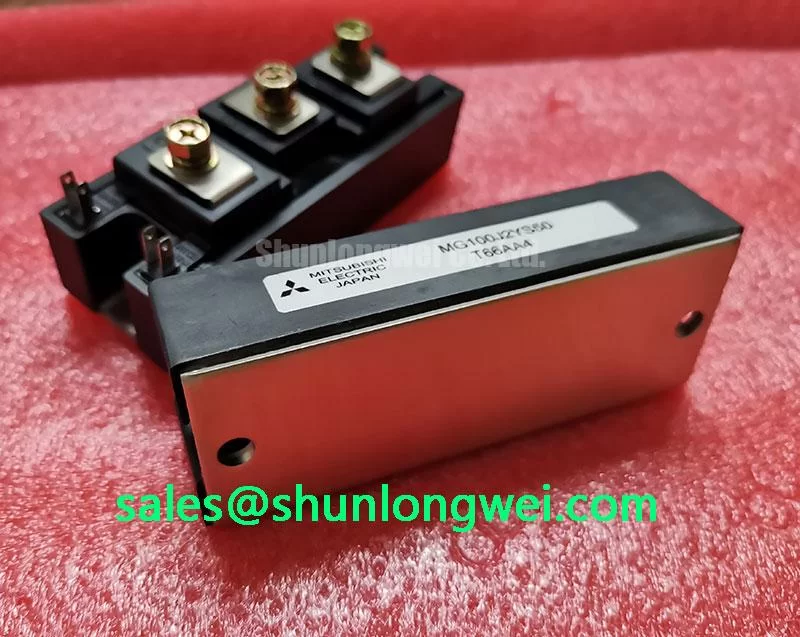
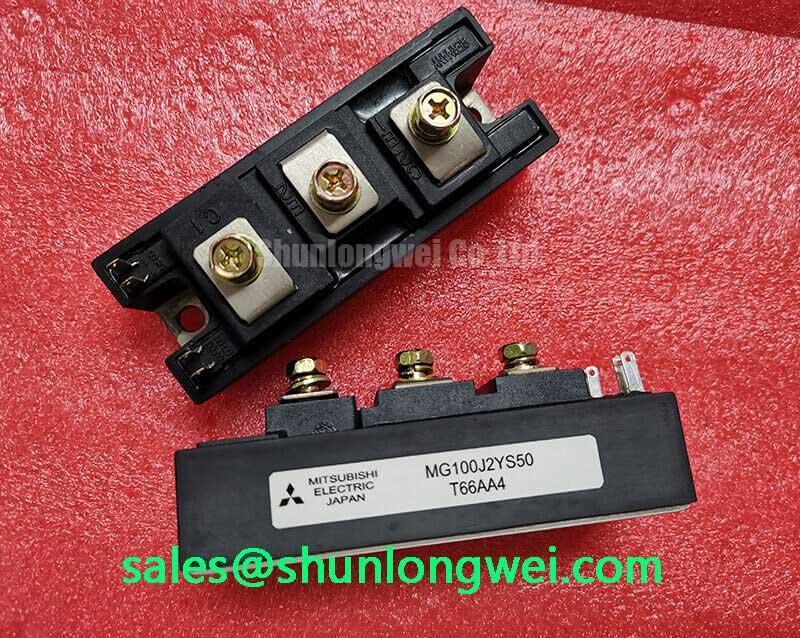
The Toshiba MG100J2YS50 is an N-channel silicon IGBT module configured in a half-bridge topology. Developed for high-power switching applications, it offers ratings of 600V collector-emitter voltage and 100A continuous collector current. This device combines two IGBTs with fast-recovery freewheeling diodes in an isolated package to address thermal dissipation challenges. It provides industrial power electronics engineers with a stable switching platform for medium-voltage motor controllers and inverter topologies.
Download official datasheet (PDF)
Technical Analysis of Switch Performance and Thermal Characteristics
The switching profile of the MG100J2YS50 is characterized by a typical turn-off time (toff) of 0.5 microseconds and a fall time (tf) of 0.2 microseconds. In high-frequency converters, these rapid switching transitions directly decrease dynamic energy losses per cycle. This performance allows engineers to increase operating switching frequencies while minimizing overall system heat generation.
For thermal management, the module features a maximum junction-to-case thermal resistance (Rth(j-c)) of 0.31 °C/W for the IGBT section. You can visualize thermal resistance like a physical water pipe: a wider pipe allows water to flow with less resistance. Similarly, a lower thermal resistance rating allows heat to transfer easily away from the silicon junction to the heatsink. This helps to prevent premature thermal breakdown during continuous high-load operations.
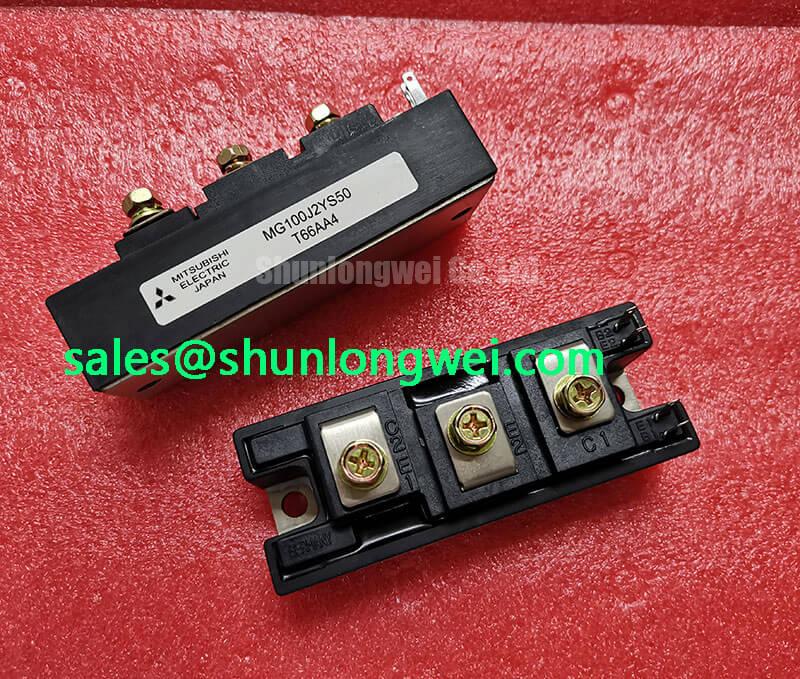
Additionally, the integrated fast-recovery diodes exhibit a forward voltage of 3.0V maximum at 100A. This low forward drop optimizes the free-wheeling diode performance during inductive load commutation, preventing voltage spikes and reducing reverse recovery current stresses.
Target Applications
- AC/DC Motor Drives: Utilizes the integrated half-bridge topology to manage current delivery with low conduction losses.
- Uninterruptible Power Supplies (UPS): Leverages the module’s 0.5 µs fast turn-off switching characteristics for high efficiency.
- Industrial Inverters: Benefiting from the isolated baseplate, which simplifies mounting and configuration on common heatsinks.
Best Match: Optimized for AC/DC motor drives requiring isolated packaging up to 100A continuous current.
Key Specifications
| Absolute Maximum Ratings (Ta = 25°C) | ||
|---|---|---|
| Collector-Emitter Voltage | VCES | 600 V |
| Gate-Emitter Voltage | VGES | ±20 V |
| Collector Current (DC) | IC | 100 A |
| Collector Current (1ms Pulse) | ICP | 200 A |
| Collector Power Dissipation (Tc = 25°C) | PC | 400 W |
| Junction Temperature Range | Tj | -40 to +150 °C |
| Electrical Characteristics (Ta = 25°C) | ||
| Collector Cut-off Current | ICES (VCE = 600V) | 1.0 mA (Max) |
| Gate-Emitter Leakage Current | IGES (VGE = ±20V) | ±100 nA (Max) |
| Gate-Emitter Threshold Voltage | VGE(th) (IC = 100mA) | 3.0 V (Min) | 6.0 V (Max) |
| Collector-Emitter Saturation Voltage | VCE(sat) (IC = 100A, VGE = 15V) | 2.1 V (Typ) | 2.7 V (Max) |
| Thermal Characteristics | ||
| Thermal Resistance (Junction to Case, IGBT) | Rth(j-c) | 0.31 °C/W (Max) |
| Thermal Resistance (Junction to Case, Diode) | Rth(j-c) | 0.70 °C/W (Max) |
Engineer FAQ
Q1: What is the gate-emitter threshold voltage range for the MG100J2YS50?
A1: The gate-emitter threshold voltage VGE(th) is specified between 3.0V minimum and 6.0V maximum when measured at a collector current of 100mA.
Q2: Can the MG100J2YS50 be mounted directly onto a shared heatsink?
A2: Yes. The module features an isolated baseplate with an AC isolation voltage rating of 2500V for one minute. This allows multiple modules to share a single heatsink without electrical interference.
Q3: What are the typical switching turn-off and fall times?
A3: The typical turn-off time (toff) is 0.5 microseconds, and the typical fall time (tf) is 0.2 microseconds under nominal test conditions.
The MG100J2YS50 module provides reliable N-channel switching capabilities and integrated fast-recovery diodes, facilitating high efficiency in industrial motor control and power conversion designs. Its low thermal resistance and isolated packaging ensure long-term stability in thermal management schemes.