Semikron SKR240/16 1600V 240A Stud Rectifier Diode: Features, Specs, and Applications
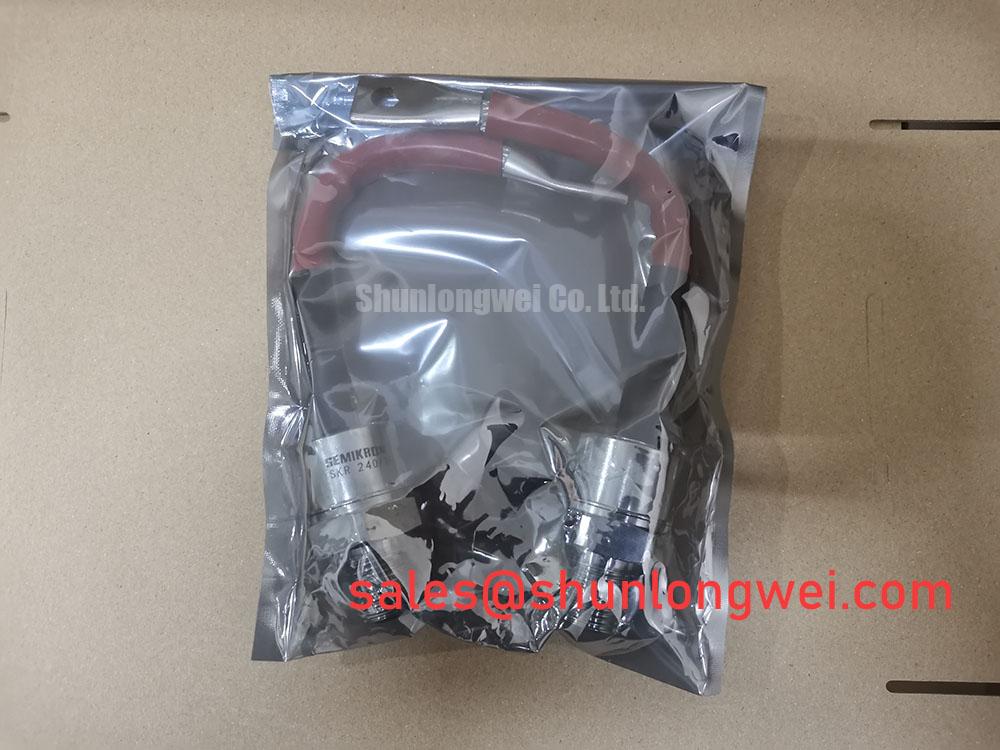
SKR240/16 Semikron 1600V 240A Stud Rectifier Diode
Introduction and Core Highlights
The SKR240/16 is a Semikron stud-mounting rectifier diode optimized for high-current power rectification applications. Featuring a reverse polarity design with the anode on the stud, this power semiconductor simplifies electrical layouts by allowing direct heatsink mounting. It is cataloged under the power semiconductors category, offering robust engineering solutions for heavy-duty industrial platforms.
- Core Specification: 1600V Peak Reverse Voltage | 240A Average Forward Current | M16 x 1.5 Stud Thread.
- Engineering Benefits: Eliminates insulation washers in common-anode heatsink designs and reduces thermal contact resistance.
- Junction Temperature: Operates reliably at temperatures up to 180°C for stable thermal performance under heavy cycling.
Request Official Datasheet (PDF)

Polarity Configuration and Thermal Optimization
When engineering high-power rectifier assemblies, matching polarity is critical for effective space and thermal management. The SKR240/16 features a reverse polarity configuration where the anode connects directly to the threaded stud. This layout makes it the exact counterpart to the cathode-on-stud SKN240/16 diode. Pairing these devices on a single heatsink allows designers to construct rectification bridges without isolation barriers, decreasing overall thermal impedance.
Thermal resistance is a primary limiting factor in high-power semiconductor lifetime. The SKR240/16 exhibits a low junction-to-case thermal resistance ($R_{th(j-c)}$) of 0.16 K/W. You can think of thermal resistance as a narrow funnel in a drainage system; a wider funnel allows water to pass quickly. Similarly, a lower K/W value ensures that generated heat flows rapidly from the silicon junction to the external cooling structure, preventing thermal runaway.

Surge Current Resilience and Passivation
Industrial electrical systems are prone to sudden current surges. The SKR240/16 is rated for a maximum non-repetitive surge peak forward current ($I_{FSM}$) of 5000A at a 10ms half-sinewave pulse. This high surge rating protects the internal silicon wafer from catastrophic failure during transient overloads. The mechanical structure features a hermetic metal-to-glass seal that shields the semiconductor die from moisture and contaminants. This structural sealing mirrors the design principles used in glass passivation for high-reliability components.


Target Application Scenarios
- Industrial Welding Power Supplies: The 5000A peak surge rating accommodates the extreme current fluctuations typical of arc starting.
- Heavy-Duty Battery Chargers: High reverse voltage blocking (1600V) prevents mains line feedback from damaging the battery bank.
- Unregulated DC Power Supplies: Serves as a reliable input rectifier when paired with similar high-capacity stud components like the SKR 320/08.
- AC-to-DC Converter Bridges: Ideal for non-isolated heatsink designs where anode-to-stud polarity simplifies busbar routing.
Best Match: The SKR240/16 is best suited for non-isolated bridge rectification designs demanding high thermal tolerance and up to 240A continuous current.
Key Technical Specifications
| Parameter | Official Value | Conditions |
|---|---|---|
| Repetitive Peak Reverse Voltage ($V_{RRM}$) | 1600 V | Max rating |
| Average Forward Current ($I_{F(AV)}$) | 240 A | $T_c = 100^circtext{C}$ |
| Surge Forward Current ($I_{FSM}$) | 5000 A | 10 ms, half-sine, $T_j = 180^circtext{C}$ |
| Forward Voltage Drop ($V_F$) | 1.55 V | Max at $I_F = 750text{ A}$ |
| Thermal Resistance ($R_{th(j-c)}$) | 0.16 K/W | Junction to case |
| Operating Junction Temperature ($T_j$) | -40 to +180 °C | Continuous operation range |
| Mounting Torque | 30 Nm | Nominal torque for M16 thread |
Engineer FAQ
Q: What is the main difference between the SKR240/16 and the SKN240/16?
A: The difference is the polarity configuration. The SKR240/16 features the anode connected to the stud thread (reverse polarity), whereas the SKN240/16 has the cathode connected to the stud. They are typically used together on a single heatsink to create bridge rectifiers.
Q: What happens if the mounting torque deviates from the specified 30 Nm?
A: Tightening the M16 thread below 30 Nm increases the contact thermal resistance, causing the device to overheat. Exceeding 30 Nm can permanently deform the copper stud base and rupture the internal silicon junction.
Q: Is the SKR240/16 suitable for high-frequency switching power supplies?
A: No. The SKR240/16 is a standard recovery diode designed for line frequency rectification (50/60 Hz). High-frequency switching applications require fast recovery or Schottky diodes to prevent severe switching losses.
By pairing reverse-polarity options like the SKR240/16 with standard polarity stud diodes, power electronics engineers can simplify cooling structures and optimize packaging layout. The 1600V and 240A ratings provide electrical safety margins required for demanding industrial applications.