Optrex DMF50260NFU-FW-15: 9.4-Inch VGA Monochrome FSTN LCD Module for Legacy Industrial HMIs
DMF50260NFU-FW-15 Optrex 9.4-Inch VGA Industrial STN LCD
The DMF50260NFU-FW-15 is a legacy 9.4-inch monochrome Film-compensated Super Twisted Nematic (FSTN) liquid crystal display module designed by Optrex (now Kyocera). Featuring a 640×480 (VGA) resolution and a high-transmissivity transflective architecture, this unit delivers crisp black-and-white graphics and alphanumeric text in challenging ambient lighting conditions. It integrates a Cold Cathode Fluorescent Lamp (CCFL) backlight system, standard 4-bit parallel data interface, and a built-in LC79401/LC79402 row/column driver structure for dependable performance in demanding human-machine interface architectures.


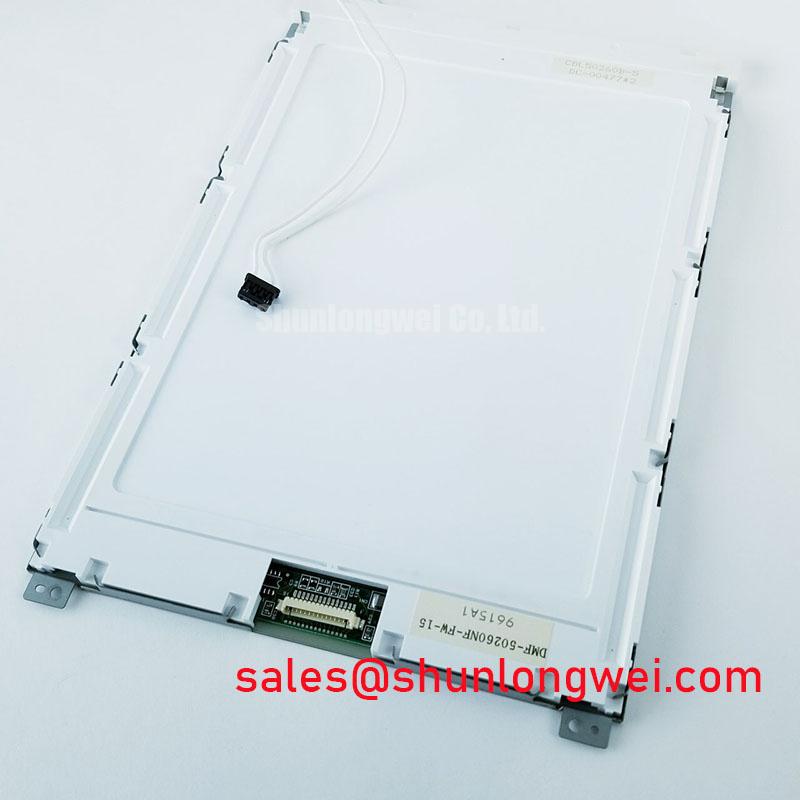
- Core Display Format: 9.4-inch Diagonal | 640 × 480 Dots | 0.30 × 0.30 mm Dot Pitch
- Optical & Electrical Ratings: Transflective FSTN Mode | Black & White Display | CCFL Backlight System
- Key Advantage: Direct drop-in maintenance path for classic industrial instrumentation and legacy CNC terminals.
- Integration Value: Eliminates display redesign overhead through standardized 4-bit parallel timing sequences.
Engineering Value Proposition & Optical Analysis
The DMF50260NFU-FW-15 utilizes Film-compensated Super Twisted Nematic (FSTN) technology, incorporating an optical compensation film that suppresses color tinting and provides a high-contrast ratio (typically 20:1) with a pure black-on-white image. In industrial process control, optical clarity directly affects operator precision. Think of the optical retardation film like a pair of high-grade polarized sunglasses: it selectively aligns and straightens skewed light waves passing through the liquid crystal layer, ensuring sharp character outlines regardless of fluctuating ambient light levels. You can learn more about display compensation mechanisms in our guide to industrial display compensation.
Operating with a 1/240 duty cycle and 1/14 bias, the panel manages 640×480 pixels using onboard high-voltage driver ICs. The dual-voltage architecture requires a +5.0V logic supply ($V_{DD}$) and a dedicated negative bias supply ($V_{EE}$ typically around -22V to -24V, generating an operational $V_{LCD} = V_{DD} – V_{EE}$ between 20V and 27V depending on ambient temperature). Maintaining an appropriate $V_{LCD}$ curve prevents cross-talk and ensures consistent contrast throughout the operating temperature range from 0°C to +50°C. For system designs handling similar passive panels, review our technical coverage of the DMF50260NFU-FW-27 and related DMF-50260NFU-FW-23 displays.
Backlighting is supplied by a replaceable single CCFL tube along the top edge, coupled with a light guide panel (LGP) and diffuser sheet. This provides uniform illumination across the $197.0 times 148.0text{ mm}$ active viewing area. System integrators must drive the lamp with a compatible high-voltage inverter providing an ignition voltage of approximately 1000–1300 $V_{RMS}$ and an operating current of 5.0 $mA_{RMS}$ at 25–40 kHz. The physical dimensions and mounting holes match the broader DMF-50260 series footprint, ensuring backwards mechanical compatibility during field retrofits. For detailed comparisons with other monochrome options, explore our LCD core technology technical archives.
Recommended Application Scenarios
- Legacy CNC Controllers & Machine Tools: Direct replacement for worn or damaged graphic displays in retrofitted Fanuc, Mitsubishi, and Heidenhain operating consoles.
- Medical Diagnostic & Laboratory Equipment: Suitable for legacy biochemical analyzers, ultrasound displays, and electrocardiographs requiring stable grayscale rendering.
- Industrial Process & Flow Monitors: Delivers sharp visualization of waveforms, pump metrics, and flow diagrams in manufacturing automation racks.
- Commercial Measurement Instrumentation: Reliable display interface for spectrum analyzers, power monitors, and automated test equipment (ATE).
Best Fit Application: Ideal for sustaining operational availability in legacy industrial terminals without undergoing expensive mechanical or firmware redesigns.
Technical Specifications
| Category | Parameter | Specification / Typical Value |
|---|---|---|
| Mechanical Characteristics | Module Dimensions ($W times H times D$) | $260.0 times 180.0 times 10.0text{ mm}$ (approx.) |
| Active Area ($W times H$) | $191.97 times 143.97text{ mm}$ (9.4-inch diagonal) | |
| Effective Viewing Area | $197.0 times 148.0text{ mm}$ | |
| Dot Format (Resolution) | $640 times 480text{ dots}$ (VGA) | |
| Dot Pitch / Dot Size | $0.30 times 0.30text{ mm}$ / $0.27 times 0.27text{ mm}$ | |
| Weight | Approx. 450 g | |
| Electrical Characteristics | Logic Supply Voltage ($V_{DD} – V_{SS}$) | $+5.0text{V} pm 5%$ |
| LCD Driving Voltage ($V_{LCD} = V_{DD} – V_O$) | $22.0text{V} – 25.5text{V}$ (Adjustable based on temp) | |
| Logic Current Consumption ($I_{DD}$) | Typ. $8.0text{ mA}$ ($V_{DD} = 5.0text{V}$) | |
| LCD Driving Current ($I_{EE}$) | Typ. $10.0text{ mA}$ ($V_{EE} = -22.0text{V}$) | |
| Signal Interface | 4-Bit Parallel (D0–D3, CP, LP, FLM, DISP) | |
| Optical & Backlight Ratings | Display Mode | FSTN / Black & White / Transflective |
| Contrast Ratio ($CR$) | Typ. $20:1$ at $theta = 0^circ, phi = 0^circ$ | |
| Response Time ($t_r / t_d$) | Typ. $160text{ ms} / 110text{ ms}$ (at 25°C) | |
| Backlight Type & Current | $1timestext{CCFL}$ | $5.0text{ mA}_{RMS}$ ($V_L approx 350text{V}_{RMS}$) | |
| Environmental Limits | Operating Temperature | $0^circtext{C to } +50^circtext{C}$ |
| Storage Temperature | $-20^circtext{C to } +60^circtext{C}$ |
Frequently Asked Questions for Integration Engineers
Q1: What interface signals are required to drive the DMF50260NFU-FW-15?
The module requires standard STN timing lines: FLM (First Line Marker / Frame Start), LP (Latch Pulse / Horizontal Sync), CP (Clock Pulse / Data Shift Clock), DISP (Display Enable), and a 4-bit data bus (D0 through D3). A micro-controller or FPGA graphic engine must stream 4 pixels per clock cycle across 160 clock pulses to complete each 640-pixel line.
Q2: Why does the display contrast vary across ambient temperatures?
Liquid crystal viscosity and threshold switching voltages change naturally with ambient temperature. To maintain optimal legibility and contrast between 0°C and +50°C, designers must adjust $V_{LCD}$ ($V_{DD} – V_{EE}$) using a thermistor-based temperature compensation feedback circuit on the power supply rail.
Q3: What precautions should be taken when connecting the CCFL backlight?
The CCFL requires high-frequency alternating current ($25text{–}40text{ kHz}$) and starting voltages over $1000text{ V}_{RMS}$. Keep high-voltage inverter leads as short as possible to prevent parasitic capacitance losses and electromagnetic interference (EMI) with the 4-bit data bus.
The Optrex DMF50260NFU-FW-15 remains a standard FSTN monochrome solution for sustaining long-lifecycle instrumentation, automation consoles, and mission-critical legacy HMI systems.