A Technical Deep Dive into the Toshiba MIG20J902H Intelligent Power Module
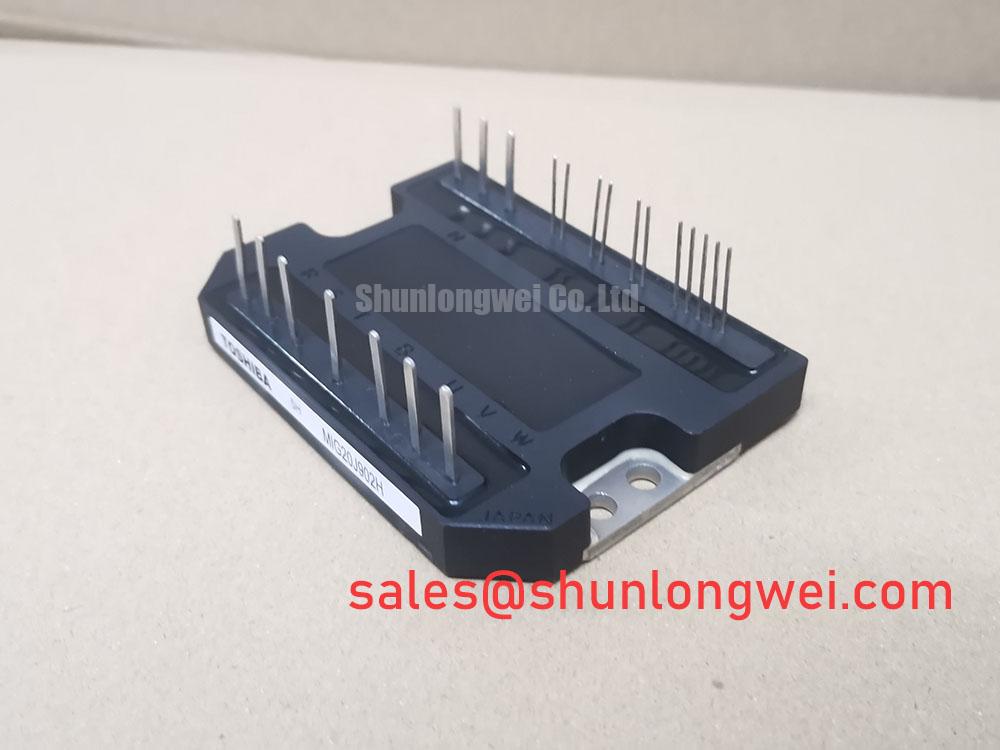
Toshiba MIG20J902H 600V 20A 6-in-1 Intelligent Power Module
Introduction to the MIG20J902H IPM
The Toshiba MIG20J902H is a highly integrated Intelligent Power Module (IPM) that combines six Insulated Gate Bipolar Transistors (IGBTs) and freewheeling diodes (FWDs) into a single, compact package. This module simplifies the power stage of three-phase motor control systems by including gate drivers and protection circuits. Its primary value is enabling engineers to develop smaller, more reliable low-to-medium power inverters with a significantly reduced component count and accelerated design cycle.
- Core Specifications: 600V | 20A | 6-in-1 IGBT Configuration
- Key Advantages: Integrated gate drivers and protection circuits reduce design complexity. A built-in thermistor allows for real-time temperature monitoring.
This integrated approach is crucial for applications where board space and reliability are priorities. By providing a pre-optimized power stage, the module helps mitigate common issues related to parasitic inductance that can arise in discrete component layouts.
Download the Official Datasheet (PDF)

Technical Analysis: Integration and Reliability
The engineering value of the MIG20J902H extends beyond its basic ratings. The integration of drivers and protection circuits within the module provides distinct advantages. The internal High-Voltage IC (HVIC) manages gate driving, including the necessary level-shifting for the high-side IGBTs, which removes the need for external gate drive transformers or optocouplers. This tight integration minimizes signal path lengths, leading to more predictable and reliable switching behavior.
A standout feature is the comprehensive suite of on-board protection. The module includes safeguards against overcurrent (OC), short-circuits (SC), control supply undervoltage (UV), and over-temperature (OT) conditions. Think of these integrated protections as a vehicle’s advanced driver-assistance system; they react instantly to dangerous conditions to prevent catastrophic failure, a level of response difficult and costly to replicate with discrete components. For example, the short-circuit protection is designed to shut down the IGBTs in a controlled manner if a fault is detected, preserving the device. A fault signal (Fo) pin provides diagnostic feedback to the system’s microcontroller.
Furthermore, the inclusion of an on-chip thermistor simplifies thermal management. This allows for direct monitoring of the module’s substrate temperature, providing critical data for the system’s cooling strategy and enabling proactive fault detection. This is essential for achieving the long-term operational reliability detailed in guides on IGBT module safety and reliability.


Optimized Application Scenarios
The specific characteristics of the MIG20J902H make it a strong candidate for several applications:
- Low-Power AC Motor Drives: The 20A rating and integrated design are ideal for compact variable frequency drives (VFDs) up to approximately 2.2 kW.
- Air Conditioner Compressors: The high level of integration and built-in protection enhance the reliability of HVAC systems, where long-term, maintenance-free operation is essential.
- Servo Drives: In robotics and automation, the module’s ability to simplify the power stage allows for smaller, more efficient servo amplifiers.
- Washing Machine and Fan Motors: Its cost-effectiveness and robust protection suite are well-suited for appliance motor control.
This module is best matched for motor control systems under 3kW requiring a compact, highly reliable, and protected inverter stage.
Key Specifications of the MIG20J902H
| Absolute Maximum Ratings (Tj = 25°C) | |
|---|---|
| Supply Voltage (VCC) | 450V |
| Collector-Emitter Voltage (Vces) | 600V |
| Collector Current (Ic) | 20A |
| Collector Power Dissipation (Pc) | 52W |
| Junction Temperature (Tj) | 150°C |
| Electrical Characteristics (Tj = 25°C) | |
| Collector-Emitter Saturation Voltage (VCE(sat)) | 2.4V (Typ) / 2.9V (Max) at Ic = 20A |
| Diode Forward Voltage (Vf) | 2.2V (Typ) / 2.7V (Max) at Ie = 20A |
| Short Circuit Protection Trip Level (ISC) | 35A (Typ) |
Engineer’s FAQ
- How does the MIG20J902H simplify 3-phase inverter design?
- It integrates the complete power stage: six IGBTs, six FWDs, and the necessary high-side and low-side gate drivers with level shifting. This eliminates the need for numerous discrete components and complex gate drive circuits, reducing PCB space and potential sources of failure. The designer only needs to provide PWM signals and a control power supply.
- What are the main thermal management considerations for this module?
- Proper heatsinking is critical. The datasheet specifies a maximum case temperature (Tc) of 100°C. The thermal resistance from junction to case (Rth(j-c)) is 2.4°C/W for the IGBT and 4.0°C/W for the diode. A heatsink must be selected to ensure the junction temperature stays below the 150°C maximum under worst-case operating conditions. Utilizing the built-in thermistor is highly recommended for active thermal monitoring.
- Do I need an external gate driver for the MIG20J902H?
- No. The module contains integrated HVICs and LVICs that provide full gate drive functionality. You interface directly with the module using 5V logic-level PWM signals for each of the six IGBTs, as outlined in the datasheet’s timing requirements.
- What is the function of the Fo (fault output) pin?
- The Fo pin is an open-drain output that signals a fault condition, such as short circuit (SC), undervoltage (UV) on the control supply, or over-temperature (OT). When a fault occurs, this pin goes low, alerting the host microcontroller to take protective action, like disabling PWM signals.
Enabling Compact and Robust Motor Control
The MIG20J902H provides a validated and compact power stage that enables engineers to focus on system-level innovation rather than on the complexities of power semiconductor layout and protection. By integrating critical functions into a single, thermally efficient package, this IPM serves as a foundational building block for creating smaller and more reliable motor control solutions. For those working on next-generation systems, exploring the advantages of integrated power modules is a crucial step toward achieving performance and reliability goals.