A Technical Review of the VUO50-08NO3 Three-Phase Rectifier
VUO50-08NO3 Three-Phase Bridge Rectifier | 800V, 55A
Technical Analysis of the VUO50-08NO3 Three-Phase Rectifier
The VUO50-08NO3 from IXYS/Littelfuse is a three-phase uncontrolled rectifier bridge engineered for reliable AC-to-DC power conversion in demanding industrial environments. Its core value proposition lies in delivering robust performance through high electrical isolation and thermal efficiency. The module integrates planar passivated diode chips onto a Direct Copper Bonded (DCB) ceramic base plate, a construction that ensures both longevity and stable operation under thermal stress.
- Core Specifications: 800V VRRM | 55A IdAV | 3000V~ Isolation Voltage.
- Key Advantages: Facilitates simplified thermal management and ensures high system safety.
- Primary Function: Efficiently converts three-phase AC input into a stable DC output for power supplies and motor drive front-ends.
Download the VUO50-08NO3 Official Datasheet (PDF)
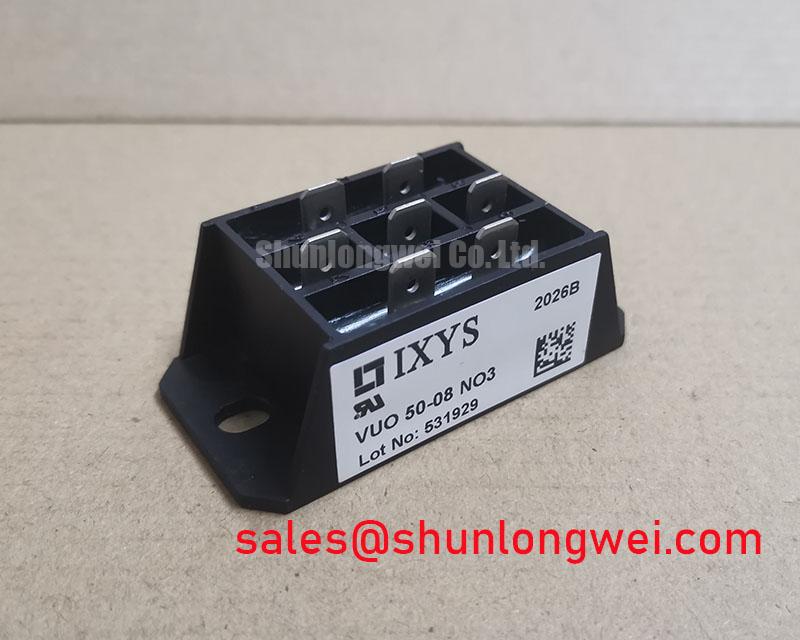

Engineered for Isolation and Thermal Performance
A critical parameter for industrial power components is the isolation voltage. The VUO50-08NO3 specifies an isolation voltage (VISOL) of 3000V~ (RMS) for one minute. This high level of isolation is essential for protecting sensitive downstream control electronics and ensuring operator safety by preventing high voltage from crossing over to the low-voltage side. Think of this DCB ceramic baseplate as a fortified electrical barrier; it effectively separates the high-power AC input from the rest of the system, a fundamental requirement for building compliant and reliable industrial equipment.
The module’s thermal design directly contributes to its operational efficiency and reliability. The specified thermal resistance from junction to case (RthJC) is 0.3 K/W per diode. This low value signifies a highly efficient pathway for heat to escape from the active silicon chips to the heatsink. This efficiency is analogous to a wide pipe allowing a large volume of water to flow freely. A lower thermal resistance means the diodes can run cooler for a given load current, which minimizes power loss and extends the component’s operational lifespan. This is a key factor in mastering thermal design in power systems.
Optimized Application Scenarios
The specific characteristics of the VUO50-08NO3 make it a strong candidate for several power conversion applications. Its architecture provides a straightforward solution for the input stage of many systems.
- Input Rectifiers for PWM Inverters: The module’s 800V reverse voltage rating provides a safe operating margin for standard 380-480V AC line inputs, and its 55A current handling is sufficient for many low-to-mid-power Variable Frequency Drives (VFDs).
- Supplies for DC Power Equipment: For general-purpose industrial power supplies, the VUO50-08NO3 offers a compact, easy-to-mount solution for AC/DC rectification, simplifying assembly.
- Battery Charging Systems: The robust surge current rating (IFSM) of 450A ensures the rectifier can withstand the inrush currents often encountered when charging large capacitor banks or batteries.
- DC Motor Field Current Supplies: The module provides a reliable, unregulated DC source required for the field windings of DC motors.
This module is best matched for applications requiring a robust, isolated, and thermally efficient front-end rectifier for three-phase systems up to 25 kW.
Key Technical Specifications
| Parameter | Symbol | Value | Unit |
|---|---|---|---|
| Repetitive Peak Reverse Voltage | VRRM | 800 | V |
| Average Forward Current (TC = 85°C) | IdAV | 55 | A |
| Peak Forward Surge Current (10 ms, 50 Hz) | IFSM | 450 | A |
| Forward Voltage (IF = 50 A, TVJ = 25°C) | VF | 1.19 (Typ.) | V |
| Isolation Voltage (50/60Hz, RMS, 1 min) | VISOL | 3000 | V~ |
| Thermal Resistance, Junction to Case (per diode) | RthJC | 0.3 | K/W |
| Operating Junction Temperature Range | TVJ | -40 to +150 | °C |
Engineer’s FAQ
1. What are the main applications for an 800V three-phase rectifier like the VUO50-08NO3?
This module is primarily intended for the input stages of industrial systems connected to 380V or 480V three-phase AC lines. Common applications include AC motor drives, uninterruptible power supplies (UPS), industrial power supplies, and battery chargers where a simple and robust AC-to-DC conversion is needed.
2. What is the recommended mounting torque for this module?
The datasheet specifies a mounting torque of 1.5 – 2.0 Nm (or 13-18 lb.in.). Adhering to this specification is critical. Insufficient torque leads to poor thermal contact with the heatsink, increasing junction temperature. Excessive torque can damage the ceramic substrate, compromising the module’s isolation and mechanical integrity.
3. What does the use of “planar passivated chips” imply for the device’s reliability?
Planar passivation is a manufacturing process that creates a stable and robust silicon dioxide layer on the surface of the diode chip. This layer protects the sensitive p-n junction from environmental contaminants and electrical field effects at the surface. The result is a device with lower leakage currents, higher voltage stability, and enhanced long-term reliability, which is a cornerstone of devices like those based on glass passivation technology.
4. Does this module require external freewheeling diodes?
As an uncontrolled input rectifier, the VUO50-08NO3 does not typically require external freewheeling diodes for its own operation. Freewheeling diodes are generally used on the output side of a controlled rectifier (like a thyristor bridge) or in chopper/inverter stages to handle inductive load currents.
This VUO50-08NO3 rectifier bridge provides a foundation for high-reliability power conversion systems. Its integration of efficient thermal performance with high electrical isolation enables engineers to develop compact and safe power solutions for a range of industrial applications.