An In-Depth Guide to the Semikron SKIIP 82AC12IT1 1200V MiniSKiiP IGBT Module
Semikron SKIIP 82AC12IT1 1200V MiniSKiiP IGBT Module
Introduction and Core Specifications
The SKIIP 82AC12IT1 is a highly integrated, baseplate-less 3-phase converter IGBT Module optimized for industrial motor drives and high-efficiency power conversion. Utilizing advanced Semikron SKiiP® Technology, this component implements a solder-free spring contact interface to maximize thermomechanical reliability.
- Core Ratings: 1200V maximum collector-emitter voltage, 15A nominal collector current, and a low typical $V_{CE(sat)}$ of 1.7V at $T_j = 125^circ C$.
- Engineering Benefits: Solderless PCB assembly streamlines production, while the absence of a copper baseplate mitigates stress under extreme thermal cycling.
- Thermal Safety: The integrated NTC thermistor enables precise, real-time temperature tracking for active system protection.
Download Official Datasheet (PDF)
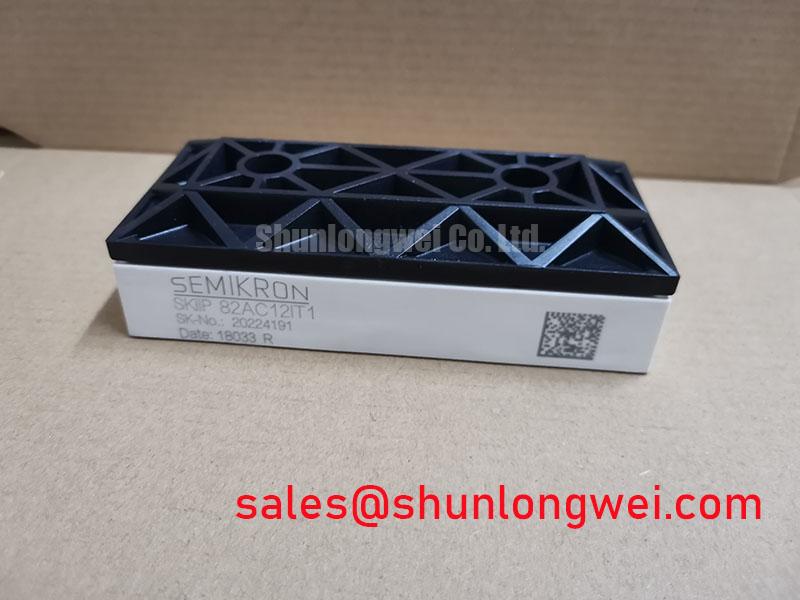


In-depth Technical Analysis
The thermal structure of the SKIIP 82AC12IT1 utilizes a baseplate-less design. In traditional modules, mismatched thermal expansion coefficients between the copper baseplate and the ceramic substrate cause solder fatigue over time. By eliminating the baseplate, the ceramic substrate couples directly to the heatsink, vastly extending the power cycling lifetime of the module under fluctuating loads.
For electrical connections, solder-free spring contacts form the interface for control and power paths. When the housing is mechanically clamped, these preloaded springs establish a high-pressure contact. This design avoids the typical crack propagation seen in solder joints under thermal stress. To explain this thermomechanical system, think of the heatsink assembly as a water drain: a baseplate-less module behaves like a wider pipe, allowing heat to escape directly into the heatsink without hitting the thermal bottlenecks caused by intermediate solder layers.


Additionally, the module features a CAL freewheeling diode. This Controlled Axial Lifetime diode offers soft recovery characteristics, which minimize high-frequency electromagnetic interference (EMI) during switching transitions. Proactive thermal monitoring is handled by the integrated NTC sensor, which outputs resistance changes mapped directly to the internal ceramic substrate temperature.
Optimized Industrial Applications
- Variable Frequency Drives (VFDs): The 1200V rating is ideal for standard 380V to 480V three-phase AC motor controllers, providing robust current capabilities.
- Solar Inverters: High-efficiency operation is supported by low-loss Trench IGBT3 technology, reducing overall switching losses under high-frequency PWM regimes.
- Industrial UPS Systems: Reliable waveform reconstruction is achieved via the fast switching speed and stable diode characteristics of the module.
- Servo Drives: The compact packaging of the module allows for space-constrained physical integration within robotic joints and automation cabinets.
Best-Fit Recommendation: Optimized for compact, high-reliability industrial power stages requiring baseplate-less thermal dissipation and solder-free mechanical mounting at 15A continuous loads.
Key Specifications Parameter Table
| Parameter | Typical Value | Maximum Rating | Conditions / Notes |
|---|---|---|---|
| Collector-Emitter Voltage ($V_{CES}$) | – | 1200 V | $T_j = 25^circ C$ |
| Continuous Collector Current ($I_C$) | 15 A | 25 A | $T_s = 80^circ C$ / $T_s = 25^circ C$ |
| IGBT Saturation Voltage ($V_{CE(sat)}$) | 1.7 V | 2.1 V | $I_C = 15 A, T_j = 125^circ C$ |
| Diode Forward Voltage ($V_F$) | 1.8 V | 2.2 V | $I_F = 15 A, T_j = 125^circ C$ |
| Short Circuit Current Delay ($t_{psc}$) | 10 µs | – | $V_{CC} = 600V, V_{GE} le 15V, T_j = 125^circ C$ |
| Integrated NTC Resistance | 5000 Ω | – | $T = 25^circ C$ |
Engineer’s Frequently Asked Questions
Q: How does the baseplate-less design of the SKIIP 82AC12IT1 affect thermal calculations?
A: The absence of a copper baseplate eliminates the case-to-sink thermal resistance step ($R_{th(c-s)}$). Thermal resistance is defined directly from junction to heatsink ($R_{th(j-s)}$). Engineers should design heatsink contact profiles to match the specified substrate flatness values under pressure to avoid air gaps.
Q: What mounting precautions must be observed during the solderless assembly?
A: Mounting relies entirely on uniform pressure applied by the clamping screws. PCBs must be within standard mechanical flatness tolerances, and the mounting screws should be tightened to the recommended torque specification (typically 2.0 to 2.5 Nm) to prevent mechanical cracking of the ceramic substrate.
Q: Is a negative gate-drive turn-off voltage required for this module?
A: While standard Trench IGBT3 devices can be turned off with $0text{V}$, applying a negative gate-bias voltage (such as $-8text{V}$ to $-15text{V}$) is highly recommended to protect against parasitic turn-on events triggered by high-$dv/dt$ transients in industrial designs.
Closing Summary
The SKIIP 82AC12IT1 offers a robust power-switching platform for compact, high-reliability inverter designs. By combining Trench IGBT3 performance with Semikron’s solderless spring-contact technology, this module mitigates standard mechanical failure modes while optimizing thermal dissipation. This configuration allows engineers to reduce system footprints and simplify overall manufacturing flows.