CM20TF-12H IGBT: Technical Review and Application Guide
Mitsubishi CM20TF-12H IGBT: A 6-in-1 Three-Phase Module
Integrated Power Stage for Compact Motor Control and Inverters
The Mitsubishi CM20TF-12H is an IGBT module that integrates a full three-phase bridge into a single, compact component. This 6-in-1 configuration simplifies the design of power electronics by consolidating six IGBTs and six free-wheeling diodes, reducing both component count and assembly complexity. It is engineered for medium-power switching applications where efficient and straightforward inverter design is a primary objective.
- Core Specifications: 600V | 20A | 2500Vrms Isolation
- Key Advantages: Simplifies PCB layout, enhances thermal management
This module’s architecture directly addresses the need for compact solutions in applications like small motor drives, where space and ease of assembly are critical engineering considerations.
Download the CM20TF-12H Datasheet (PDF)
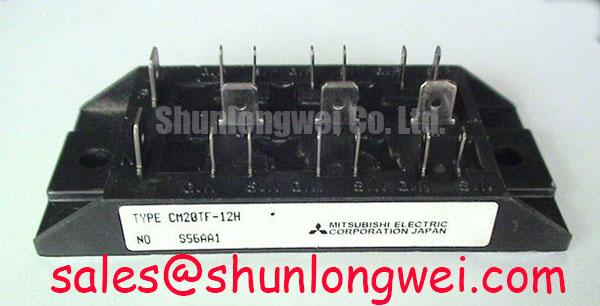
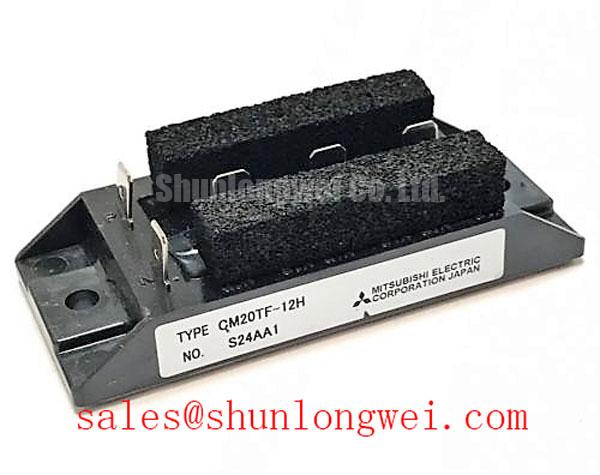
Technical Analysis for System Integration
The primary engineering value of the CM20TF-12H module lies in its high level of integration. By co-packaging the entire three-phase inverter, the physical loops between transistors and diodes are minimized. This inherently reduces stray inductance compared to a design using discrete components. Lower parasitic inductance results in lower voltage overshoots during high-speed switching, which can reduce the need for larger snubber circuits and mitigate EMI challenges.
Another key feature documented in the datasheet is the module’s electrical isolation. With an isolation voltage (Viso) of 2500Vrms for one minute, the baseplate is insulated from all power terminals. This allows the module to be mounted directly onto a grounded heatsink, simplifying thermal design and assembly. Think of the module’s thermal resistance as a bridge for heat; the single isolated baseplate provides a wide, predictable path for thermal energy to move from the semiconductor junctions to the cooling system, ensuring more reliable temperature management.
Optimized Application Scenarios
The electrical characteristics and physical construction of the CM20TF-12H make it well-suited for several specific applications:
- AC Motor Control: The 600V/20A rating is ideal for driving fractional to low-horsepower three-phase induction motors in industrial equipment.
- Motion/Servo Control: Its configuration provides the necessary three half-bridges to precisely control the phases of AC servo motors, enabling accurate positioning systems.
- Uninterruptible Power Supplies (UPS): The module can function as the core inverter stage in a double-conversion UPS, converting DC power back to a stable AC output.
- Welding Power Supplies: Suitable for the inverter stage in some welding applications that require controlled high-frequency power switching.
This module is best matched for power conversion systems under 7.5 kW that prioritize a reduced bill of materials and simplified thermal architecture.
Key Specifications of the CM20TF-12H
| Absolute Maximum Ratings (Tj = 25°C) | |
|---|---|
| Collector-Emitter Voltage (VCES) | 600V |
| Gate-Emitter Voltage (VGES) | ±20V |
| Collector Current (IC) | 20A |
| Maximum Collector Dissipation (Pc) | 125W |
| Junction Temperature (Tj) | -40 to +150°C |
| Isolation Voltage (Viso) | 2500Vrms |
| Electrical Characteristics (Tj = 25°C) | |
| Collector-Emitter Saturation Voltage (VCE(sat)) | 2.7V (Max) at IC = 20A, VGE = 15V |
| Gate-Emitter Threshold Voltage (VGE(th)) | 4.0 to 8.0V at IC = 2mA, VCE = 10V |
| Free-Wheel Diode Forward Voltage (VF) | 2.5V (Max) at IE = 20A |
Engineer’s FAQ
What is the internal configuration of the CM20TF-12H?
The module contains six IGBTs and six corresponding super-fast recovery free-wheel diodes arranged in a three-phase bridge (6-in-1) configuration. All components are internally connected and electrically isolated from the baseplate, simplifying external circuitry.
What are the mounting torque recommendations for this module?
The datasheet specifies a mounting torque for the M5 mounting screws between 1.47 and 1.96 N·m. Applying the correct torque is critical to ensure proper thermal contact between the module’s baseplate and the heatsink. Uneven or incorrect torque can lead to poor heat transfer and potential device failure.
How does the collector-emitter saturation voltage (VCE(sat)) affect system efficiency?
VCE(sat) is the voltage drop across the IGBT when it is fully turned on. A lower VCE(sat) means less power is dissipated as heat during the on-state (conduction loss). The CM20TF-12H has a maximum VCE(sat) of 2.7V, which is a key parameter for calculating total power loss and determining the required cooling capacity.
Does this module include an NTC thermistor?
Based on the provided circuit diagram in the datasheet, the CM20TF-12H does not include an integrated NTC thermistor for temperature monitoring. External temperature sensing on the heatsink near the module is recommended for thermal protection.
Enabling Simplified Power Designs
The CM20TF-12H provides a robust, integrated foundation for power inverter designs. Its consolidated three-phase topology allows engineers to accelerate development, reduce system complexity, and simplify thermal management for a range of low-to-medium power motor control and power conversion applications.