DD89N18K Infineon 1800V 89A Rectifier Diode Module: Reliability through Pressure Contact Technology
DD89N18K Infineon 1800V 89A Rectifier Diode Module
Reliable Power Conversion with Advanced Pressure Contact Technology
The DD89N18K is a high-performance rectifier diode module engineered by Infineon for demanding industrial applications. This Diode-Diode configuration is built on pressure contact technology, which ensures superior thermal cycling capability and mechanical robustness compared to soldered alternatives. With a repetitive peak reverse voltage of 1800V and an average forward current of 89A at a case temperature of 100°C, this module provides a stable foundation for high-voltage rectification systems. Engineers often ask, “How do I calculate the power dissipation for the DD89N18K in a continuous load environment?” To determine this, one must analyze the forward voltage drop (VF) and thermal resistance parameters provided in the official technical documentation.
Download Official DD89N18K Datasheet (PDF)
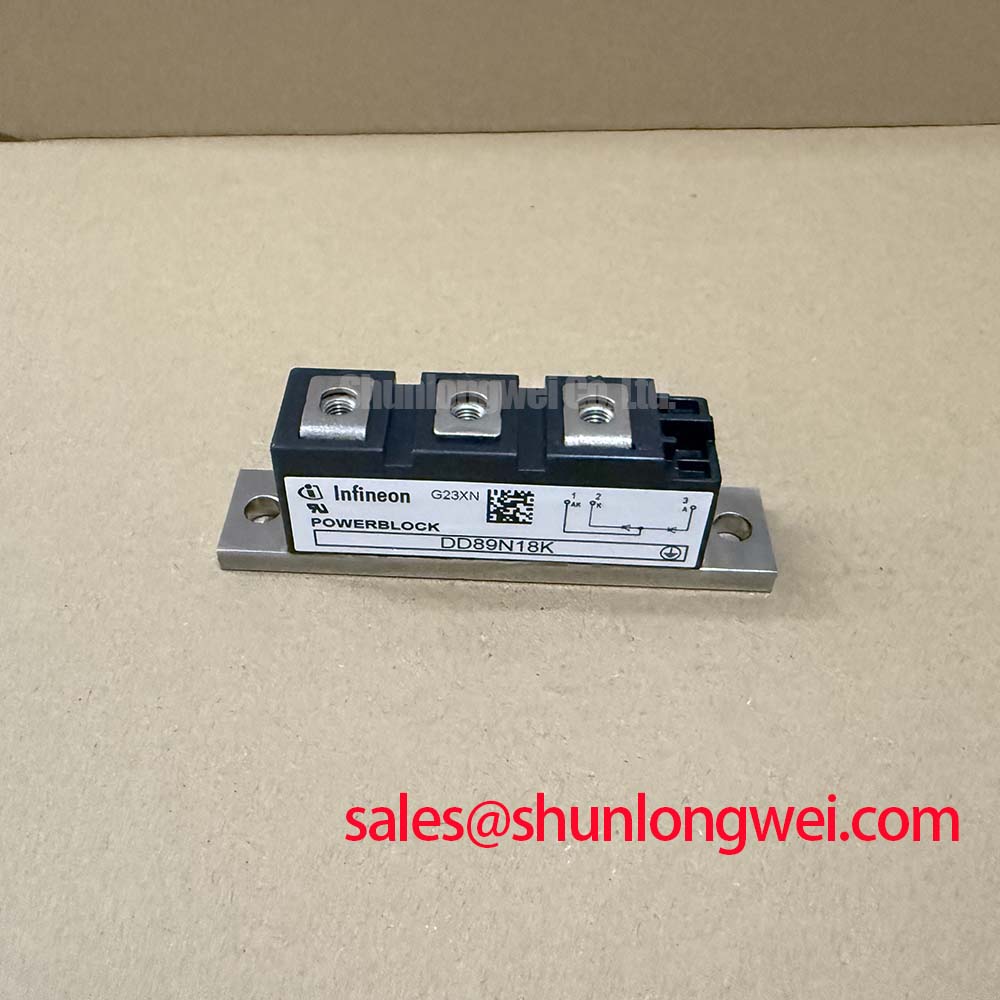
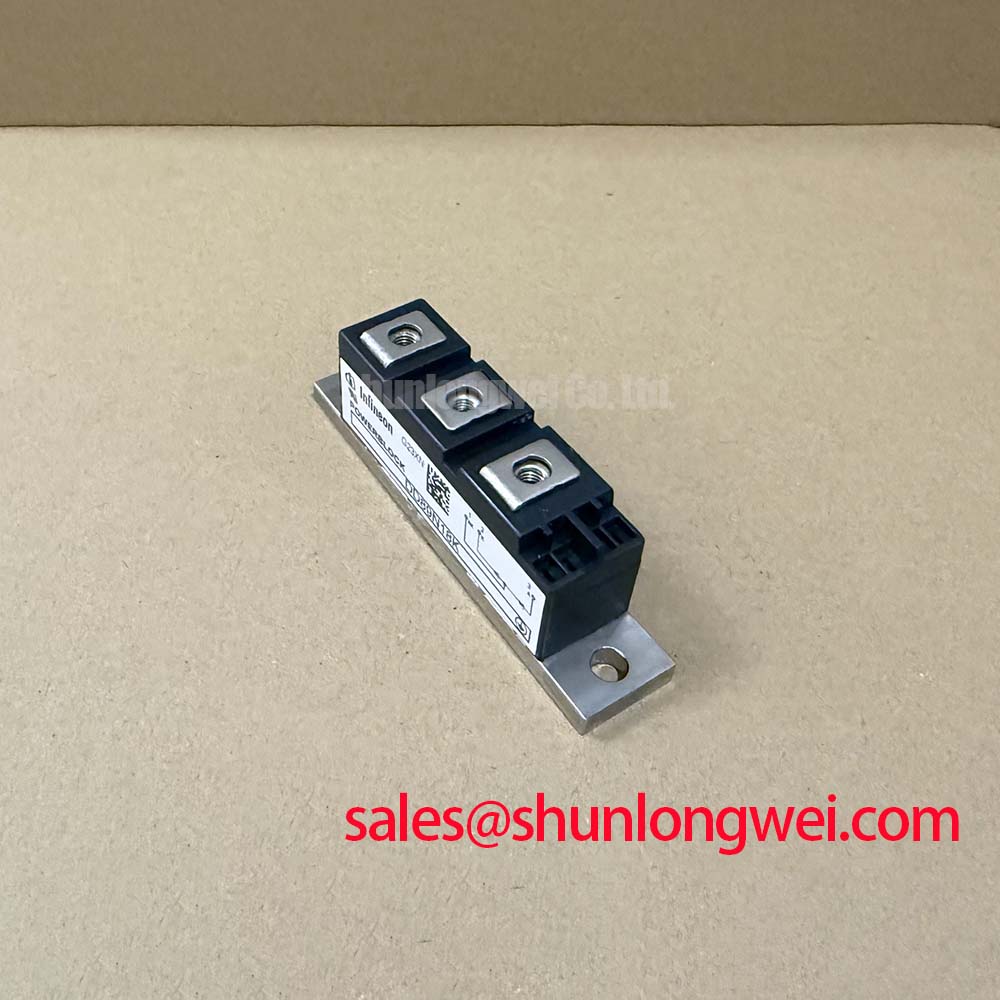
Technical Analysis: Engineering Resilience and Efficiency
The UVP (Unique Value Proposition) of the DD89N18K lies in its exceptional surge current resilience. It features a maximum non-repetitive peak surge current (IFSM) of 1800A at 10ms. You can think of the surge current rating as the width of a structural beam; a higher rating means the device can absorb sudden massive “weight” or electrical transients without fracturing its internal semiconductor structure. This robustness is critical in industrial environments where line voltage fluctuations and inductive load switching are common occurrences.
From an efficiency standpoint, the module maintains a low maximum forward voltage drop of 1.30V at a peak current of 300A. Minimizing VF is essential because every millivolt saved translates directly into lower thermal dissipation. This design choice helps engineers maintain lower junction temperatures ($T_{vj}$ up to 150°C), thereby extending the operational lifespan of the entire power stack. Effective thermal management is further supported by an isolated baseplate, which simplifies the mounting process onto aluminum heat sinks.
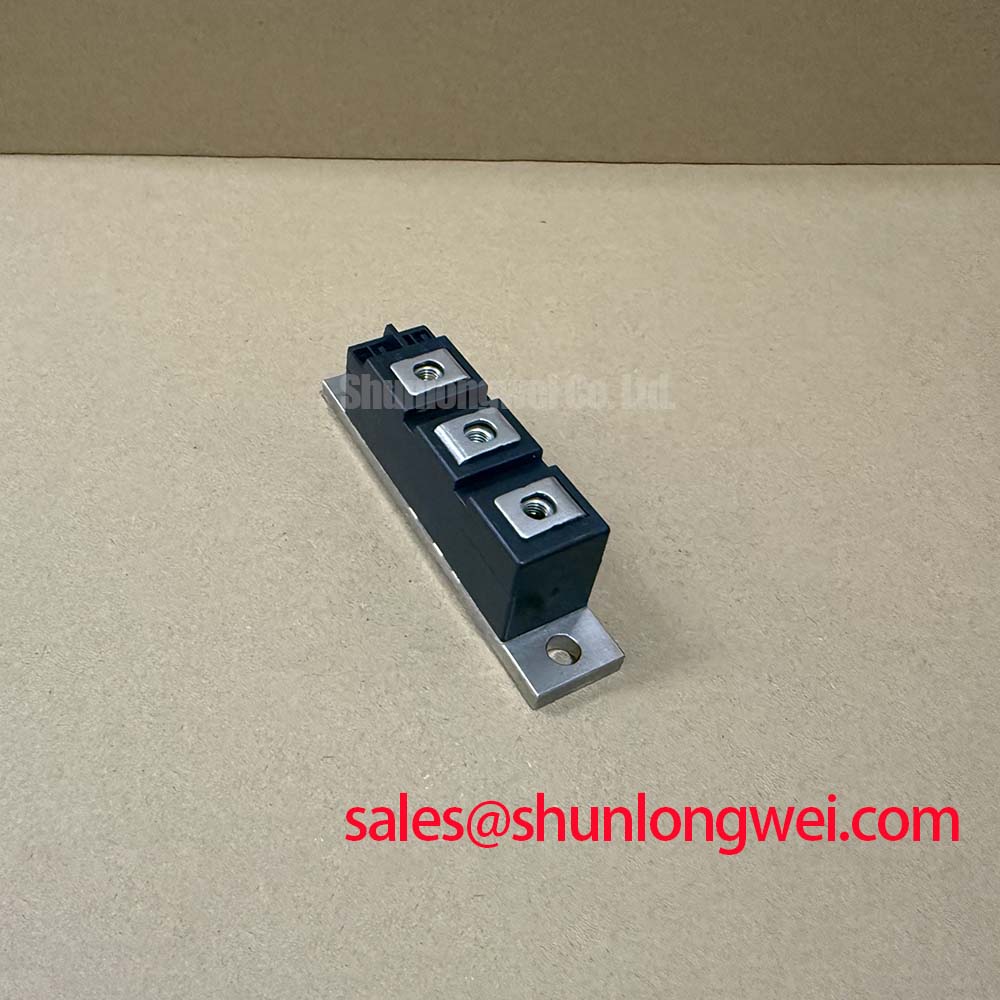
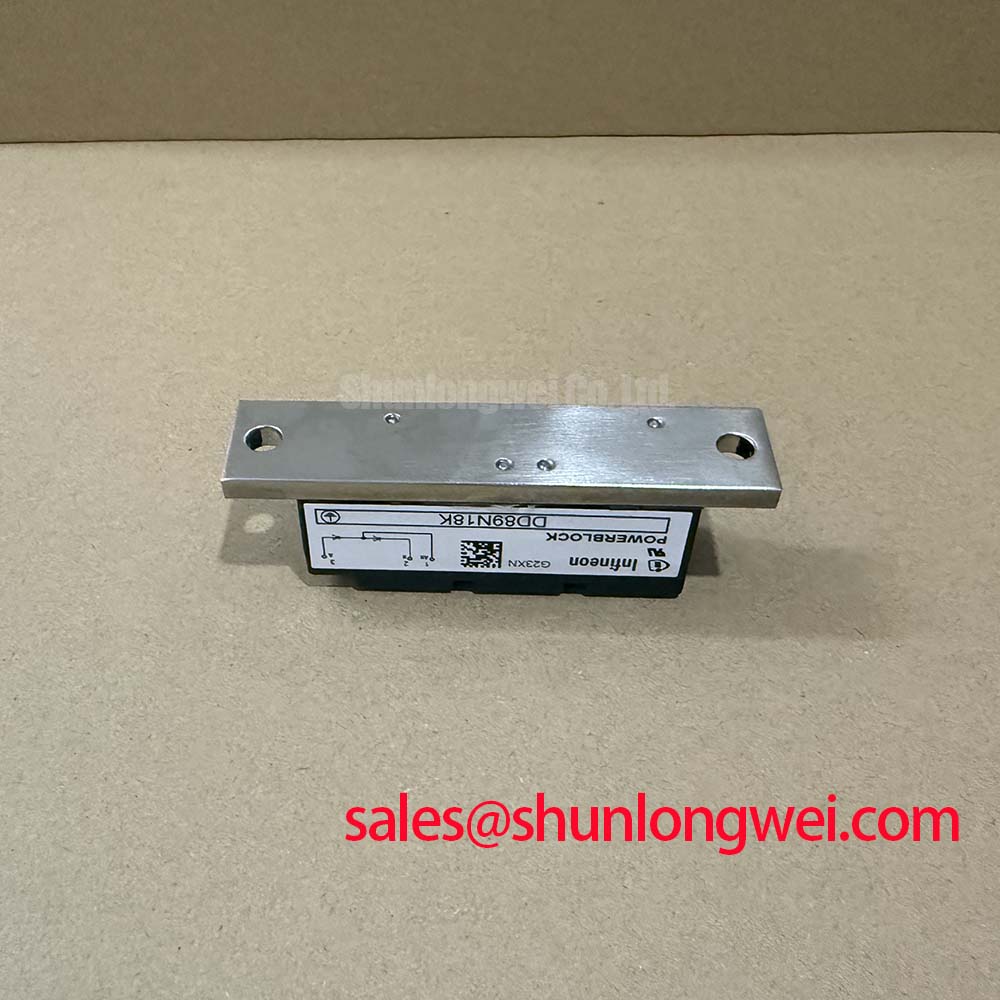
Optimized Application Scenarios
The DD89N18K is particularly well-suited for several critical industrial roles:
- Non-Controllable Rectifiers: Ideal for AC/DC input stages in industrial power supplies due to its high $V_{RRM}$.
- Line Rectifiers for Transistorized Drives: Provides reliable rectification for variable speed drives, benefiting from the pressure contact reliability.
- Battery Chargers: The high surge current capability handles the initial inrush current during the charging cycle of large battery arrays.
- Power Supplies for DC Motors: Ensures consistent DC voltage delivery under heavy mechanical load variations.
Best Match Conclusion: This module is the optimal choice for 400V-600V AC line systems requiring durable, high-voltage blocking and simple heat sink integration.
Key Specifications and Ratings
| Parameter Category | Description | Value / Unit |
|---|---|---|
| Absolute Maximum Ratings | Repetitive Peak Reverse Voltage ($V_{RRM}$) | 1800 V |
| Current Ratings | Average Forward Current ($I_{FAVM}$) @ $T_C=100^circ C$ | 89 A |
| Surge Performance | Surge Forward Current ($I_{FSM}$) @ 10ms, $25^circ C$ | 1800 A |
| Electrical Data | Forward Voltage Drop ($V_F$) @ $I_F=300A$ | Max 1.30 V |
| Thermal Characteristics | Maximum Junction Temperature ($T_{vj max}$) | 150 °C |
| Mechanical Properties | Isolation Test Voltage (RMS, f=50Hz, 1 min) | 3000 V |
Engineer’s FAQ
Q1: What mounting torque is recommended for the DD89N18K to ensure proper thermal contact?
A1: Based on standard industrial practices for this housing type, it is critical to adhere to the manufacturer’s specified mounting torque for both the baseplate and the electrical terminals. This ensures uniform pressure on the internal semiconductor die, which is vital for the integrity of the pressure contact technology.
Q2: Can the DD89N18K be used in high-frequency switching applications?
A2: No. This is a standard recovery rectifier diode optimized for line frequencies (50/60Hz). For high-frequency switching, one should consider Fast Recovery Diodes or Power Semiconductors designed for high-speed commutation.
Q3: How does the isolated baseplate benefit system design?
A3: The isolated baseplate allows multiple modules to be mounted on a single common heat sink without external electrical insulation. This reduces the footprint and complexity of the overall assembly while ensuring high safety through a 3000V isolation rating.
The DD89N18K stands as a benchmark for reliability in low-frequency power rectification. By integrating pressure contact technology and high-voltage tolerances, it empowers engineers to build robust power conversion systems that withstand the thermal and electrical rigors of heavy industry.