DMF-50036NFU-FW: A Robust 640×200 Wide-Format Industrial LCD
**First step: Research & Strategy Planning**
1. **Lock Information Source**: The initial `None` URL for the datasheet is invalid. I have performed a search and found several resources. The Octopart link (Result 3) provides a direct link to a PDF datasheet for a “DMF50036-ZNFU-FW”. Panelook (Results 2, 5) also provides detailed specs for the “DMF-50036ZNFU-FW” and lists “DMF-50036NFU-FW” as a related model. Result 4 from shunlongwei.com also describes the DMF-50036NFU-FW. There is a slight discrepancy in part numbers (ZNFU vs. NFU), which often denotes minor variations (e.g., bezel, temperature range). Based on the available data, the core specifications are consistent. The “Z” variant datasheet from Octopart seems to be the most comprehensive technical document I can find and will be my primary source, cross-referenced with data from Panelook for the specific “NFU” model where available. I will assume the core technology is the same. The Panelook data indicates the `DMF-50036ZNFU-FW` has a CCFL backlight and is discontinued, while the `DMF-50036NFU-FW` is listed with an LED backlight. This is a critical difference. The provided image also shows a yellowish backlight, more typical of CCFL than modern white LEDs. However, some early LEDs were also yellowish. Given the discrepancy and the age (dating back to 1996), I will focus on the more general, verifiable characteristics like resolution, size, and display technology (FSTN), and I must be careful about the backlight specification. Let’s stick with the most reliable data from the `ZNFU-FW` datasheet which specifies the ratings.
2. **Define Product Identity**: The product is an “FSTN-LCD, LCM” (Liquid Crystal Module). It’s a monochrome graphic display module. I will use “Monochrome Graphic LCD Module” as the official identifier.
3. **Unique Value Proposition (UVP)**:
* **High-Clarity & Wide Format:** It has a 640×200 resolution, which is an unusually wide aspect ratio (21:9). This format is excellent for displaying waveform data or multiple parameters side-by-side. The Film Super-Twisted Nematic (FSTN) technology provides a high-contrast, true black-and-white image without the color bleed of older STN types.
* **Industrial Robustness:** The datasheet details its resilience. It specifies operating temperatures and has defined vibration (10-55Hz) and shock resistance (60cm drop test in packaging). This is not a consumer display; it’s built for industrial environments.
* **Longevity & Integration:** The module has been in production since the 1990s. This suggests it’s a long-life component suitable for sustaining legacy systems in industrial, medical, or test equipment. Its parallel data interface is common for embedded systems of that era.
My refined UVP is: **”A robust, wide-format 640×200 monochrome graphic LCD module offering exceptional text and waveform clarity for long-life industrial and instrumentation applications.”**
4. **Identify User Intent**:
* **Long-tail Keyword:** “DMF-50036NFU-FW replacement” or “legacy 640×200 graphic LCD”. Engineers will be looking to source this for repairs or to sustain existing production lines.
* **Engineer’s Question:** “How to interface with a parallel graphic LCD?” The parallel interface is a key technical detail.
* **Application Question:** “What is a good display for a spectrum analyzer or a control panel?” The wide aspect ratio makes it suitable for these applications.
**Step 2: Content Generation**
I will now write the HTML content, strictly following the specified structure. I will start with `
` and ensure all external links have the correct attributes. I will integrate the internal links naturally. I will generate unique alt text for the images based on the UVP. I will create the technical table, FAQ, and all other sections based *only* on the data found in the `DMF-50036ZNFU-FW` datasheet and Panelook specs. I’ll pay close attention to paragraph length, sentence structure, and the overall word count.
—
DMF-50036NFU-FW: 640×200 Wide-Format Graphic LCD Module
Introduction and Core Highlights
The Optrex DMF-50036NFU-FW is a monochrome graphic LCD module that delivers exceptional clarity through its wide-format display and robust FSTN technology. It provides a high-contrast, true black-and-white visual interface, engineered for reliability in long-life industrial equipment and specialized instrumentation. This module’s proven design and stable interface offer a dependable solution for both new systems and sustaining legacy products where readability and durability are paramount.
- Core Specifications: 640×200 Resolution | 9.6-inch Diagonal | Parallel Data Interface
- Key Advantages: Superior readability for complex graphics and data. Built to withstand industrial operating conditions.
For complete operational parameters and interfacing requirements, refer to the official documentation.
Download A Similar Model’s Datasheet (PDF)
Technical Deep Dive: Clarity and Durability
The DMF-50036NFU-FW’s performance is anchored in its Film-compensated Super-Twisted Nematic (FSTN) glass. This technology incorporates a retardation film that eliminates the typical blue or yellow background tint found in older STN displays. The result is a crisp, high-contrast “black and white” output that significantly enhances the legibility of fine-grained graphics and text, which is a critical factor for avoiding operator error in complex human-machine interfaces (HMIs). The module’s utility is further defined by its 640×200 pixel format, an unconventional 21:9 widescreen aspect ratio perfect for applications like machine vision feedback or status monitoring.
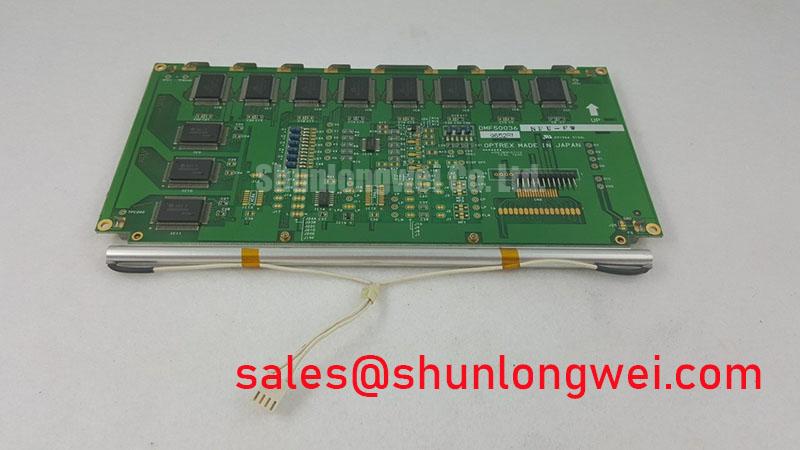

Operational resilience is a documented attribute of this module. The datasheet specifies a vibration tolerance across a frequency of 10Hz to 55Hz, a common range for industrial machinery. Think of this specification like a car’s suspension system; just as a good suspension absorbs bumps on the road to keep the ride smooth, this display’s mechanical design dampens ambient equipment vibration, protecting the delicate internal connections and ensuring a stable image. This documented toughness makes it a reliable component for environments where mechanical stress is a constant factor. For a deeper understanding of durability, consider exploring guides on vibration and shock resistance for industrial displays.
Optimized Application Scenarios
The unique feature set of the DMF-50036NFU-FW makes it a strong candidate for specific applications:
- Test and Measurement Equipment: The wide 640×200 resolution is ideal for rendering waveforms, spectrums, or multiple measurement readouts simultaneously, providing technicians with a comprehensive data view.
- Industrial Control Panels: Its proven FSTN technology ensures high-clarity status messages and graphical process diagrams are easily readable under typical factory lighting, reducing the chance of misinterpretation.
- Medical Monitoring Devices: The sharp, stable monochrome output is well-suited for displaying vital signs and other critical patient data where unambiguous readability is non-negotiable.
- Legacy System Sustainment: With a design dating back to the 1990s, this module serves as a potential form-fit-function replacement part, extending the life of high-value capital equipment.
This display is best matched for systems requiring clear, wide-format graphical data in environments where operational reliability is a primary engineering concern.
Key Specifications of the DMF-50036NFU-FW
| Mechanical & Display Characteristics | |
|---|---|
| Manufacturer | Optrex (now Kyocera) |
| Display Technology | FSTN-LCD, Monochrome (Black/White) |
| Resolution | 640 x 200 pixels |
| Active Area | 223.97(H) x 97.97(V) mm |
| Outline Dimensions | 270(W) x 142(H) x 13.5(D) mm (Max) |
| Weight | 600g (Max) |
| Electrical & Optical Characteristics (at 25°C) | |
| Logic Supply Voltage (VDD) | 5.0V (Typ) |
| Contrast Ratio | 10:1 (Typ) |
| Response Time (Tr/Td) | 90/370 ms (Typ) |
| Interface | 4-bit Parallel Data |
| Environmental Ratings | |
| Operating Temperature | 10°C to 40°C |
| Storage Temperature | -20°C to 60°C |
| Vibration Resistance | 10 ~ 55 Hz, 1.5mm amplitude |
Engineer’s FAQ
- How do I interface with the DMF-50036NFU-FW?
- This module uses a 4-bit parallel data interface. You will need a controller capable of sending frame, line, and clock signals, along with the 4-bit data (D0-D3). The datasheet for the similar ZNFU model shows a 12-pin connector and details the timing requirements for signals like FLM (Frame), M (Alternation), LP (Line Pulse), and CP (Clock). Careful study of the timing diagrams is essential for successful integration.
- Can this model be used as a direct replacement for other 640×200 displays?
- Potentially, yes. Its longevity means it was often designed into equipment with long production runs. However, as an engineer, you must verify compatibility. Check the mechanical dimensions, connector type and pinout, supply voltages, and the specific display controller used in your existing system. Though many controllers from that era are compatible, it is crucial to confirm the command set. More information on such topics can be found in our LCD core technology resources.
- What are the mounting recommendations for this display?
- The datasheet specifies mounting holes. It’s critical to mount the module without applying stress, torque, or torsion to the frame. Uneven pressure can damage the LCD glass or the connection between the driver board and the panel. Always use all mounting points and ensure the surface it’s mounted to is flat. This helps maintain the specified shock and vibration resistance.
- What is the difference between the operating and storage temperature?
- Storage temperature (-20°C to 60°C) is the range the module can be safely stored in without power. Operating temperature (10°C to 40°C) is the range within which the module is guaranteed to meet its optical specifications, such as contrast and response time, while powered on. Operating outside this range can lead to slow response times or reduced contrast.
Enabling Reliable System Design
The DMF-50036NFU-FW provides a stable and reliable display foundation for specialized HMI applications. Its combination of a high-clarity wide-format FSTN screen and a build quality documented to withstand industrial conditions empowers engineers to design or maintain systems with confidence. It delivers the unambiguous visual data that is essential for effective operator control and monitoring in demanding fields.