F4-50R12KS4 IGBT Module: A Technical Analysis for Efficient Power Conversion
F4-50R12KS4 IGBT Module | 1200V 50A EconoPACK™ 2
Introduction and Core Highlights
The Infineon F4-50R12KS4 is a four-pack IGBT module housed in the industry-recognized EconoPACK™ 2 package, providing a robust and efficient solution for power conversion systems. This module integrates fast IGBT2 technology, achieving a finely tuned balance between conduction and switching losses. This optimization facilitates efficient operation, particularly in high-frequency applications, enabling designers to improve system power density and thermal performance.
- Core Specifications: 1200V | 50A | 70A Peak
- Key Advantages: Low switching losses for higher frequency capability, high thermal conductivity AlN substrate.
- Engineering Value: Addresses the core challenge of minimizing power loss and simplifying thermal management in industrial inverter designs.
Download the Official F4-50R12KS4 Datasheet (PDF)
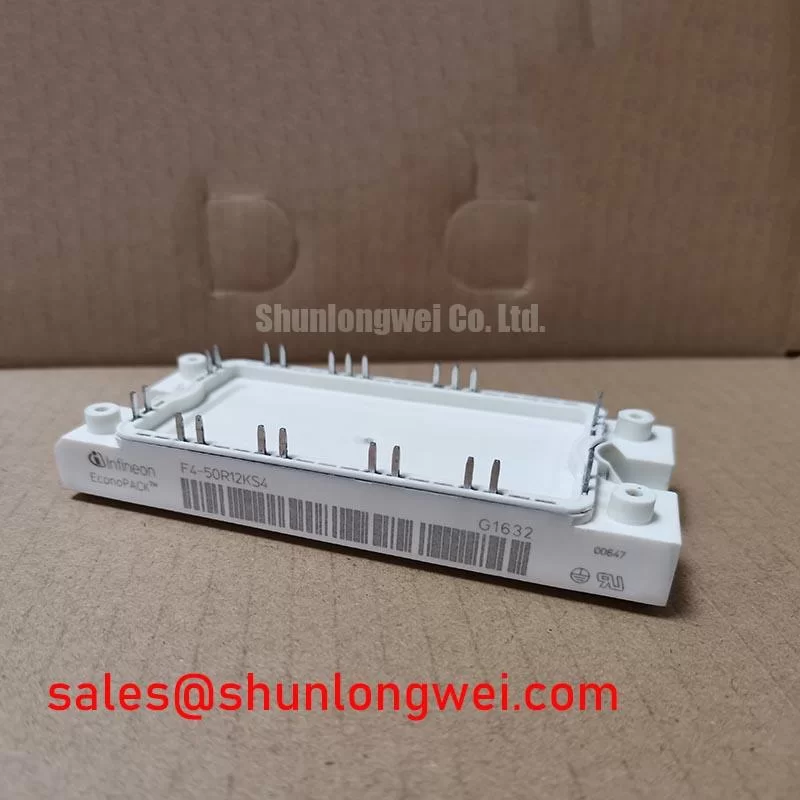

Technical Analysis for System Optimization
The F4-50R12KS4’s performance is fundamentally shaped by its fast IGBT2 technology. The datasheet specifies a typical collector-emitter saturation voltage (VCE(sat)) of 2.15 V at the nominal current of 50 A and a junction temperature of 25°C. This parameter is critical as it directly dictates conduction losses during operation. Furthermore, the total switching energy (Ets) is documented at 10.0 mJ under the same conditions. This value represents the energy dissipated during turn-on and turn-off events. The module’s low Ets makes it well-suited for systems operating at higher switching frequencies, as it helps to keep total power losses under control.
Effective thermal dissipation is crucial for reliability in power modules. The F4-50R12KS4 utilizes an Aluminium Nitride (AlN) ceramic substrate, which offers superior thermal conductivity compared to standard Aluminium Oxide (Al2O3). This is reflected in the low thermal resistance from junction to case (RthJC) of 0.36 K/W for each IGBT. Think of thermal resistance as the width of a pipe for heat; a lower value, like that of the F4-50R12KS4, signifies a wider pipe, allowing heat to flow away from the sensitive silicon chip more efficiently. This robust thermal design, combined with a maximum operating junction temperature (Tvj op) of 150°C, ensures dependable performance under demanding industrial loads. For further reading, explore the practical guide to the Zth curve for IGBTs.
Optimized Application Scenarios
The specific characteristics of the F4-50R12KS4 make it an excellent component for several power conversion applications:
- Motor Drives: Its balanced loss profile and robust thermal performance are ideal for the dynamic load cycles found in industrial motor control.
- Solar Inverters: The module’s efficiency, stemming from its low VCE(sat) and switching energy, is critical for maximizing energy harvest in photovoltaic systems.
- Uninterruptible Power Supplies (UPS): The high reliability of the EconoPACK™ housing and the module’s ability to handle surge currents ensure stable operation in critical backup power systems.
- Welding Power Supplies: The fast switching capability allows for precise control over the welding arc, while its thermal design handles the high-current pulses typical of welding applications.
This module is best matched for inverter designs up to 20 kVA where switching frequency and thermal efficiency are primary design considerations.
Key Specification Parameters for the F4-50R12KS4
| Absolute Maximum Ratings | |
|---|---|
| Collector-Emitter Voltage (VCES) | 1200 V |
| Continuous DC Collector Current (IC,nom) @ TC=80°C | 50 A |
| Repetitive Peak Collector Current (ICRM) @ tP=1ms | 100 A |
| Gate-Emitter Voltage (VGES) | +/- 20 V |
| Electrical & Thermal Characteristics (Per IGBT, typical values @ Tvj=25°C) | |
| Collector-Emitter Saturation Voltage (VCE(sat)) @ IC=50A | 2.15 V |
| Total Switching Energy (Ets) @ IC=50A | 10.0 mJ |
| Thermal Resistance, Junction-to-Case (RthJC) | 0.36 K/W |
| Maximum Operating Junction Temperature (Tvj op) | -40°C to 150°C |
Note: These values are for reference only. Engineers must consult the official F4-50R12KS4 datasheet for complete and precise specifications.


Engineer’s FAQ
1. What makes the F4-50R12KS4 suitable for a 1200V motor drive application?
The F4-50R12KS4 is rated for a collector-emitter voltage of 1200V, providing a sufficient safety margin for DC bus voltages commonly found in 400VAC and 480VAC systems. Its integration of four IGBTs in a single EconoPACK™ 2 package simplifies the construction of B6 bridges or other inverter topologies, while its thermal efficiency supports the demanding power cycles of motor control.
2. What is the recommended mounting procedure to ensure proper thermal contact?
To achieve the specified thermal performance, the datasheet indicates that an evenly distributed layer of thermal grease (0.05mm – 0.1mm) should be applied to the module’s baseplate. The M5 mounting screws should be tightened to a torque of 3.0 – 6.0 Nm. Incorrect torque or uneven application of thermal interface material can lead to increased thermal resistance and potential device failure. You can learn more about the importance of module integrity in our analysis of silicone gel in IGBT modules.
3. How does the integrated NTC thermistor function?
This module includes an NTC (Negative Temperature Coefficient) thermistor. This component provides a means for real-time temperature monitoring of the module’s baseplate. The resistance of the NTC decreases predictably as temperature increases, allowing the control system to detect potential overheating conditions and trigger protective measures, such as reducing power output or shutting down the system. For a deeper look at this safety feature, see our article on the role of an integrated NTC.
Enabling Efficient Power Conversion
The F4-50R12KS4 module provides a well-documented and highly reliable component for building efficient power conversion systems. By integrating fast switching IGBTs and a thermally efficient AlN substrate within the standardized EconoPACK™ 2 housing, it empowers engineers to develop compact, high-performance inverters while streamlining the thermal design process.