Fuji 7MBR25SA120: An Integrated Power Solution for Compact Motor Drives
Fuji 7MBR25SA120 IGBT Module | 1200V 25A 7-in-1 PIM
Integrated Power Stage for Compact Motor Drives
The Fuji Electric 7MBR25SA120 is a 7-in-1 Power Integrated Module (PIM) that consolidates a complete three-phase inverter, a dynamic brake chopper, and a converter diode bridge into a single, compact package. This high level of integration is engineered to reduce system complexity and shrink the footprint of low-power motor drives. It provides a streamlined solution for engineers developing variable frequency drives (VFDs) and servo systems where space and assembly efficiency are critical design constraints.
- Core Specifications: 1200 V | 25 A | VCE(sat) (typ) 2.2 V
- Key Advantages: Reduces component count and simplifies PCB layout. Includes an integrated NTC thermistor for precise temperature monitoring.
Download Official Datasheet (PDF)
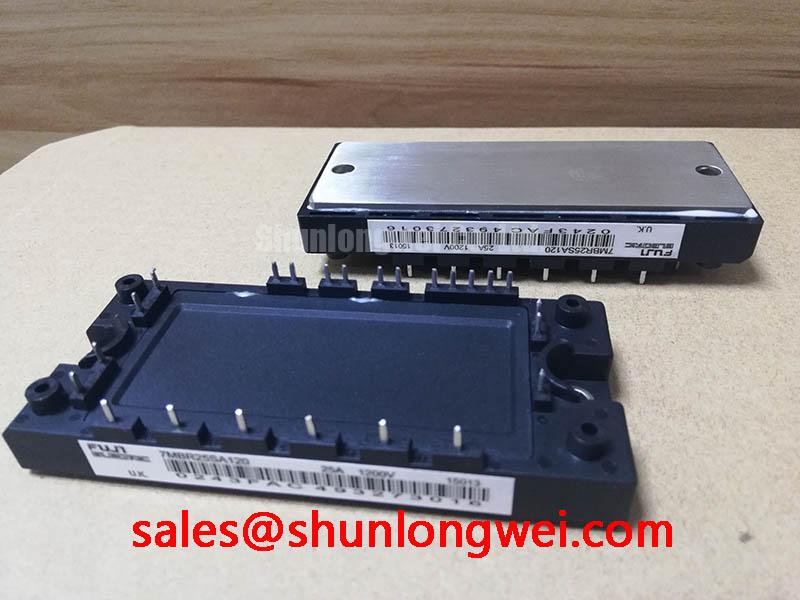


Technical Analysis of the 7MBR25SA120
The engineering value of the 7MBR25SA120 lies in its functional density and thermal efficiency. By integrating seven distinct power semiconductor stages, the module inherently reduces the parasitic inductance that can occur in designs using discrete components. This leads to cleaner switching characteristics and potentially lower EMI. The module’s design simplifies not only the electrical layout but also the mechanical assembly, requiring a single heatsink interface for the entire power stage.
A key performance metric is the collector-emitter saturation voltage (VCE(sat)), which is typically 2.2 V at the nominal 25 A collector current. This parameter is critical for thermal management. You can think of VCE(sat) as a measure of electrical friction; a lower value means less power is converted into heat when the IGBT is conducting current. This lower heat generation simplifies the cooling system requirements, enabling more compact and cost-effective thermal designs.
Furthermore, the inclusion of an on-board NTC thermistor is a crucial feature for system reliability. It allows for direct and real-time monitoring of the module’s operating temperature. This data feed is essential for implementing over-temperature protection within the drive’s control logic, safeguarding the IGBTs from thermal runaway and extending the operational lifespan of the end application.
Optimized Application Scenarios
The 7MBR25SA120 is specified for power conversion systems where efficiency and a small form factor are primary objectives. Its characteristics make it suitable for several applications:
- Inverters for Motor Drives: The 1200 V / 25 A rating is well-suited for AC motor drives in the 2.2 to 5.5 kW range. The integrated brake circuit efficiently handles regenerative energy during deceleration.
- AC and DC Servo Drives: Compactness is vital in servo systems. This module’s high power density allows for smaller drive housings without sacrificing performance.
- Uninterruptible Power Supplies (UPS): The module can serve as the core inverter block in online UPS systems, providing a reliable and space-saving power stage.
With its all-in-one design, this module is an optimal match for motor control systems requiring a robust, integrated power stage to accelerate development time.
Key Specifications of the 7MBR25SA120
| Parameter | Symbol | Value | Unit |
|---|---|---|---|
| Absolute Maximum Ratings | |||
| Collector-Emitter Voltage (Inverter) | VCES | 1200 | V |
| Collector Current (Inverter, DC, Tc=80°C) | IC | 25 | A |
| Collector Power Dissipation (Inverter, 1 device) | PC | 180 | W |
| Electrical Characteristics (Inverter Part) | |||
| Collector-Emitter Saturation Voltage (IC=25A) | VCE(sat) | 2.2 (Typ) / 2.7 (Max) | V |
| Forward Voltage (FWD, IF=25A) | VF | 2.1 (Typ) / 2.6 (Max) | V |
| Thermal Characteristics | |||
| Thermal Resistance (Junction-to-Case, IGBT) | Rth(j-c) | 0.69 | °C/W |
Engineer FAQ
- What is the primary benefit of the 7-in-1 configuration in the 7MBR25SA120 for a motor drive design?
- The 7-in-1 configuration integrates the three-phase inverter, rectifier, and brake chopper into one module. This significantly reduces the printed circuit board (PCB) space required compared to a solution with discrete components. It also simplifies the assembly process and can reduce electromagnetic interference (EMI) by minimizing the length of high-current traces. For more information on module choices, see our guide on PIM vs. discrete IGBTs.
- How should I approach the thermal design for this module?
- Effective thermal design requires a properly selected heatsink. The datasheet specifies the maximum thermal resistance from junction-to-case (Rth(j-c)) as 0.69°C/W for the inverter IGBTs. To calculate the total power loss, you must consider both conduction and switching losses based on your specific application conditions (current, switching frequency, etc.). A heatsink must be chosen to ensure the junction temperature (Tj) remains below the 150°C maximum rating under worst-case operating conditions. A guide to mastering IGBT thermal design can provide further context.
- What is the function of the integrated NTC thermistor?
- The built-in Negative Temperature Coefficient (NTC) thermistor provides a means for real-time temperature sensing of the module’s baseplate. Its resistance decreases predictably as temperature increases. The control system can monitor this resistance to estimate the IGBT junction temperature, enabling crucial safety features like over-temperature alarms or shutdowns to protect the module.
- What are the recommended mounting screw torque specifications?
- The datasheet recommends a mounting screw torque in the range of 2.5 to 3.5 N·m for the M5 screws. Applying the correct torque is critical to ensure a low thermal resistance path to the heatsink without inducing excessive mechanical stress on the module’s case.
Enabling Efficient Power Conversion
The Fuji Electric 7MBR25SA120 provides a robust, functionally dense solution for power electronics engineers. Its integrated nature directly addresses the need for smaller, more reliable, and easier-to-assemble power conversion systems. By combining performance-oriented IGBTs and diodes with essential thermal monitoring in a single component, this module offers a solid foundation for developing next-generation low-power motor controls.