G242CX5R1AC Seiko Instruments 240×128 Industrial Graphic LCD Module: Technical Overview and Applications
G242CX5R1AC Seiko Instruments Industrial Graphic LCD Module
Introduction to High-Reliability 240×128 Graphic Visualization
The G242CX5R1AC is a professional-grade graphic Liquid Crystal Display module manufactured by Seiko Instruments (SII), specifically engineered for the rigorous demands of industrial automation and precision measuring instrumentation. This monochromatic STN display serves as a cornerstone for human-machine interfaces requiring clear, high-contrast data representation in a compact mechanical footprint. By integrating a dedicated controller and driver logic, it minimizes the processing overhead on the host microcontroller, facilitating efficient system integration for legacy equipment maintenance and new-build industrial controllers.
- Core Specifications: 240 x 128 Dots | 5.0V Logic Supply | STN Transmissive Mode
- Key Engineering Value: Broad operating temperature range and robust mechanical mounting reduce environmental stress failures.
- Simplified Integration: The parallel 8-bit interface allows for straightforward communication with various industrial-grade processors.
Engineers often ask: How can I ensure long-term readability in low-light factory environments? The G242CX5R1AC addresses this through its optimized backlight distribution and high-contrast fluid chemistry, ensuring critical data remains legible under varying ambient light conditions. This is vital for maintaining operator safety and system uptime.
Download Official Datasheet Summary (PDF)

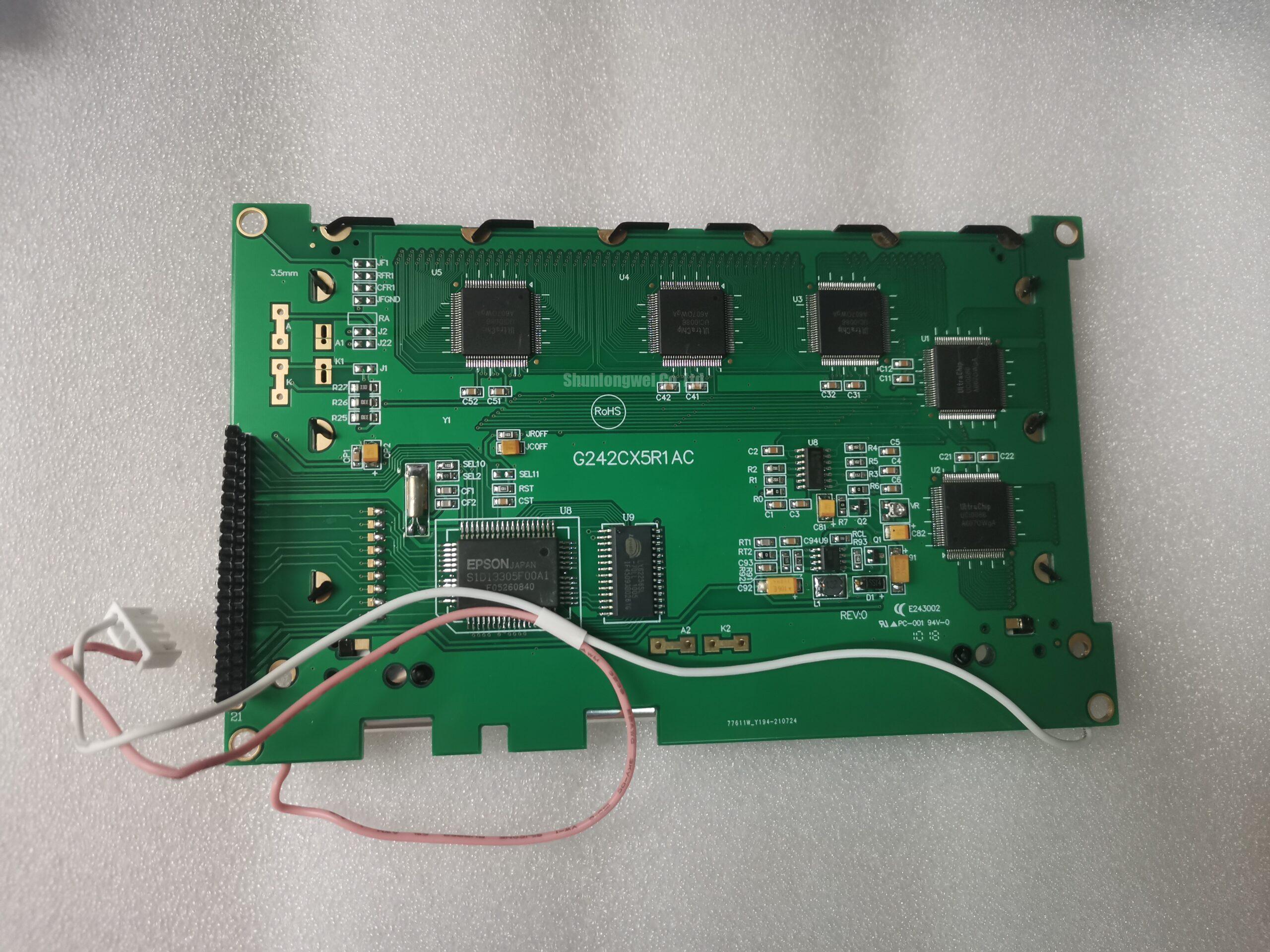


Technical Analysis of Contrast and Thermal Resilience
The engineering utility of the G242CX5R1AC stems from its specific fluid chemistry. Utilizing Super-Twisted Nematic (STN) technology, the module achieves a steep electro-optical threshold curve. In practical terms, this allows for a higher multiplexing rate while maintaining a sharp distinction between “on” and “off” pixels. For system designers, this translates to cleaner graphical renderings and reduced ghosting effects when scrolling through diagnostic menus or real-time wave-form plots.
Consider the module’s viewing angle stability as analogous to a high-quality compass; just as a clear compass must be readable from multiple orientations to be useful in the field, the G242CX5R1AC provides consistent optical performance across a wide viewing cone. This prevents the “grayscale inversion” common in consumer-grade panels when viewed from off-axis angles, a critical factor for HMIs mounted at non-standard heights on factory floors. Furthermore, managing the backlight lifespan is essential for long-term system reliability.
From a thermal management perspective, the G242CX5R1AC incorporates internal temperature compensation circuitry. LCD contrast is inherently sensitive to ambient temperature fluctuations because the viscosity of the liquid crystal material changes with heat. By adjusting the driving voltage (Vee) relative to the temperature, this module maintains consistent visual density from cold-start conditions to maximum operating temperatures, negating the need for external potentiometer adjustments by the end-user.
Optimized Industrial Application Scenarios
The G242CX5R1AC is best suited for applications where reliability over-specifies aesthetic color depth. Its monochromatic nature ensures lower power consumption and higher electromagnetic interference (EMI) immunity compared to high-speed digital TFT-LCD alternatives.
- CNC Controller Units: The 240×128 resolution is ideal for displaying G-code strings and tool path coordinates. The high vibration resistance of the frame prevents pixel-flicker during heavy machining cycles.
- Medical Diagnostic Monitors: Used in portable ultrasound or bedside monitoring where high contrast is necessary for identifying distinct numerical values instantly.
- Industrial Power Inverters: Perfect for displaying real-time load graphs and fault logs. Its tolerance for electrical noise makes it a stable choice for environments with heavy switching machinery.
- Precision Weighing Scales: The module’s low logic current draw facilitates its use in battery-backed or energy-sensitive field equipment.
Best-Fit Conclusion: The G242CX5R1AC is the optimal choice for engineers seeking a drop-in replacement or a reliable graphic core for high-duty-cycle industrial HMIs.
Critical Technical Specifications
| Parameter Category | Specification Details | Unit |
|---|---|---|
| Module Resolution | 240 (W) x 128 (H) | Dots |
| Supply Voltage (Logic) | 4.5 to 5.5 | V |
| LCD Drive Voltage (Vee) | -15.0 (Typical) | V |
| Interface Type | 8-bit Parallel (6800/8080 Compatible) | – |
| Operating Temperature | 0 to +50 (Industrial Standard) | °C |
| Viewing Area | 114.0 x 64.0 | mm |
Engineer’s Frequently Asked Questions (FAQ)
Q1: What is the recommended driving sequence for the G242CX5R1AC to avoid DC residual build-up?
A: Always ensure that the logic supply (Vdd) is fully stabilized before applying the negative LCD drive voltage (Vee). Power-down sequences should be the exact inverse. Applying Vee without Vdd can cause permanent damage to the LC material due to electrochemical degradation.
Q2: Can this module be used as a direct replacement for generic 240128 series panels?
A: While the resolution is standard, the physical dimensions and connector pinout of the G242CX5R1AC must be verified against the host PCB. Industrial HMI specifications often vary between manufacturers regarding mounting hole locations and FPC pitch.
Q3: How does the G242CX5R1AC perform in high-EMC environments?
A: The module features a metal frame that is electrically connected to the system ground. This acts as a Faraday cage for the internal driver ICs, making it significantly more resilient to electrostatic discharge (ESD) and radiated noise than plastic-framed consumer displays.
Closing Engineering Statement
The G242CX5R1AC represents a balance of proven graphic display technology and industrial-grade durability. By prioritizing high-contrast legibility and mechanical stability, it provides a dependable visualization solution for critical systems where data integrity and operator interface clarity are paramount. This model remains a trusted component for maintaining the operational longevity of sophisticated industrial hardware.