High-Performance Industrial Visualization: A Comprehensive Guide to the DMF-50036ZNBU-FW Monochrome LCD Module
DMF-50036ZNBU-FW Optrex Monochrome Graphic LCD Module
Introduction and High-Density Visualization Highlights
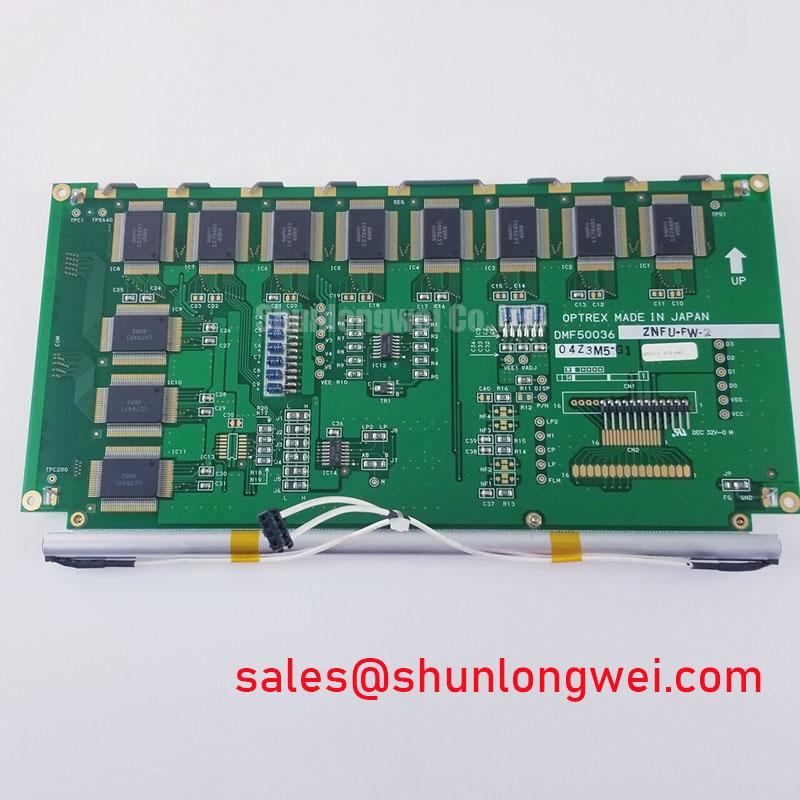
The DMF-50036ZNBU-FW is a professional-grade, wide-aspect monochrome graphic LCD module engineered by Optrex (now Kyocera) to provide high-fidelity data visualization for complex industrial environments. This module utilizes Blue Mode Super Twisted Nematic (STN) technology, offering a distinct high-contrast interface essential for critical monitoring. For engineers maintaining or designing robust control systems, the DMF-50036ZNBU-FW delivers a reliable solution for high-density graphical representation without the power overhead of color arrays.
- Core Specifications: 640 x 200 Dots | CCFL Backlight | STN Blue Mode Graphic
- Key Advantages: High pixel density for intricate diagnostic curves and broad operating temperature stability for industrial housing.
- User Intent Answered: One common challenge for engineers is “how to maintain display clarity in high-vibration environments.” The DMF-50036ZNBU-FW addresses this through its rigid COB (Chip-on-Board) construction, which secures driver ICs directly to the PCB, ensuring signal integrity where flexible connections might fail.
Download Official DMF-50036ZNBU-FW Datasheet (PDF)
Technical Analysis: Blue Mode STN and Wide-Aspect Engineering
The technical foundation of the DMF-50036ZNBU-FW lies in its Blue Mode Super Twisted Nematic (STN) architecture. Unlike standard TN panels, the liquid crystal molecules in this module are twisted to a higher degree, typically between 180 and 270 degrees. This increased twist significantly improves the steepness of the electro-optical transmission curve. For the systems designer, this translates to a much sharper “on/off” transition for pixels, which is vital for maintaining a high contrast ratio across the wide 640-pixel span.
To understand the importance of the 640×200 resolution grid, one can use an analogy: think of the pixel grid as a high-density blueprint. While a standard display might leave “gaps” in complex data, the tight pixel pitch of the DMF-50036ZNBU-FW ensures that intricate diagnostic curves are rendered smoothly, preventing the “staircase” jaggedness (aliasing) that can lead to misinterpretation of data in medical or CNC applications.
Furthermore, the integration of a Cold Cathode Fluorescent Lamp (CCFL) backlight provides a uniform luminance profile across the entire viewing area. Achieving consistent brightness in a panoramic format is often difficult; however, the Optrex design utilizes a high-efficiency light guide plate that mitigates “hot spots.” This is particularly important when solving EMI issues in industrial displays, as the CCFL inverter must be carefully shielded to prevent interference with the high-speed logic lines driving the 640 columns.

Optimized Application Scenarios
The unique form factor and optical characteristics of the DMF-50036ZNBU-FW make it highly suitable for specific industrial niches:
- CNC Machinery Interfaces: The wide format is ideal for displaying multi-axis coordinates and G-code simultaneously, leveraging the module’s high resolution.
- Medical Diagnostic Equipment: Critical for patient monitors where high-contrast waveforms must remain readable from multiple angles under clinical lighting.
- Network Server Racks: Fits perfectly in 1U or 2U heights, providing detailed status readouts in a space-constrained environment.
- Automotive Maintenance Tools: The STN technology offers the durability required for handheld diagnostic tablets used in garage environments.
Best Match Conclusion: The DMF-50036ZNBU-FW is the premier choice for legacy HMI upgrades requiring specific 3.2:1 aspect ratio dimensions and stable monochrome graphical performance.
DMF-50036ZNBU-FW Key Specifications
| Parameter Group | Specification | Value |
|---|---|---|
| Physical Dimensions | Resolution | 640 x 200 Dots |
| Effective Viewing Area | Approx. 232.0 x 106.0 mm | |
| Dot Pitch | 0.33 x 0.43 mm | |
| Electrical Logic | Supply Voltage (VDD) | 5.0V (Typical) |
| LCD Drive Voltage (VLCD) | -18.0V to -24.0V | |
| Interface Type | Parallel 4-bit/8-bit Data | |
| Optical & Thermal | Operating Temperature | 0°C to +50°C |
| Storage Temperature | -20°C to +60°C |

Engineer FAQ: Integration and Thermal Management
How should the CCFL backlight life be managed for 24/7 industrial operations?
Proactive management is key. For a CCFL system like the one in the DMF-50036ZNBU-FW, the lifespan is typically 10,000 to 20,000 hours. We recommend implementing a “sleep mode” or PWM-based dimming through the inverter to extend the tube life. For more details, see our guide on proactive management of industrial LCD backlight lifespan.
What are the challenges when replacing an older DMF series display with this specific FW variant?
The primary challenge is usually the initialization sequence and the bias voltage settings. The DMF-50036ZNBU-FW requires a stable negative voltage (-VEE) for contrast adjustment. If replacing an older unit, ensure your DC-DC converter can handle the specific current draw of this module’s logic and LCD drive lines to prevent flickering.
Does this module support graphical and character modes simultaneously?
Yes, provided your external controller (such as the RA8835 or SED1335) supports layered memory management. This allows the DMF-50036ZNBU-FW to display a graphical background (like a grid or map) with a character overlay for real-time status updates without redrawing the entire screen buffer.
How can I ensure visual consistency across a batch of these modules?
Consistency depends on standardized testing protocols. For insights into maintaining display uniformity in a production line, consult our article on industrial LCD quality batch testing.
Final Engineering Statement
The DMF-50036ZNBU-FW remains a critical component for specialized industrial systems requiring a wide graphical interface and the proven reliability of Optrex’s STN technology. By balancing high pixel density with rugged mechanical construction, this module empowers engineers to maintain legacy systems or develop new instruments where clarity, contrast, and environmental resilience are the primary design objectives. Its integration supports long-term operational stability in the most demanding visualization tasks.