Hitachi LMG5320XUFC: A High-Clarity FSTN Display for Industrial Applications
Hitachi LMG5320XUFC: 7.2-inch 640×480 FSTN LCD Module
Introduction and Core Highlights
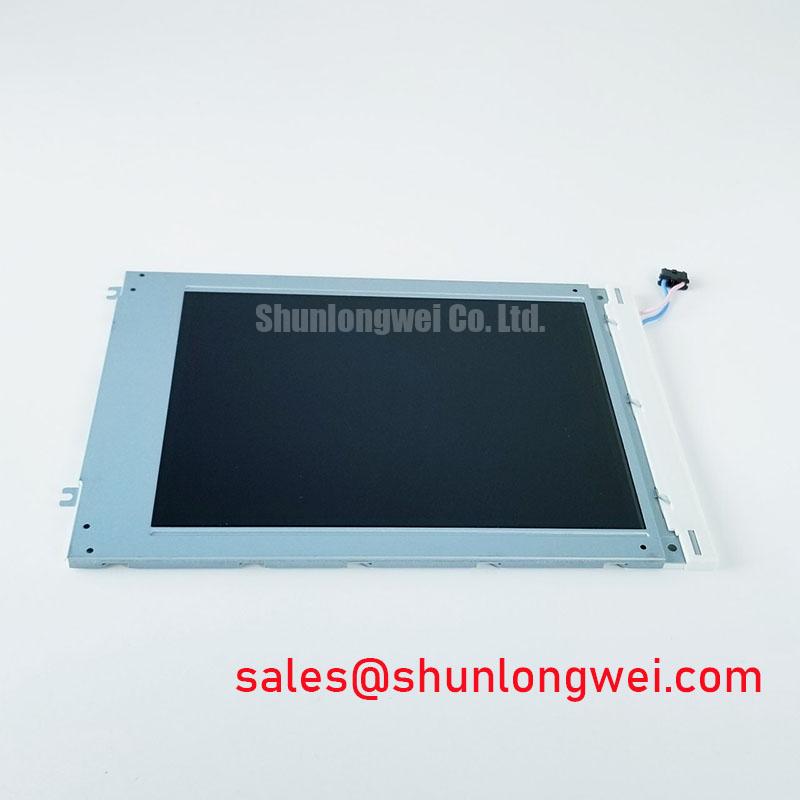
The Hitachi LMG5320XUFC is a 7.2-inch FSTN (Film-compensated Super-twisted Nematic) monochrome display module engineered for exceptional clarity and reliability in industrial applications. Its key value is delivering sharp, high-contrast 640×480 VGA resolution on a passive-matrix screen, ensuring excellent readability for operator interfaces and instrumentation. The straightforward 4-bit parallel data interface simplifies integration with a wide range of microcontrollers, making it a durable component for new designs or for sustaining legacy systems. This display provides a robust solution where clear data presentation and operational longevity are primary objectives.
- Core Specifications: 7.2-inch Diagonal | 640×480 VGA | FSTN Monochrome
- Key Advantages: High-contrast text and graphics, simplified 4-bit parallel interface.
Download Official Datasheet (PDF)

Technical Analysis
FSTN Technology for Industrial Clarity
The LMG5320XUFC utilizes Film-compensated Super-twisted Nematic (FSTN) technology, a significant advancement over standard STN displays. By incorporating a retardation film layer, the FSTN structure effectively corrects for the color dispersion inherent in passive-matrix displays. This compensation yields a true black-and-white image with a significantly higher contrast ratio and a wider, more consistent viewing angle. For an engineer designing an HMI panel, this means the displayed information remains legible from various operator positions and under typical factory floor lighting, reducing the chance of misinterpretation.
Simplified Integration with a Parallel Interface
This module’s 4-bit parallel data interface is a key feature for straightforward system integration. It requires fewer I/O pins from the host controller compared to 8-bit or 16-bit interfaces, which can be a critical advantage in pin-limited designs. The control scheme, using signals such as clock (CP), frame (FLM), and load (LP), is well-documented and requires minimal external logic to implement. Think of this interface as a four-lane road; while it carries less data per clock cycle than an eight-lane highway, it’s simpler to build, more efficient for the required data load of an HMI, and compatible with a vast range of cost-effective microcontrollers. This reduces both hardware and software development complexity.
Optimized Application Scenarios
The specific feature set of the LMG5320XUFC makes it a strong fit for several key applications:
- Industrial HMI Panels: Its 640×480 resolution is well-suited for rendering menus, process schematics, and system alerts with high clarity.
- Test and Measurement Equipment: The high-contrast monochrome output provides a crisp, unambiguous display for waveforms and numerical data, where precision is essential.
- Medical Instrumentation: Offers a reliable platform for displaying patient data and equipment status, where readability and long-term stability are non-negotiable.
- Legacy System Sustainment: Serves as a form-fit-function replacement for older VGA monochrome panels, extending the life of existing industrial machinery.
Its robust design and clear visual output make this display best matched for applications requiring a reliable VGA interface with high-contrast monochrome performance.
Key Specification Parameters
| Mechanical & Display Specifications | |
|---|---|
| Panel Type | FSTN-LCD, LCM |
| Screen Size | 7.2 inches (diagonal) |
| Resolution | 640×480 (VGA) |
| Active Area | 147.18(H) × 110.38(V) mm |
| Outline Dimensions | 205(H) × 143(V) × 6.5(D) mm |
| Pixel Pitch | 0.23(H) × 0.23(V) mm |
| Electrical & Interface Specifications | |
| Logic Supply Voltage (VDD) | +5V DC (Typ.) |
| LCD Drive Voltage (VEE) | -22V DC (Typ.) |
| Interface Type | 4-bit Parallel Data |
Engineer’s FAQ
- What is the correct power-up and power-down sequence for the LMG5320XUFC?
- A strict power sequence is critical for this module’s longevity. During power-up, the +5V (VDD) logic supply must be applied first, followed by the -22V (VEE) LCD driver voltage. For power-down, the sequence is reversed: VEE must be turned off before VDD. Applying VEE without VDD can damage the display’s integrated controller circuits.
- Does this display module require an external backlight inverter?
- Yes. The datasheet indicates a CCFL (Cold Cathode Fluorescent Lamp) is used for the backlight. CCFLs require a separate, dedicated inverter module to generate the high AC voltage necessary for their operation. The power supply for the inverter must be sourced separately from the display’s logic and driver voltages.
- What are the primary considerations for mechanical mounting?
- The module’s outline dimensions are 205mm x 143mm with a slim 6.5mm depth. Engineers should design a bezel or mounting frame that secures the display without putting direct stress on the glass or the PCB. Attention to vibration and shock resistance in the mounting system is crucial for long-term reliability in an industrial setting.
- Why choose a monochrome FSTN display over a color TFT display?
- While color TFTs are common, monochrome FSTN displays like the LMG5320XUFC offer distinct advantages in certain contexts. They typically consume less power and provide superior contrast and readability in high ambient light. For HMIs that primarily display text, numbers, and simple graphics, the exceptional clarity of a monochrome display is often more effective and less fatiguing for the operator than a color display.
Concluding Statement
The Hitachi LMG5320XUFC provides a proven and highly reliable display solution for clear, unambiguous information presentation. Its robust FSTN technology, which ensures high-contrast visibility, combined with a simple and widely supported parallel interface, allows engineers to implement a dependable human-machine interface with minimal design overhead.