IXYS MEO450-12DA: Technical Overview of the 1200V 450A Fast Recovery Diode Module
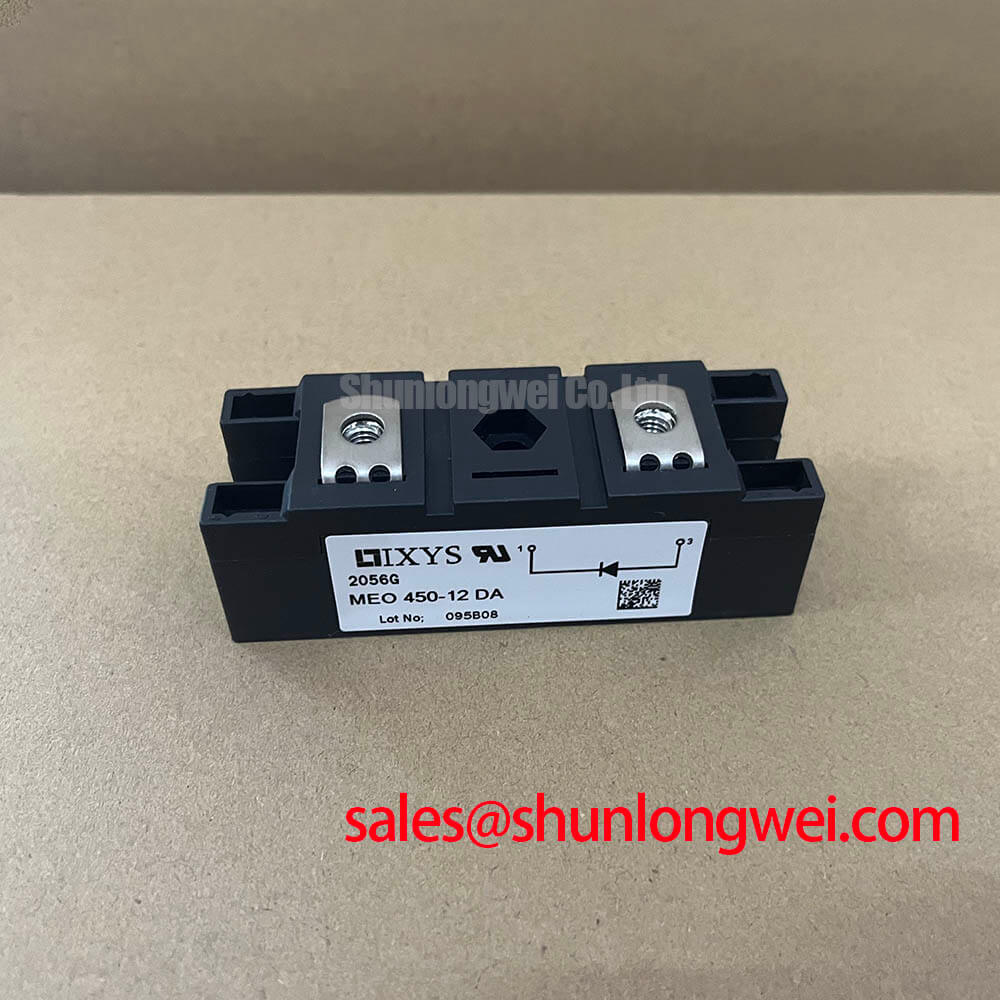
IXYS MEO450-12DA 1200V 450A Fast Recovery Diode Module
Introduction and Core Technical Advantages
The MEO450-12DA is an industrial-grade, fast recovery epitaxial diode (FRED) module engineered for efficient high-power rectification and freewheeling applications. Featuring a repetitive peak reverse voltage ($V_{RRM}$) of 1200V and an average forward current ($I_{FAV}$) of 450A, this module utilizes planar passivated chips to deliver outstanding reverse blocking stability. Its advanced packaging makes it highly suitable for demanding electrical environments where thermal performance is critical.
- Core Specifications: 1200V Repetitive Reverse Voltage | 450A Average Forward Current ($T_C = 85^circtext{C}$) | Typical $t_{rr}$ of 150 ns.
- Key Benefits: Minimizes conduction losses due to a low forward voltage drop, and reduces cooling overhead through optimized package thermal coupling.
Download Official MEO450-12DA Datasheet (PDF)

Technical Analysis of the Unique Value Proposition
At the center of the MEO450-12DA design is its epitaxial diode technology. This structure achieves a highly optimized balance between forward voltage drop ($V_F$) and reverse recovery time ($t_{rr}$). Conduction losses are kept remarkably low under high continuous load currents. The ultra-fast, soft-recovery characteristic dampens high-frequency oscillations and voltage overshoots during switching cycles. This performance makes the module an excellent match when configured as a free-wheeling diode to protect active switching devices.


The module is designed with an exceptionally low junction-to-case thermal resistance ($R_{thJC}$). You can think of thermal resistance as a highway lane bottleneck; a lower resistance acts like opening up additional lanes, allowing heat to flow seamlessly away from the silicon junction to the heatsink. This efficient heat dissipation prevents thermal runaway and ensures long-term operational reliability under continuous full-load conditions, dramatically reducing the rate of typical semiconductor wear-out failures.
Furthermore, mechanical mounting is simplified by utilizing an isolated copper baseplate with Direct Copper Bonding (DCB) ceramic technology. This provides up to 3000V AC isolation voltage. By isolating the electrical paths from the thermal baseplate, designers can mount multiple modules onto a single heatsink. This layout approach saves precious cabinet space and supports highly reliable soft recovery diode performance in compact assemblies.


Optimized Application Scenarios
- High-Frequency Switched-Mode Power Supplies (SMPS): The fast recovery epitaxial chips minimize switching energy dissipation during transition cycles, raising overall converter efficiency.
- Industrial Motor Inverters: Serves as a reliable freewheeling component across inductive motor winding outputs to suppress transient voltage spikes.
- Uninterruptible Power Supplies (UPS): Acts as a heavy-duty input or output rectifier, ensuring continuous, low-distortion power routing under peak load.
- Welding Power Inverters: Handles sudden, rapid current changes and extreme cyclic thermal loads typical of manual and robotic arc welding.
Best Match: The MEO450-12DA is ideal for power converters demanding rapid recovery, low conduction loss, and high thermal cycle reliability.
Key Technical Specifications
| Symbol | Parameter Description | Maximum Ratings / Values |
|---|---|---|
| VRRM | Repetitive Peak Reverse Voltage | 1200 V |
| IFAV | Average Forward Current (TC = 85°C) | 450 A |
| IFSM | Max Peak Surge Forward Current (10ms, sine) | 4500 A |
| VF | Forward Voltage Drop (typical at 450A, TJ = 125°C) | 1.6 V |
| trr | Typical Reverse Recovery Time | 150 ns |
| VISOL | Isolation Voltage (RMS, 50/60 Hz, 1 minute) | 3000 V AC |
| Tvj | Maximum Operating Junction Temperature | 150 °C |
Engineer FAQ
Q1: What recovery characteristics does the MEO450-12DA feature during switching?
A1: The module offers ultra-fast, soft-recovery behavior. This suppresses inductive voltage ringing and significantly drops EMI, preventing the need for complex, heavy snubbers in high-power converters.
Q2: How does the isolated baseplate simplify thermal system design?
A2: The baseplate utilizes Direct Copper Bonding (DCB) ceramics to provide 3000V AC electrical isolation. Engineers can mount this module alongside other devices on a single heatsink, removing the need for external isolating thermal pads.
Q3: How does conduction loss behave at elevated junction temperatures?
A3: Conduction losses decrease slightly at higher temperatures due to the negative temperature coefficient of the forward voltage drop typical of FRED chips, optimizing overall system performance under continuous operation.
The MEO450-12DA combines planar epitaxial reliability with optimized isolated packaging. This enables robust, low-loss performance in high-current rectification systems, helping engineers meet rigorous design goals in demanding environments.