MDS500A/1600V: A Technical Guide to High-Power Industrial Rectification
MDS500A/1600V Three-Phase Rectifier Bridge | 500A 1600V
High-Capacity Rectification for Demanding Industrial Power Systems
The MDS500A/1600V is a three-phase diode bridge module engineered for high-power rectification, delivering a substantial 500A output current with a high reverse voltage capability of 1600V. This module’s primary value lies in its ability to provide robust and reliable AC-to-DC conversion for heavy industrial loads, supported by excellent thermal performance and high electrical isolation. Its design allows engineers to efficiently manage power conversion in demanding applications, where both high current and voltage are critical operational parameters.
- Core Specifications: 1600V VRRM | 500A IO | 2500V Isolation
- Key Advantages: Simplifies high-power AC-DC conversion design, ensures high reliability through effective thermal management.
For detailed electrical and thermal characteristics, refer to the official component documentation.
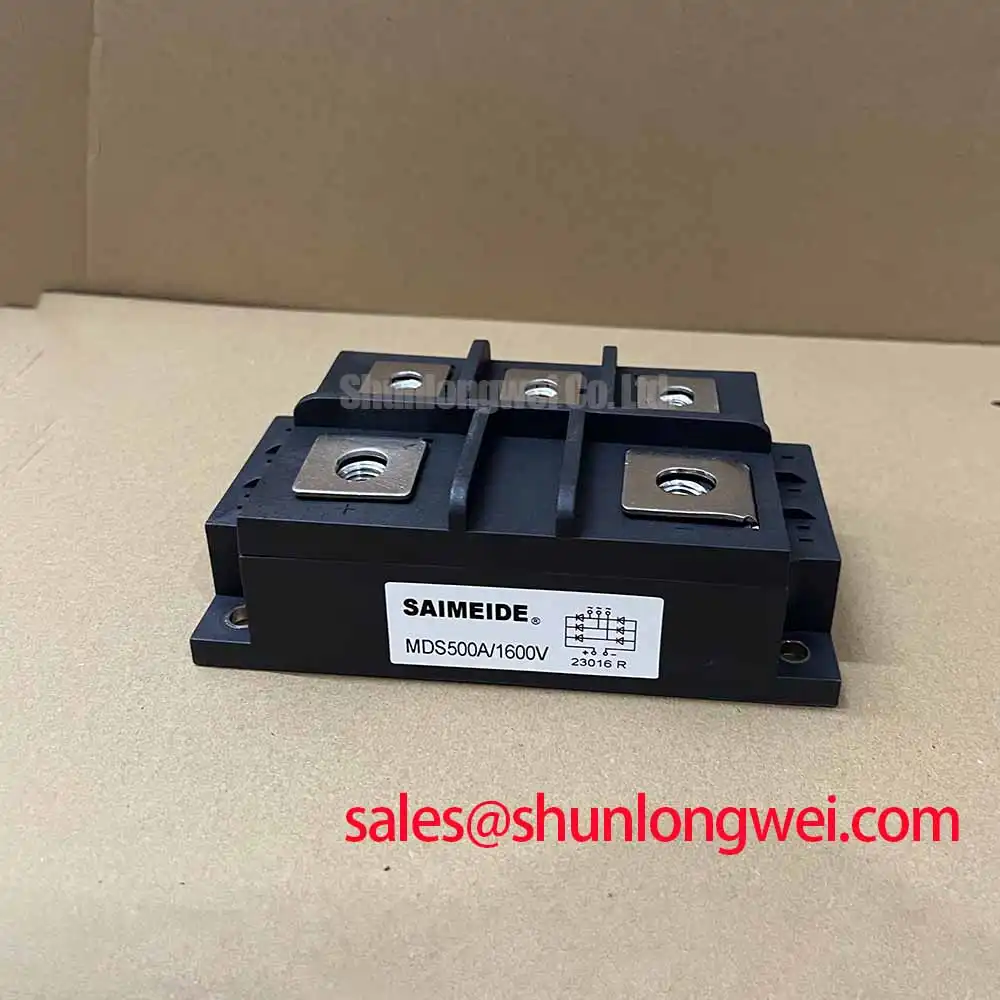

Technical Analysis for System Integration
The MDS500A/1600V is built to handle substantial electrical loads. Its 1600V repetitive peak reverse voltage (VRRM) provides a significant safety margin for operation on standard industrial three-phase mains, including 480V and 690V systems. The 500A average forward current (IF(AV)) rating allows it to serve as the primary input rectifier for high-power equipment, converting high AC input currents into a stable DC bus voltage. This high-capacity design often eliminates the need for paralleling smaller rectifier modules, simplifying the overall system architecture and reducing potential points of failure.
A critical aspect of high-power module reliability is thermal management. The module features an electrically isolated baseplate, which is crucial for safety and mounting flexibility. The module’s thermal resistance from junction to case (Rth(j-c)) is a key parameter for heatsink selection. Think of thermal resistance as the width of a pipe for heat flow; a lower value indicates a wider pipe, allowing heat to dissipate more easily from the active semiconductor junctions to the case and heatsink. This efficient heat transfer is vital for maintaining the junction temperature within safe operating limits, especially under continuous high-current conditions.

Optimized Application Scenarios
The specifications of the MDS500A/1600V make it highly suitable for a range of high-power industrial applications.
- Input Rectifiers for VFDs: Its high current and voltage ratings are ideal for the front-end rectifier stage of large Variable Frequency Drives (VFDs) that control industrial motors.
- Industrial Power Supplies: Serves as a robust core component in power supplies for applications like industrial heating, electrolysis, and welding.
- Large-Scale UPS Systems: Provides dependable AC-to-DC conversion to maintain the DC bus voltage in Uninterruptible Power Supply (UPS) systems for data centers and critical facilities.
- Battery Charging Systems: Suitable for high-power DC charging stations for electric forklifts, industrial vehicles, and large battery banks.
This module is best matched for systems requiring straightforward and reliable AC-to-DC conversion for loads significantly exceeding 100kW, where thermal stability is paramount.
Key Specifications of the MDS500A/1600V
| Parameter | Symbol | Value | Unit |
|---|---|---|---|
| Absolute Maximum Ratings (TC = 25°C unless otherwise noted) | |||
| Repetitive Peak Reverse Voltage | VRRM | 1600 | V |
| DC Output Current | IO | 500 | A |
| Surge Forward Current (50Hz, 10ms) | IFSM | 8500 | A |
| Operating Junction Temperature | TJ | -40 to +150 | °C |
| Electrical & Thermal Characteristics | |||
| Peak Forward Voltage (per diode) | VFM | 1.45 | V |
| Thermal Resistance, Junction to Case | Rth(j-c) | 0.07 | °C/W |
| Isolation Voltage (AC, 1 min) | Visol | 2500 | V |
Note: These values are typical and sourced from aggregated datasheets. Engineers must consult the official manufacturer’s datasheet for definitive specifications.
Engineer’s FAQ
What is the recommended approach for selecting a heatsink for the MDS500A/1600V?
To select a heatsink, first calculate the total power dissipation (PD) based on the forward voltage drop and output current. Then, use the module’s thermal resistance (Rth(j-c)) and the maximum desired junction temperature to determine the required case-to-ambient thermal resistance (Rth(c-a)) of the heatsink. Always ensure proper thermal compound is applied for optimal heat transfer.
What are the torque specifications for mounting the module and its terminals?
While specifics vary by manufacturer, modules of this size typically require M5 or M6 screws for both terminal and mounting connections. Always refer to the official datasheet for the exact torque values to ensure a secure mechanical connection and optimal thermal contact without causing mechanical stress.
Is the isolated baseplate sufficient for safety grounding?
The isolated baseplate, typically rated at 2500V, separates the electrical circuit from the mounting surface (heatsink). This simplifies mounting and enhances safety. However, the heatsink and overall system chassis should still be properly grounded according to local electrical codes and safety regulations for complete system protection. Proper baseplate isolation is a foundational element of high-voltage design.
How does the high surge current rating (IFSM) benefit a design?
The high IFSM rating (e.g., 8500A) indicates the module’s ability to withstand large, non-repetitive inrush currents, such as those occurring during capacitor charging at startup or during fault conditions. This robustness is critical for system reliability and helps prevent rectifier failure in demanding industrial environments.
Enabling High-Power System Reliability
By integrating a high current capacity with effective thermal dissipation and robust electrical isolation, the MDS500A/1600V provides a dependable foundation for industrial power converters. This module enables engineers to construct resilient and efficient AC-to-DC front-ends, meeting the rigorous demands of heavy-duty motor drives, power supplies, and uninterruptible power systems.